Showing posts with label Africa. Show all posts

Friday, December 13, 2024

Astounding fact -- or rather projection -- imagine Ethiopia with twice the population of Russia

At Foreign Policy Ivan Krastev and Stephen Holmes argue that Putin's concern with Russia's projected depopulation is an import factor in his motivation for his invasion of Ukraine. In making their argument they site this astounding "fact" (which admittedly is a projection):

Today, Russia defines its national security by the size of its population, not the extent of its landmass. Putin understands that, in the world of tomorrow, Russia will be a territorial giant and population dwarf. Russia’s population will not only be much smaller than the populations of India, China, or the United States but also one-half of Ethiopia’s and one-third of Nigeria’s. For Putin, this population decline translates into an irreversible loss of power. As he stated in 2020, “Russia’s destiny and its historic prospects depend on how numerous we will be.”/

I'm used to thinking of Nigeria as a big deal because of its population, but the idea that a future Ethiopia may be twice the population of Russia astounds me (but not my wife who says "they [the Russians] all live in St. Petersburg [and the rest of Russia is empty]."

I will definitly have to pay more attention to Ethiopia.

Image: a crowd in Ethiopia

Saturday, July 29, 2023

Houston schools don't need libraries -- Boko Haram, Texas style

I was reading about the military coup in the west African State of Niger, and ran across a reference to Boko Haram, a Islamist terror organization that has been making trouble for years now in that region. I have often thought Boko Haram deserves a prize for honesty in extremist politics for the name (which, admittedly, is not its official name). Haram is derived from Arabic and can mean forbidden, corrupt or bad. Boko is from Hausa, a major West African language and now means something like Western Civilization (which is bad).

But look at the word boko. Doesn't it just scream to be translated as "book?" It's not like people in Nigeria, a major center of Boko Haram, aren't familiar with English.

Maybe this is just a fantasy, one if those coincidences common in language studies. No, Hausa is not related to Basque, or Sumerian.

If Boko Haram gets a rather ironic prize for its informal name what do these Houston school boards deserve:
HOUSTON, Texas (KTRK) -- Students at dozens of Houston ISD schools will return in a few weeks without librarians and to former libraries that have been converted into disciplinary spaces. New Superintendent Mike Miles announced earlier this summer that librarian and media specialist positions would be eliminated at the 28 original schools being overhauled under his reform program, New Education System (NES). Both the librarian and media specialist positions are similar, but librarians typically have an advanced degree in library science. HISD said the 57 additional schools that opted into NES will be assessed on a case-by-case basis. "We understand the significance of certain programs associated with libraries and will strive to maintain those valuable offerings," the statement said.</blockquote> See the bold line above for the key sentence.

Monday, January 30, 2023

Hear what the Spirit is saying to the church

That is what yesterday's response by the congregation  to the First Reading at my church, Micah 6: 1-8.  The Prophet Micah is spelling out what God expects of Israel.  My wife tells me the response to Biblical  readings used to be more uncompromising: "this is the Word of the Lord." 

But I can't help looking at Old and New Testaments and trying to reconstruct the scene when these readings were first written or read out.  When we read psalms which scholars believe may have composed in the time of David, what they mean to that  king?  Indeed, what did David and his audience?

How about Zion, sometimes known as Mount Zion?  Here it is:


Mountain, Royal city (or castle), whatever, it sure gives a different impression  than the endless talking up of Zion.

I am by no means the first historically-minded person to take this approach, but it sure is interesting.


Monday, April 23, 2018

Ibn Battuta and the Empire of Mali in Extra History


Extra History is a series of hisotrical animations (I guess you could call them that) on You Tube.  Currently EH is posting material on the 14th century Empire of Mali (roughly today's West African country of Mali) famous as one of the world's chief sources of gold, and the location of Timbuktu.  EH is following the travelogue of the footloose Islamic scholar Ibn Battuta, who, if you take him at his word, went from his birthplace  in Morocco all the way to China, beating for distance the somewhat later Marco Polo.

When I was still teaching I loved talking  about Ibn Battuta, whose account gives us a good idea of what Islam meant to people outside the Arabic and Persian-speaking areas of the Middle East.  Ibn Battuta had a rather harsh judgement on these relatively new converts.  Not up to snuff, he said. But you can also get an idea of the flexibility of Islam in this period, which allowed it to appeal to people who lived in the Sahara, on the Russian steppes, and the islands of the Intian Ocean, to name just a few.

This EH series is one of the best of the bunch.  See it here.

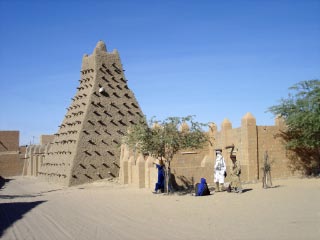
Image:  A mosque in Timbuktu. By Senani P at English Wikipedia, CC BY 2.5, https://commons.wikimedia.org/w/index.php?curid=1831543

I can't help but point out that Ibn Battuta's Saharan journey took place at exactly the time that the Combat of Thirty v. Thirty.

Friday, April 24, 2015

"Progress"?

A good piece from Michela Wrong in Foreign Policy:

When Migrants Flee Progress

Each migrant trying to cross the Mediterranean in a rickety boat has his or her own reason for risking the journey. But for people who study Africa, one overall lesson quietly emerges from this mass movement: Man cannot live by MDGs alone.

I’m talking about the Millennium Development Goals, the eight targets the United Nations drew up as benchmarks of successful development back in 2000. The U.N. set precise goals for poverty alleviation, education, and health care that poor countries, supported by Western donors, could tick off a list -- the supposed building blocks of a better life. Ironically, the deadline set for achieving the MDGs was 2015, the very year in which Europe has been confronted by a mass exodus of refugees voting with their feet.

Some migrants are fleeing violence in Syria and Somalia; some are West Africans who worked in Libya and now find it too dangerous to stay. But a significant share comes from African countries neither wracked by civil unrest nor embroiled in war. Counterintuitively, many of these nations perform extremely well on the MDG front.

Take the Red Sea nation of Eritrea, which accounts for the greatest number of migrants to Europe after Syria, an extraordinary figure given its population of just around 6 million. According to the U.N. refugee agency, 34,561 Eritreans crossed the Mediterranean in 2014.

Bizarre as it may seem, I often encourage Western friends to take holidays in Eritrea, this country so many are now fleeing and which I myself can’t access, for want of a journalist visa. It’s safe, clean, and cheap, and it boasts some of Africa’s best roads and most dramatic scenery, and the continent’s most beautiful capital city. Back in 2013, President Isaias Afewerki’s government patted itself on the back for achieving three health MDGs ahead of schedule: reducing infant mortality, improving maternal health, and combating HIV, malaria, and other diseases. It expects to check three more off the list by the end of this year.

... The point is: All that just isn’t enough. Eritrea, run by a former communist rebel movement that seized power in 1991, may well offer its citizens excellent medical care. Claims that it knows how to protect its people from East Africa’s frequent droughts and resulting famines may even be true. But the government has failed dramatically to deliver on a range of less quantifiable needs that hold the key to human fulfillment.

There’s no independent media or political opposition in the country. Religious freedom is narrowly curtailed. A multiparty constitution has never been implemented*, no presidential elections staged. Both men and women must do military service, which is often open-ended. If you’re lucky enough to get demobilized, there’s no private-sector economy to soak up your labor and provide you with skills. Asmara is an elegant cage -- a suffocating place to live.

Africa is struggling to digest a massive youth bulge, and youngsters are instinctively aspirational. They want the chance of a better existence in their own lifetimes, not promises of some distant utopia. While governments such as the one in Eritrea may score impressively when it comes to keeping youth fed, vaccinated, and literate (the MDG emphasis is on primary education, of course, not the tertiary education likely to produce rebellious students), they routinely frustrate deeper needs.

Indeed, the paradox is not unique to Eritrea. Since the end of the Cold War, a new generation of African leaders has emerged that wins the consistent and enthusiastic backing of the U.S. Agency for International Development and Britain’s Department for International Development for delivering on the MDGs, even while these leaders show open contempt for civil society, human rights groups, and the free press. “Democracy is a luxury we can’t afford,” is the implicit message to Western partners.

... “Africa Rising,” the recent buzz phrase adopted by investors excited by the economic potential of the continent’s growing middle class and the spread of modern technology, has distracted attention from a series of reactionary trends. In east, west, and central Africa we are seeing elections rigged not once, but repeatedly; the establishment of de facto royal dynasties; and draconian legislation aimed at closing down the non-governmental sector, muffling the press, and stamping out homosexuality. Annual reports by human rights organizations make for grim reading.

Back when the U.S. President George H.W. Bush promised “a new world order” premised on liberal values, such developments would have alarmed Western partners. Now they generate shrugged shoulders from diplomats and development officials who regard them as part of the realpolitik of the modern era.

The MDGs were designed, in part, to give Western donors and African governments apolitical, uncontroversial common ground upon which all could agree. Clean water, primary education, decent health care -- who wouldn’t want those, after all? But the message coming from the migrants crossing the Mediterranean is: “Oh, sure, we want those. But we want far, far more.” And who can blame them?

Thursday, February 07, 2013

Senegal, Madagascar and Dr. Amadou Ba

Dr. Ba, who teaches history at Nipissing and Laurentian Universities, yesterday presented a paper entitled "African Soldiers in the French Colonial Army during the Conquest and  Colonization of Madagascar."

The several points of interest included:

  •  the fact that there were a lot of colonial wars in  Madagascar, which pretty much no one  knows anything about. (Madagascar must count as  the most obscure country in the world.)  
  • that the French waged these wars mainly with West African troops, who were all called Senegalese, whether they came from Senegal or not.
  • that there are descendants of the Senegalese still in Madagascar, where they are a despised symbol of colonial oppression.
  • that the  French are not blamed at all for the abuses of their regime. Indeed they are remembered as mitigating the brutalities of their Senegalese enforcers.
  • that no one in Senegal  is at all aware  of this Madagascar connection.
Somehow it was that last point --- that lost history -- that  struck me the most. There is so much that falls through the cracks.

UPDATE 2023-02-04 

I don't know if Madagascar still counts as the most obscure in the world.  It showed up in newsfeeds several times in the last week or so in connection with the papal visit to Africa.  Madagascar is now a typical poor country with food security problems.  South Sudan also now gets attention as "South Sudan," as a country and not just as a part of Sudan afflicted by civil war.  Why?  Papal visit. And a papal visit brought the Democratic Republic of the Congo for something beyond internal warfare motivated by a desire for valuable rare earths.

Papal visits!   Some time around 1000 CE it was papal recogition (and recognition by the German emperor, representing Rome the empire) that made the King of Poland a real Christian monarch.

Another case of "the more things change..."

Saturday, August 28, 2010

Now, that's frustrating!


In a recent commentary in the Guardian, Ioan Lewis is guilty of tantalizing his readers. In an article entitled "Somalia has a role model for success on its doorstep," first outlines of troubles of the failed state of Somalia, then points to a neighbor, Somaliland, as a good example for those who would rebuild the country. Lewis then proceeds to make some interesting observations that suggest more than they actually describe. Lewis is fairly clear in the summary of Somalia's political fragmentation:

Somali society is extremely fragmented along kinship lines and, to a degree most foreign observers fail to appreciate, lacking in political centralisation. The familiar African chiefs are largely absent in this highly individualistic world where the individual's loyalties are a matter of competing blood-ties. Such bonds cut across membership of al-Shabab whose leaders, however, tend to belong to the Hawiye clan-family, based in central southern Somalia. The Somali historian Said Samatar aptly described their predecessors, the Union of Islamic courts, as a "fragile coalition of clans wrapped in an Islamic flag to look respectable"; al-Shabab similarly relies heavily on kinship ties to maintain solidarity and confront its enemies.

The underlying loyalties here are, as is usual in the Somali world, fluid and readily subject to fission. External pressures, especially from non-Islamic sources, normally provoke internal solidarity. This, of course, is a major reason why external force, intended to replace al-Shabab [a radical Islamist group in Somalia] by less extreme forms of Islam, will almost certainly fail. Indeed, radical change in the al-Shabab regime is only likely to be achieved by subtle internal initiatives and the problem would be how to design and implement these. The perceived oppressive character of al-Shabab provides abundant opportunities for currents of Somali disaffection to grow and multiply.

then goes on to laud Somaliland's contrasting success:
A very important local factor will be the positive demonstration effect provided by the existence of the adjacent Somaliland Republic. Although largely officially ignored by the UN and OAU, this state based on the former British Somaliland Protectorate had initially joined Somalia, but in 1990, at the climax of the collapse of dictator Mohamed Siyad Barre's brutal regime, broke away to reassert its independence. Despite being regarded in Somalia as a sort of phantom limb, with virtually no external help, this state has built itself up by a remarkable series of internal peace agreements and democratic consolidation to its current situation as a functioning democracy. This has been achieved by local self-help and without the massive international effort devoted, with such striking lack of success, to restoring governance in Somalia.

Somaliland has just had its second successful presidential election (and changed president in a peaceful process validated by international observers). Its people are Somalis like their kinsfolk in Somalia, but by a judicious combination of traditional and modern politics, have successfully established a viable modern government and associated institutions. Despite internal and external pressures and with fewer economic resources than Somalia, these have demonstrated remarkable viability and have, so far, been blessed by an impressive degree of political stability. Its time now to learn from Somaliland's success and see how to emulate it.

But no hint, not the littlest merciful drop, of how these people who share the kinship values of the people of Somalia, have "by a judicious combination of traditional and modern politics, ... successfully established a viable modern government and associated institutions." Good grief, Lewis, isn't that always the challenge, and don't you think we might like to know how they did it?

It's depressing to have no way of choosing between an overblown observation, a keen insight, and the sad possibility that the guts were taken out of this article by an editor. Except, of course, by conducting one's own research.

Image: Surely this patriotic imagery is not the Somaliland secret!

Tuesday, November 17, 2009

Monday, December 08, 2008

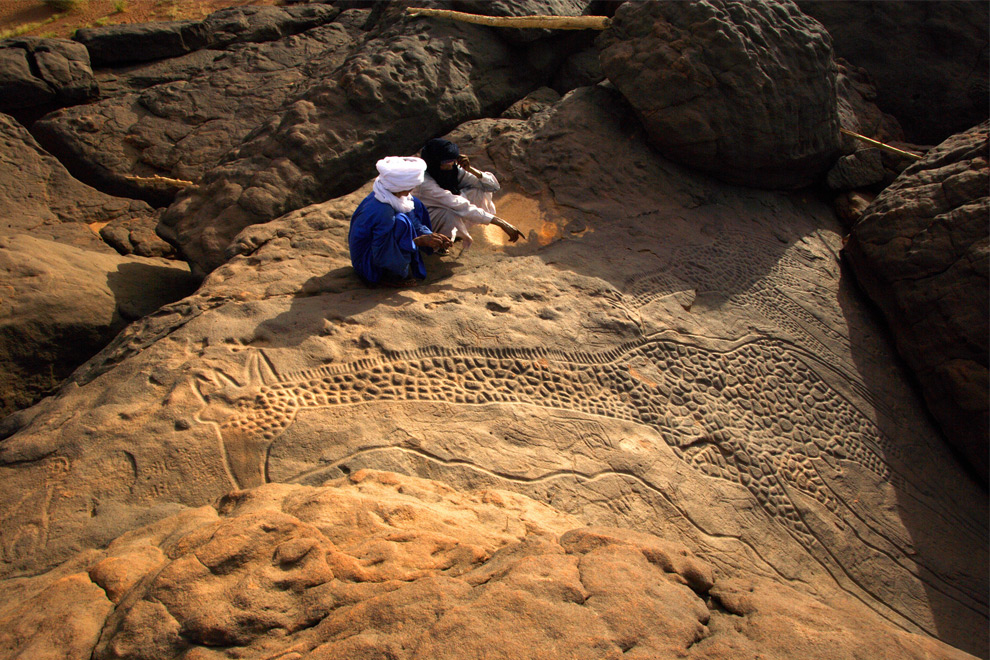
An ancient Saharan petroglyph of a captive giraffe

One surviving bit of the culture of the last wet era in Saharan history, from The Big Picture (click to see the "big picture," or go here to see a whole collection of Saharan archaeology pics.)

Friday, November 21, 2008

Piracy

John at Dymaxion World points us to an interesting observation at Talking Points Memo, and declines to comment further:

Josh Marshall:
I don't want to draw over-broad interpretations. But historically, the rising incidence of piracy has frequently, if not always, been a sign of the receding reach of whatever great power has taken on responsibility for policing the sea lanes. The decline of the Hellenistic monarchies in the Mediterranean before the rise of Rome. Caribbean piracy during Spain's long slide into decrepitude and before England decided she lost more than she gained from it. There are many examples. I note too that the Russians just announced that they're sending a few more warships to try to get things under control off the coast of East Africa.
The EU is sending an armada as well. Man, there's so much to talk about with this kind of issue. Do I blog about how the combined forces of the industrialized world don't have the necessary assets to put down piracy off the coast of east Africa? Do I blog about how this is a good example of why it's probably a bad idea to go around creating failed states in places like this? Or do we talk about the possible signal of the EU finally emerging as a global military actor in it's own right?

Well, lucky for you I don't have the time to write about any of those things so you're spared a few hundred words of my prose. Ha-ha!
I won't comment, either, except to say that if you fire up Google Earth and search the Google Earth Community for "Somali pirates" you find a variety of downloadable maps on the subject.

Tuesday, November 18, 2008

Special topics course in the new South Africa

The transition of South Africa from apartheid to democracy was one of the most amazing events of the late 20th century. Next term NU students will have the opportunity to study what is happening in South Africa now. The listed prerequisite is being waived.

From the prof.:

GEND 3057, Special Topics in Human Rights and Social Justice is being offered on Mondays from 12:30 to 3:30 next term.

The course topic is Apartheid and the "New" South Africa.

South Africa's transition to democracy after nearly fifty years of racial segregation is heralded as one of the great triumphs of freedom over brutality in the twentieth century. Not only was civil war avoided but reconciliation, as embodied in the personal stances of President Nelson Mandela and Archbishop Desmond Tutu, became the mantra of the "rainbow nation." Today, fourteen years into democracy, pressing concerns such as crime, poverty, and HIV/AIDS have eclipsed the euphoria of political freedom. In 1994 the ANC government promised "a better future for all." But how much has changed in the 'new' South Africa?

In this survey course we first examine the structure and nature of apartheid and the dynamics of South Africa's negotiated transition to democracy. How did race, class, ethnicity, gender and other social cleavages interact in the struggle for and against apartheid? In the second half of the course, we examine how these social cleavages or groupings interact today both as the "legacy" of apartheid and in the face of new challenges wrought under conditions of globalisation.

Dr. Rosemary Nagy
Gender Equality & Social Justice Program

Monday, June 23, 2008