Ancient, medieval, Islamic and world history -- comments, resources and discussion.
Showing posts with label Ibn Battuta. Show all posts
Monday, April 23, 2018
Ibn Battuta and the Empire of Mali in Extra History
Extra History is a series of hisotrical animations (I guess you could call them that) on You Tube. Currently EH is posting material on the 14th century Empire of Mali (roughly today's West African country of Mali) famous as one of the world's chief sources of gold, and the location of Timbuktu. EH is following the travelogue of the footloose Islamic scholar Ibn Battuta, who, if you take him at his word, went from his birthplace in Morocco all the way to China, beating for distance the somewhat later Marco Polo.
When I was still teaching I loved talking about Ibn Battuta, whose account gives us a good idea of what Islam meant to people outside the Arabic and Persian-speaking areas of the Middle East. Ibn Battuta had a rather harsh judgement on these relatively new converts. Not up to snuff, he said. But you can also get an idea of the flexibility of Islam in this period, which allowed it to appeal to people who lived in the Sahara, on the Russian steppes, and the islands of the Intian Ocean, to name just a few.
This EH series is one of the best of the bunch. See it here.
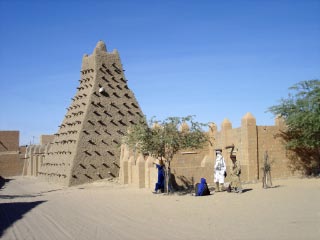
Image: A mosque in Timbuktu. By Senani P at English Wikipedia, CC BY 2.5, https://commons.wikimedia.org/w/index.php?curid=1831543
I can't help but point out that Ibn Battuta's Saharan journey took place at exactly the time that the Combat of Thirty v. Thirty.
Labels:
14th century,
Africa,
Combat of the Thirty,
Extra History,
Ibn Battuta,
Islam
Sunday, September 30, 2012
Ibn Battuta an imposter?
So thinks a German scholar as reported here:
But just how credible is this report? In his epilogue, Ralf Elger writes that there are numerous indications that Ibn Battuta's travel account is not based on his own observations – for example in the case of descriptions of rulers who verifiably governed before or after Battuta's lifetime; there are also many inconsistencies in the geographical details.
Most notable are however the striking resemblances to various writings of his era, primarily to a pilgrimage account written by a certain Ahmad Ibn Jubayr. Pages of this work were either slightly reworked or copied word for word: "Many of Ibn Battuta's accounts do not provide us with his immediate travel impressions at all, but rather confront us with his skill as a plagiariser," says Elger.
In this context, Elger also has a plausible explanation for why Ibn Battuta repeatedly mentions the generosity he was shown by all the rulers he encountered.
Opportunist fabrications
"If you appreciate Ibn Battuta's account as an implicit demand for a sumptuous gift, then it is very easy to explain many of the passages," says Elger.
"The reader may well have wondered how it could have been possible for an unknown traveller from Morocco to gain access to the world's leaders and be honoured as such by them. The correct answer is probably that these contacts were invented for this very purpose, to proffer himself to the Sultan of Fez."
The descriptions of his work as qadi can also be interpreted in this light: If I have served as a judge throughout the entire Islamic world, reads the message to the Sultan of Fez, then all the more at your behest in my homeland Morocco.
Labels:
Ibn Battuta,
Islam
Tuesday, November 25, 2008
Will the Maldives disappear?
Subscribe to:
Posts (Atom)
