Further, March 16: Another discussion by experts on CBC 1's excellent The House with no reference to Trump's physical and mental health. In fact, the experts didn't know what to say on any aspect of the current crisis. This is where we are.
Showing posts with label politics. Show all posts
Showing posts with label politics. Show all posts
Tuesday, March 04, 2025
Trump will die


Wednesday, February 26, 2025
2025
Whether Trump wins or is stopped this year will forever be considered a turning point in American history.
Wednesday, February 12, 2025
Apocalypse Now: Literally
Timothy Burke offers us a truly terrifying explanation of what Trumpism and related apocaliptic movements realy mean.
The gentle beginning:,
READ IN APP
I keep circling around the cluster of people involved in Trump Administration’s programmatic disassembly of constitutional government in the United States, pacing like a zoo animal in a cage. What are they thinking? How conscious are they of their motives? What do they represent?And it gets much worse...I try to remember a point I’ve made many times before about governments and leaders, that almost no leader is himself or herself the pivot on which all decisions turn, that the visible leader in a political coalition like like the tip of an iceberg, representing some vaster structure hidden below the water.
Perhaps even, as the phrase goes, a deep state. Or a deep strata of society, a formation embedded across a whole geology, that suddenly erupts into the surface of the earth. American Presidents normally are just the titular heads of an assemblage of ambitious public servants and elected officials who frequently share some social connections and some loose ideological priors, somewhat like the C-suite of a corporation where the CEO speaks for a cluster of executives who’ve risen through the company and some recruited new executives whose experience elsewhere has been deemed useful or generative. (On which point, once again: the CEO is not a king except in a few rare cases of smaller privately-held companies that are led by the scion of a particular family. Maybe.)
Trump’s first administration had him as the unhappy CEO of a cluster of Republican-affiliated leaders with business experience, military experience, administrative experience and experience in electoral politics, a different cluster than the one that had risen through service in the Reagan, Bush I and Bush II presidencies. He was unhappy because his assemblage wanted to domesticate his wild impulses and careless gestures, to yoke him to something like a coherent strategic vision of governance and some degree of continuity with past Republican policy initiatives. In the end, Trump won out by attrition and began to summon an entirely new assemblage to his side, recruited first and foremost for their servility to his personal authority and impulses and secondly for the extremism of their vision, for advocacy of post-constitutional executive power.
Those people are still with him today. To that assemblage he has now added a few more representatives of other extremist lineages, most notably Steve Bannon’s “populists” and some advocates of Christian nationalist theocracy. And a new assemblage has added itself to Trumpism—or perhaps believes that it has added Trumpism to itself, namely the Big Tech billionaires club defined by Elon Musk, Peter Thiel, Marc Andreessen and associates. That this new assemblage is unstable and volatile is already very much on display—it is hard to believe that it can survive four years without a night of the long knives within the coalition—but at least for the moment it also is fueling the destruction of a long-standing constitutional republic’s basic administrative and procedural infrastructure.
As I pace mentally and try to apprehend what this coalition really wants, how it really thinks, what its aims are, I keep coming back to a repeated theme. I’ve already argued that the base of political support for this group wants to see that existing infrastructure blown six ways to Sunday, that at least some of them represent a millenarian yearning for the old world to fall so that some new world, whose nature is as yet unknown, might rise from its ashes. I now think that this might also accurately describe most or all of the people who hold power in Washington right now, that they also are millenarians, though not all of the same kind as their supporters. And perhaps some of them are something bleaker: nihilists who want to negate everything and have no hope of a new world to follow.
Sunday, June 23, 2024
A history of American intolerance -- from Talking Points Memo
My favorite news source, Talkingpointsmemo.com, suits me very well, because it takes history seriously as the background for current political and cultural developments. Much of this is due to the influence of Josh Marshall, the founder of TPM and a trained historian, but other talented members of his staff do their part. And TPM brings in outside talent, too.
A day or two ago TPM reprinted an essay from Arthur Goldwag's book The Politics of Fear. It is long and it is good. Here's an excerpt that should tell you if you might be interested:
Some of the American dream is real, of course. As a second-generation Jew, I’m a beneficiary of it, as are the descendants of many of the other immigrant groups that came here voluntarily. Many Americans — including Black ones — really have pulled themselves up by their bootstraps, and for all of its many failures in practice, our system leans toward more rather than less liberty and opportunity. But America’s past, like most countries’, is not just marred by but defined by force and violence and fear and hate; worse still, as William Faulkner put it in Requiem for a Nun (a novel whose plot turned on the legacies of race and rape), “it’s not even past.” Among the fiercest of America’s old hatreds, I would argue, is the hatred of Catholics. The first colonists brought it with them from England. A recent archaeological find sheds new light on this. In 2013, the remains of four men were discovered at the site of a chapel in Jamestown. One of them, Captain Gabriel Archer, had been buried with a silver box that a CT scan showed contained bone fragments and a lead ampulla. It was almost certainly a Catholic reliquary, and it was, in the words of The Atlantic’s Adrienne LaFrance, “a bombshell,” potential “proof of an underground community of Catholics.” They would have had to have been secret because Catholic worship had been banned in England since 1559, when Queen Elizabeth issued the Act of Uniformity. The English Protestants who colonized the New World feared hunger, illness, and childbirth, which killed one out of eight expectant mothers and a third of their children who were born alive by their fifth birthdays. They feared the raw wilderness and its indigenous inhabitants, who they knew were servants of the Devil, and the witches and other minions of Satan that dwelled among them, disguised as their wives, children, neighbors, servants, and enslaved people. They feared their own sinful natures and Antinomianism or “Free Grace” Protestantism, the radical doctrine that once they were saved, Christians were no longer bound by the moral law, a philosophy, they believed, that could not but lead to licentiousness and attacks on property and the political order. Most of all, they feared Catholicism, which they had been at war with since the time of Henry VIII. The Catholic French had forged alliances with native tribes in the north and west. The Catholic Spaniards controlled the south. The threat of internal subversion was real as well; the Gunpowder Plot conspirators had been executed less than a year before the Jamestown settlers departed England. Many of those Puritans’ descendants still see the world much as their ancestors did, though their great enemy is no longer godless papists and savages but depraved liberalism, or at the conspiracy theorist extreme, some differently titled ism that in practice looks and sounds an awful lot like Catholicism.Recommended.
Friday, June 30, 2023
Robert Reich, well-known political insider, says "Run for office? No thanks!"
Many of you readers have probably thought about this. I have too. But this brought into focus an important aspect of democratic politics that often doesn't get discussed.
I've included some big excerpts from this piece, but I urge you to read the whole thing:
Friends, Several of you have written asking if I might consider running for office. Well, I have an announcement to make. Brace yourselves. I’m not running — for president or anything else. I’ve run once before (for the Democratic nomination for governor of Massachusetts in 2002) and learned I don’t have what it takes. Before I ran, I thought I knew everything there was to know about getting elected — which made me think I could get elected, too. I’d been involved in dozens of campaigns. I’d advised candidates running for governor, senator, and president. I’d worked for three presidents. I was wrong. It takes several unique personality traits to successfully run for a major public office. I don’t have them First, you need to be sufficiently narcissistic to be able to sell yourself to voters (and anyone you need to help bankroll your campaign). In 2002, so many Massachusetts residents urged me to run that I thought voters (and funders) would flock to me once I announced. But the moment I said I was actually running, the burden of proof instantly shifted onto me. Even my most ardent supporters wanted to know: What made me think I would be a good governor? Many of the people who I assumed would be generous with their dollars in support of my campaign became skinflints overnight. Sure, I could promote policy ideas — I’d done it all my life — but I was terrible at promoting myself. It felt excruciatingly embarrassing. Telling complete strangers why they should be enthusiastic about me made me want to crawl into a hole and disappear. Dialing for dollars was the most humiliating experience I’ve ever had. Donald Trump is a masterful self-promoter because he’s a pathological narcissist. He boasts about himself nonstop and has probably done so since he was an infant. No matter that his bragging requires dangerous lies, vile smears, law-breaking, and a grandiosity that would cause normal people to cringe; he does it all without moral constraint. It’s all he does. He’s the extreme. But you’ve got to be big on self-promotion to get anywhere in electoral politics. Second, you need to be wildly extroverted. By this I mean you get more energy out of every encounter with a total stranger — every handshake, pat on the back, morsel of conversation — than the energy you lose in such an encounter. So by the end of a day of such encounters, you end up more energized than at the start. Bill Clinton lived off this contact energy...Third, you need to be a method actor. You have to be able to will yourself into feeling whatever a situation demands, so you come off as authentic. Ronald Reagan was a master of method acting, presumably because it had been his career before politics. Clinton was almost as good. Barack Obama and Joe Biden, far less so. Trump is fairly good at this. Richard Nixon and George W. Bush were lousy method actors; even when they told the truth, they seemed to be lying.Lots more good stuff in the original post!
Saturday, December 14, 2019
Thursday, June 27, 2019
Wow
Neil MacDonald in the Globe and Mail:
I've also seen Senator Elizabeth Warren up close.
It was in a union hall in Kentucky in 2014. She was stumping for Alison Lundergan Grimes, the Democrat who was trying to unseat Senate majority leader Mitch McConnell, but Grimes might as well not have been in the room once Warren — the tiny, intense former Harvard professor — took the stage.
Elizabeth Warren fully intends to change the system, and says so.
When she said how good it felt to be with working people in a workers' hall, you knew it wasn't a platitude. When she talked about taking on the venality of corporate America, you knew she meant it. As she talked, plainly and without the usual dumbed-down patronizing, the small talk in the crowd died. People stared. When she finished, they roared.
If you are not Canadian, the reference to Lucien Bouchard will pass you by. But if you are and remember 1990...well, look up Bouchard on the net.
The only speaker I have ever seen hold a crowd like that was Lucien Bouchard, speaking to audiences of Quebecers in 1990 about the betrayal of the Meech Lake Accord.
Both politicians burned with intelligence, and radiated principle. Neither gave a toss for political triangulation. Both left their listeners convinced they meant what they said and would do it, and that to them, only the people mattered.
Monday, November 19, 2018
Political beliefs
For some months now I've been reading the commentary of Umair Haque. His understanding of the current political situation, especially in the United States is so bleak that it reminds me of Old Testament prophecy, or maybe the crazier elements of the Reformation.
But as this recent essay indicates,
Umair would not thank me for the comparisons to prophets. And in fact what he says about political beliefs is surely the most important part of this post. It is certainly worth serious thought.
A substantial excerpt:
I want to tell you the story of the greatest lesson in history, which you probably don’t know. It’s the one the 20th century is trying to teach the 21st — but we, blinded by ideologies, weary and failing ways of thinking about the world, society, and ourselves, are still only just barely struggling to grasp it — if we are not resisting it outright. After all, we are not even twenty years into this century — so it’s no surprise the last one’s greatest lesson is yet unlearned.There’s a question that’s as old as time. How do we build ciities, countries, towns, societies — worlds, lives — which prosper, endure, soar? Some said — the brutish and the shallow, mostly: “We gain by taking what is theirs! Let us enslave and exploit them! Why, they are not people at all!” And then cooler and wiser minds replied, shaking their heads: “No, no. We mustn’t do that. We must lift everyone up — and everyone is a person — never pull anyone down.” So. Shall we prosper by exploitation — or through liberation? Through subjugation and slavery, through hate and violence — or their opposites, equality, freedom, justice? Here’s a fact. Nobody really knew. So we humans, being the blind things we are, settled for the best we could: we debated it for millennia, with more and abstruse and abstract theories of morality, ethics, politics, economics. Here’s another fact. We didn’t know the answer — until now.I was amused — if not surprised — to read, somewhere in a little corner of the internet, a description of myself as a socialist. In that accusatory way that Americans — at least some of them, on the fringe — still use the word. Amused because, well — let me describe my politics to you. My politics are very simple. I try not to have any. LOL — what? I’m sure that leaves many of you bewildered, even surprised. “But you’re always going on about capitalism and — “ Very true, so I do. So what in blazes do I mean?You could in one way describe my politics, if you are very insistent of putting people in little boxes and neatly labelling them, this way. I suppose that I’m a pretty ordinary kind of social democrat — the kind that most people who aren’t Americans, but live in rich countries, are, from Europe to Canada. I think that the superior social contract at this juncture in human history is simple and straightforward ... That social contract goes like this: people provide one another the basics of a good life in modern terms, which means health care, education, some minimal income and savings, retirement, and so on. Capitalism — at a human scale — takes care of thmy politics” in the sense that people usually mean the term. They are not my beliefs, moral, social, cultural, and so on, based on theories of some such and this that, which I am trying to push on you, to persuade you of, mistakes to correct in you. They are not beliefs — things I don’t know, but presume, or hope, or wish to be true — in any whatsoever ....) So if they aren’t my beliefs, then what are they?They are facts. Nothing more and nothing less. Just facts. It is a fact that people are happier in social democracies. It is a fact that people are richer, wealthier, closer, live longer, saner, better lives, in nearly every regard. There is nothing subjective or unknown about that statement, and so it is not a belief in any way whatsoever. Do you see the difference here — between fact and belief? You might think that I’m splitting hairs — but I think that both the future, and the greatest lesson in human history that you probably don’t know lie right here.Why? Let me explain backwards. What’s unique about America? It’s that it got the social contract of modernity, which I described above — people provide each other the necessities, and capitalism provides the luxuries — absolutely backwards. America, unique amongst rich nations — all nations, in fact, tried a social contract where capitalism provides people the necessities, and the luxuries, things like yachts and mansions and so forth, are often had by way of a kind of weird, inverse socialism — cronyism, how close you are to powerful politicians and capitalists and so on, how many subsidies you can grab, how much you take from others....Now, it doesn’t take a genius to have said: hey, listen…this social contract probably isn’t going to work out. Not only does capitalism have no incentive, reason, or motive to provide people the necessities, if the way to get rich is by everyone exploiting everyone else in the first place — then a society will never really go anywhere at all. And that is exactly what happened in America during my whole adult lifetime. Society literally went nowhere.I mean that in the hardest possible terms. Society literally went nowhere.Incomes went nowhere. Life expectancy fell. Social mobility dropped. Depression and suicide rose. And so on. Along every indicator you can imagine or think of, America has made zero progress during my whole adult lifetime. That is not a belief. It is not my opinion, it is not a subject for debate — it is simply a fact. America tried out yet another social contract based on exploitation — capitalism, after segregation and slavery — whose results were as predictable then as they are real today: as people grew poorer, they turned to authoritarianism, instability became collapse, and here we are today, hoping a Blue Wave will stem the tide....But if I start “believing” things about political economy, about society, about the world, then what happens? I can’t do my job very well if I “believe” things to be true, instead of know them, can I? Then I go from being something like an observer — or maybe intellectual, or maybe just an educated person, or maybe just a civilized one, you can choose — to being something more like a fool, someone who has rejected knowing, scorned truth. Do you see the problem here? It applies to you, too.So why are we cursed with this burden of political beliefs? Why can’t more of us simply let go of beliefs — and say — whatever labels and ideologies the world, my society, my culture has trained and taught me to “believe” in, I will hold them lightly, tentatively, skeptically? Strangely, if you think about it, we can’t shed the burden of belief because it is a new thing to be able notto have political “beliefs.” Think about the world. Until the 1970s or so, it was eminently reasonable to say something like — “Who knows? Maybe capitalism is better. Maybe communism is! Maybe authoritarianism is. Or maybe apartheid states are the best kind to be! Who knows how the average person will be better off?” You see, we didn’t have much evidence about much at all, when it came to different modes and models of political economy, society, social contracts, and so forth.Let me put that to you much more starkly. We could have said, probably until the 1970s or so, that America was a rich and powerful nation — and it was still segregated. Furthermore, it had gotten rich through slavery as much or more as through innovation. Europe, too, was still rising from the ashes of war — at that point, Spain was still a military dictatorship, and Germany still a split, riven nation. Who was to say which system was better, out of all the many choices political economy had to offer? Remember my question? It’s as old as time....Over the last fifty years or so, a revolution hidden in plain sight has taken place in the world — which has gone too often unnoticed — and especially not American intellectuals, which is why Americans are in the dark about it (even though they intuitively get it, a full 70% of them can be described today as something like emerging social democrats anyways.) That miracle was this — European social democracy began to pioneer history’s highest living standards ever, period, full stop. Within fifty years — just fifty years! — less than one human lifetime, shattered, wrecked societies like Germany, Spain, and France had achieved the following things: the world’s longest lifespans, richest and largest middle classes, most equitable distributions of wealth, and so on. Scandinavia, taking it further, built history’s, and the world’s happiest, most egalitarian, and wealthiest societies....Does prosperity come from exploitation — or from liberation? No one knew. Hence, millennia of bitter debates, about morality, religion, society, and so on — which simmered until the boiled over, finally, in a century of grand social experiments. American capitalism, Soviet communism, German fascism, and so on. That century was the last one....The system that resulted in Europe, which came to be called “social democracy”, was revealed to be the most powerful lever of human possibility that had been discovered, ever. It was so powerful, in fact, that it made an impoverished, ruined Europe more prosperous in every single way than America in a single human lifetime.Now, it’s equally important to understand the rejection, if you like, of the alternate hypothesis. Since the beginning of time, human beings have been ruled by the most brutal and foolish among them — and such minds have said: “the way to prosperity is through enslaving and exploiting and abusing others! As long as we can get them to do our work, with the whip or the chain or the trinket — why, we will be kings!” America, sadly, has a tendency to listen to such minds, over and over again. Hence, the basics of the hypothesis it has been testing have always remained more or less the same — prosperity results from exploitation.But American collapse tells us that exploitation does not lead to prosperity. It leads to poverty amidst grotesque amounts of plenty, like having to choose between medicine and shelter even if you’re “middle class””, that is, profound and terrible inequality, which causes instability, which sparks authoritarianism, and so on....
That’s why America is where it is. It is a nation, sadly, which is largely ignorant, by design, of the greatest fact in the world, one of the greatest facts in history: that we have the missing formula for human prosperity, finally, after millennia of strife and war and hate and ruin. It’s simple. Prosperity comes from liberation, not exploitation. That formula — or that recipe — is at this point in human history, an empirical reality,That is why I try not to have politics, my friends. Politics are largely empty vessels, hopefully obsolete things, in this day and age, really. The future won’t be made with people with political beliefs, as it was yesterday. That is because we have stark evidence about those beliefs, finally, after all the long midnights of human history — all the slavery, all the hatred, all the whips and all the chains. Where did they lead? Upwards — or downwards?Today — this juncture in human history — really is different. We don’t need to believe, like blind people, anymore — to guess and hope and wonder. We simply need to see what is front of our eyes. The future will be made, then, by radical pragmatists. Who can take history’s great lessons — and apply them. But that is only because they understand them.
Tuesday, October 30, 2018
Nightmare
Stephen Marche will chill your blood. An excerpt describing the steps to civil war:
To sum up: the US Congress is too paralyzed by anger to carry out even the most basic tasks of government. America’s legal system grows less legitimate by the day. Trust in government is in free fall. The president discredits the fbi, the Department of Justice, and the judicial system on a regular basis. Border guards place children in detention centres at the border. Antigovernment groups, some of which are armed militias, stand ready and prepared for a government collapse. All of this has already happened.
Monday, August 13, 2018
Are Americans dumb? Umair Haque says no
Not that his answer will make you feel any better:
Some things in life, my friends, are unpredictable. The weather. True love. The stock market. But some things are entirely, utterly, and almost boringly predictable, too. And strangely, those aren’t small things. Sometimes, they’re big things. One of the most predictable things of all is fascism, the classical sequence of a proto-fascist collapse.
Don’t believe me? Let’s think about. It goes something like this: economic stagnation, a falling middle class, a rising demagogue, who scapegoats and demonizes minorities, blaming the troubles of the many on the few and the different. Soon enough, something like this follows: paramilitaries are formed, parallel judiciaries, law enforcement, and citizenship are created, camps rise, apartheid laws begin, minorities are expropriated of savings, homes, and assets (which are redistributed to the pure of blood, because, remember, the economy is stagnant), forced exile, ghettoization, enslavement, and finally, extermination. The lying press! Enemies of the people! Vermin! Animals! We know how this goes, don’t we?
Where would you saw we are in that sequence of ruin? Judge for yourself. But the fact that you can judge also says: you’re familiar with this sequence, intuitively. Maybe not intimate with it in a textbook fashion. But you know its broad outlines. That makes it predictable. We — you and I — have seen it happen in society after society. Not just Nazi Germany, but Russia, Cambodia, and Rwanda, too, to name just a few. That’s why we all have an intuitive, almost unconscious knowledge of how fascist collapses proceed.
And yet, every single day, day after day, like a broken record, my timeline is full of Americans crying out in surprise. How — for Pete’s sake — can anyone be surprised by any of this, at this point? If every adult human being on Planet Earth, more or less, is familiar, in rough terms, with the points in the sequence above by now — then why are Americans still professing surprise, every single day? Are they acting? Are they really this dumb? They’ve never read a book about the Holocaust? Seen a single movie about it? Ever?
Let met give you an example to make the point.
“Why didn’t the wash that poor kid for 80 days?!” I saw a noted columnist asking, about a neglected, abused kid who was returned from a camp, infested with lice.
Hmm, let’s think about it. There are exactly three possible reasons. There was a sudden national shortage of water, soap, pipes, and bathtubs. Or maybe everybody was timewarped back to the middle ages, where no one bathed at all, including the guards. Or (wait for it) the guards are exactly what people who put little kids in camps need to be, to do it in the first place: fascists. People who don’t think that kid who’s already a filthy subhuman needs to bathe.
Which one is the most plausible? I’m being facetious — and yet, you still don’t know it, I’d bet. There’s only one reason no one would wash a kid in the 21st century. The guards were showering every day, weren’t they? If you were taking care of a kid, and the showers at school or daycare were broken, for months, wouldn’t you just finally take him home, and give the poor kid a bath? The only reason none of the above would or could happen is that if child’s guardians believe he is inherently dirty, that no water and soap can clean him anyways, so what’s the point, that he’s impure. It is as clear a line of evidence of fascism as human history has ever seen. And yet we have a noted columnist who can’t make draw simple logical conclusions. But it’s not just the columnist. It’s every single American I know. Meet. Read. See. Hear from. Every single one appears to be living in a parallel reality where they are perpetually surprised by what they already know. How can that be? It’s baffling, bizarre, and a little gruesome, isn’t it? It leaves us with two possible outcomes. Either Americans are really this dumb, that they don’t what all this genuinely is when they see it — or they’re playing dumb. Let’s take them one by one. Are Americans really this dumb? To be that dumb, you’d have to have never, ever, like I said above, seen a single movie, read a single book, or taken a single class about any kind of atrocity or genocide in history, from the Holocaust to the Armenian genocide to North Korean camps. Does that sound plausible to you? I’m pretty sure most Americans have seen Schindler’s List. I’m fairly certain they know who Hitler was and what happened in Auschwitz. So forgive me, but I don’t think Americans are actually too dumb to understand what’s going on before their very eyes.
I think they’re playing dumb. Which is a much more interesting question, isn’t it? Why would an entire nation play dumb — when the fascists arrive? What would motivate them to commit something so cowardly, so foolish, so unbelievable that it’s actually the stuff of black comedy? After all, that’s what playing dumb really is, isn’t it? A form of cowardice, if we’re a little less polite, and a little more honest.
So why would a whole nation play dumb? I think the answer — the only answer — goes something like this. Americans are willing to give the moral benefit of the doubt to people they think are “real” Americans, and deny the benefit of the very same doubt to those they don’t think are “real” Americans. The camp guards, the agencies, the managers, the contractors — all these people, whatever they are, are at least “real” Americans.
Ah, but you see something genuinely interesting happens now. Americans have made a very foolish mistake. The same one the Germans did, too, with their own Nazis.
They are giving people who acting in bad faith the benefit of the doubt. Hasn’t it been well established by now that “they” — and we all know they are by now — are operating with something like modern history’s most profound bad faith? They’re always read to shatter a norm, break a rule, treat society with deceit, never tell the truth. Aren’t the tactics they use — twisting reality, calling up down, denying what’s in front of everyone’s eyes — all example of bad faith? Isn’t a head of state who’s a renowned liar the ultimate example of bad faith?
Now that I point out the mistake to you, I’m sure you see how foolish it is. Playing dumb with people who are acting in bad faith is like grinning happily and playing Russian roulette with someone who asks you to go first — after loading all six chambers of the revolver. Playing dumb with people acting in bad faith is a recipe to be dominated, disempowered, and shattered. Just ask anyone who’s ever had an abusive relationship — which is what fascism really is. Now. We haven’t yet answered the deeper question. Why are Americans playing dumb — at precisely the time they must wise up? Why are they expressing shock, day after day — when fascism is more predictable than the weather? When we all know exactly what happens when the fascists arrive — demonization, scapegoating, camps, apartheid laws, ghettoes, expropriation, and worse, in roughly that order?
I think the answer’s simple. Culturally, Americans play dumb about everything, don’t they? They strike a pose of coyness. It seems to be what passes for cleverness, now — pretending that the answers are out there in space somewhere. Asking questions we all know the answers to. I’ll give you a few examples — imaginary conversations between pundits. “Why, James, is life expectancy falling?” “I don’t know, Steve!” And yet we all know the answer is: the healthcare system is profoundly broken. “George, I think it’s terrible millennials can’t afford to move out and have families! Why is that?” “Well, Bob, I don’t know!” But we all know the answer is: capitalism has failed massively as a system of social organization.
And Americans do that these days because collapsing societies are something like voids. They collapse because old ideologies fail — but societies only collapse because people clung to those ideologies in the first place. And so, clinging to badly failed ideologies, people can’t seem to see what’s right in front of their own eyes. The only way out is to play dumb. That can’t really be what it seems to be, can it? No, no — it can’t be! Those aren’t fascists! Those are good and fine people. They just don’t bathe kids for months.
Let me give bad faith every last shred of the benefit of the doubt. In other words, the intersection of folly, privilege, arrogance, and tribalism. That’s how you end up with pundits asking: “why did nobody wash a kid for 80 days?!” Gee, Bob. I don’t know. Maybe the entire nation ran out of water. Maybe it timewarped back to the dark ages, where no one bathed. Or maybe, just maybe, the Nazis think those filthy, dirty kids are subhumans, whom even water is wasted upon. Which is exactly what they keep saying to you — if only your deaf ears and your broken mind was capable of listening.
Thursday, June 07, 2018
Election Day in Ontario
Today is the provincial election day in Ontario.
It's an odd day. In particular, people are taking it very seriously; as well they should, given that the Ontario equivalent of Trump (the small time equivalent) has a lead in the polls. He has the potential of doing a lot of damage.
But there have been dangerous elections before. In none that I can remember have there been so many SCA people talking about the elections on SCA forums, including whom they intend to vote for. Granted, I wasn't paying attention to the Bush vs Gore election before election day.
My wife and I walked to our poll, holding our registration certificates in our hands, and we were greeted with smiles and positive comments by people on the street, who recognized the cards we were holding. In side the polling place, things were equally cheerful. It was overall a very cheerful occasion.
Image: No! No! No!
It's an odd day. In particular, people are taking it very seriously; as well they should, given that the Ontario equivalent of Trump (the small time equivalent) has a lead in the polls. He has the potential of doing a lot of damage.
But there have been dangerous elections before. In none that I can remember have there been so many SCA people talking about the elections on SCA forums, including whom they intend to vote for. Granted, I wasn't paying attention to the Bush vs Gore election before election day.
My wife and I walked to our poll, holding our registration certificates in our hands, and we were greeted with smiles and positive comments by people on the street, who recognized the cards we were holding. In side the polling place, things were equally cheerful. It was overall a very cheerful occasion.
Image: No! No! No!
Sunday, April 08, 2018
Medievalism, Politics and Mass Media: Appropriating the Middle Ages in the Twenty-First Century, by Andrew B.R. Elliott
Medievalism can mean several different things: historical re-creation inspired by the Middle Ages, drawing on medieval precedents to shape art and literature, using the symbols of the medieval past to justify modern nationalist movements; the academic study of the Middle Ages. Undoubtedly some of you can come up with more types of medievalism. The adoption of medieval ideas and and symbols by extremists in the last little while is something that concerns me as a medievalist (academic) and a medievalist (hobbyist). These people are stealing my good name by associating medievalism with loathsome ideas and actions, which in some cases include murder.
The Medieval Review (hosting site being upgraded this week) slipped into my mail box today, and it included this very interesting book review. I know no more about it than what is written below:
Elliott, Andrew B. R. Medievalism, Politics and Mass Media: Appropriating the Middle Ages in the Twenty-First Century. Medievalism. Woodbridge: D.S. Brewer, 2017. Pp. 223. $39.95. ISBN: 978-1-84384-463-1.
Reviewed by Richard Utz
Georgia Institute of Technology
richard.utz@lmc.gatech.edu
While researched, written, and published before most of last year's momentous discussions about the role of race, gender, politics, and ideology in medieval studies and medievalism, Andrew Elliott's study is a timely and relevant contribution to the field. It continues the work begun by Louise D'Arcens and Andrew Lynch (eds., International Medievalism and Popular Culture, 2014), Tommaso Carpegna di Falconieri (Medioevo militante: La politica di oggi alle prese con barbari e crociati, 2011), David M. Marshall (ed., Mass Market Medieval: Essays on the Middle Ages in Popular Culture, 2007), and Bruce Holsinger (Neomedievalism, Neoconservatism, and the War on Terror, 2007), but deepens their insights with a focus on the roles of contemporary media and communication, specifically online medievalisms. It also offers an original theoretical framework for future investigations.
Aware of the often visceral reactions of medieval historians to the public (mis)use of the Middle Ages by non-academic voices, Elliott is careful to prepare a secure theoretical foundation for his subject matter in the first three chapters. He immediately demarcates medievalisms referring to medieval history from heavily mediated popular political medievalisms. For the latter, the Middle Ages is most often merely a "'surprise player' used throughout political discussion by the modern media in order to become a site of identity, a point of identification or an ideological weapon then reused across other media" (6). According to Elliott, these popular medievalisms tend to originate in a three-step process: First, they need to be expropriated from history, as when medieval objects, concepts, and symbols are invoked in a postmedieval context; second, this expropriation is repeated and retransmitted, allowing the meaning of the object, concept, and symbol to gradually stand for new meanings increasingly unrelated to any historical reality; and third, the object, concept, or symbols is assimilated, translated, and modified so that it is completely "divested [...] of its original meanings and context-dependent significance making it ripe to be grafted onto modern concerns" (6). In chapters 4 and 5 of his study, Elliott details this process for the use of the (medieval) crusades by both George W. Bush and Osama bin Laden:
"In each case, though for very different purposes, the cultural symbolism of the Crusades was excised from its original meaning, transmitted through the mass media in a new form, and ultimately became the subject of a dispute not over their original meaning but over their new significance as an ideological weapon. So when bin Laden calls on his fellow Muslims to resist a Crusader invasion of the Holy Land, he is referring to an established tradition which has, through relentless repetition, assimilated the modern armed incursions into the Middle East with twentieth- and twenty-first-century "crusades." Likewise, it is precisely because the term was already in use that Bush's famous description of the War on Terror as a Crusade had such enormous political and ideological resonance"(6-7).
In chapter 6, Elliott shows a similar process at work for the events and media reception of Anders Behring Breivik, the Norwegian far-right terrorist who killed 77 people in 2011 and justified his actions by stylizing himself as a Knight Templar defending western civilization against its allegedly impending Islamization. Chapters 7 and 8 move on to a discussion of the popular political medievalisms of the right-wing English Defense League (EDL) and the Islamic State (IS), respectively.
The central claim of Medievalism, Politics and Mass Media is that these various social media and other online mass medievalisms have little or nothing to do with the historical Middle Ages, but only and exclusively exist because of contemporary meme culture. In this culture, traditional models of authority and authenticity for communicating about medieval culture are pretty much irrelevant. Instead of the onerous identification of sources, causes, and paths of transmission, which would challenge ambiguity and inaccuracy, the modes of dissemination for medievalist memes in contemporary mass media are excellent examples of Jean Baudrillard's simulacra, presenting world-wide audiences with copies of copies without an original. However, even a Baudrillardian analysis of the vertical relationships between contemporary medievalisms and the Middle Ages will not do justice to the empty signifiers dominating current mass media. What is needed to understand these medievalist memes is an investigation into the horizontal relationships between various contemporary and multiply mediated mass medievalisms.
Elliott clearly has the background in communication and media theory necessary for dealing with these "elastic," "ludic," "pejorative," and "deliberately inappropriate" (all terms used in Elliott's study) mass medievalisms. In Michael Billig's Banal Nationalism (1995), which explores the uses of nationalism as when someone waves the flag not as part of a conscious and specific expression of national identity, but as a vague celebration of patriotic identity, Elliott has found a perfect model for his own study. He investigates "banal medievalisms," which he describes as bricolages of ideological redeployments of medievalist tropes or memes, or "the Middle Ages in the twenty-first century media landscape" as "unconscious sites of unchallenged heritage and, ultimately, unchallenged reference points in our collective imagination" (16).
Like Billig's seemingly innocuous "banal nationalisms," Elliott reveals "banal medievalisms" as an "endemic condition made more powerful by the fact that [they] pass unobserved in most cases" (17). Behind these medievalisms' superficially harmless repetitions and unaware remediations, then, he recognizes the potential for the kind of banal evil Hannah Arendt diagnosed in the quotidian absence and failure of thinking, imagination, and self-awareness embodied by Hitler's Adolf Eichmann.
Many traditional medievalists will consider Elliott's book as external to medieval studies and therefore unrelated to their own work. After all, he is investigating medievalisms that are intentionally extirpated from the past events, texts, and artifacts they study. Moreover, these semantically "flattened" medievalisms are popular and political, two features most academics have learned to treat with disdain or at least caution. However, I would suggest that all medievalists should read his book because they will gain important insights into how their own published work and their teaching will increasingly be perceived by academic as well as non-academic audiences. Even if only to resist the alacrity with which these medievalisms can now spread at an electronic news cycle's notice, it serves medievalists well to comprehend the processes by which certain dominant (and often contradictory) ideas of the Middle Ages come about and are transmitted.
The association between "Middle East" and "Middle Ages" in the early 2000s is a case in point: Elliott documents how politicians, journalists, and others on instant messaging services and social media ceaselessly repeated and repurposed banal tropes and memes of the Middle Ages as regressive, violent, superstitious, primitive, anti-modern, and non-technological, until these tropes and memes ended up in support of political positions completely unrelated to anything we know about medieval culture. Elliott even documents how similar or the same memes of the "dark ages" were employed by the U.S. government as well as by Al Qaeda: If George W. Bush's famous post-9/11 gaffe about calling his "war on terrorism" a "crusade" was the beginning of a wholesale cultural clash between the "modern" west and the "medieval" East, Osama bin Laden employed Bush's neoconservative use of western orientalist/medievalist rhetoric and its elision of Islamism, Islam, and Arabic culture to mask Al Qaeda's own technological sophistication as well as to brand the western interference in the Middle East as a Crusader/Zionist alliance
.
Medievalism, Politics and Mass Media would be a valuable contribution to our understanding of the phenomenon of medievalism if only for the wealth of illustrative examples it provides. However, I predict that its real legacy will be in affording a solid theoretical framework within which we can unpack what otherwise might well remain a confusing maze of medievalist mass media references. As Elliott states: "[M]edievalisms are rich with meaning because they are used so often across the mass media that the meaning is made elastic. Thus the (seemingly circuitous) assertion of banal medievalism is that medievalisms have meaning because they surround us, and they surround us because they have meaning" (45).
I am grateful to Andrew Elliott for providing us with sound scholarly tools with which to explain the proliferation of banal medievalisms in the last 15 years, and I expect similar guidance about the sociological processes motivating the cultural phenomenon of medievalism from Paul Sturtevant's forthcoming book, The Middle Ages in Popular Imagination: Memory, Film and Medievalism. How long these tools will be efficient may depend on the accelerating pace of new communication technologies and how users and societies negotiate them. And the scholarly monograph, which takes years to write and thus considerably lags behind the speed at which technological change drives communicative practice, may not be the most efficient genre for critically accompanying what the future holds for the study of mass media medievalisms.
Monday, December 04, 2017
Trump and Russia: It was that close
Josh Marshall at Talking Points Memo argues that a defacto alliance between Russia and the USA came THAT CLOSE to being implemented in the earliest days of the Trump Administration:
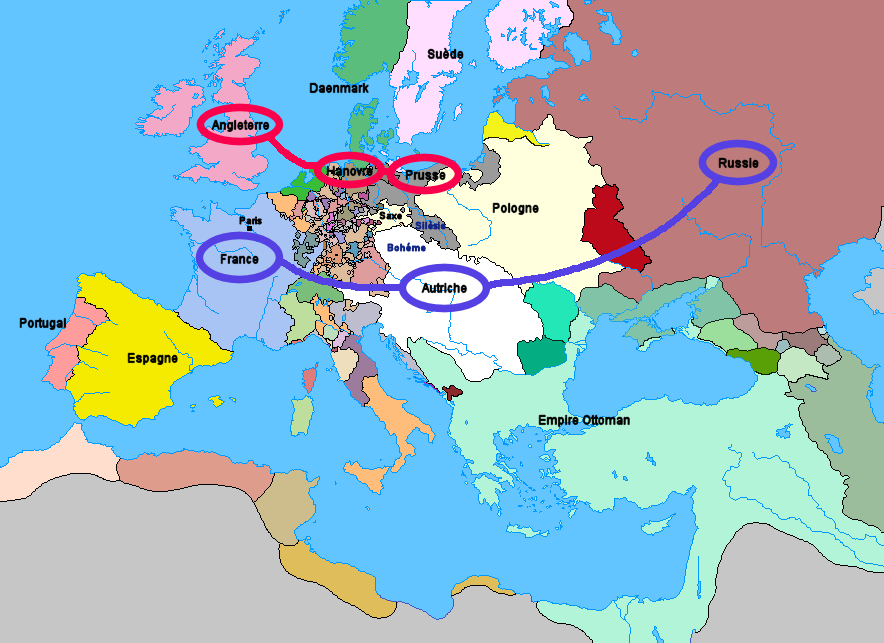
Image: The new alliances that resulted from the Diplomatic Revolution of 1756
Since this rapid settling of accounts with Russia is no longer the focus or at least at the forefront of coverage, we need to refresh our memories of exactly what was intended. The Trump transition planned to move rapidly in its first days and weeks in office to engineer a dramatic reshuffling of policy toward Russia, in essence a grand bargain which would start with lifting the December 2016 sanctions as well as those imposed in March 2014 for the annexation of Crimea. But it wouldn’t end there. It was also to include a basic reorientation of policy in the Middle East (a policy of close collaboration with Russia in Syria and Iraq/ISIS) and at least some shift in US policy toward Europe and the EU. ...
Despite the claim that Flynn had gone rogue and that Vice President Pence was lied to, details that emerged in the Flynn plea documents make clear that Flynn’s discussions with Kislyak were widely discussed among President Trump’s top advisors. Pence almost certainly knew about them, though we as yet have no direct proof of this. Events were moving rapidly. A string of denials about Flynn’s conversations with Kislyak were hit with a rush of leaks that refuted each in turn. By February 13th Flynn was out. The next day President Trump asked Comey to drop the investigation into his activities. Comey politely refused. Events were moving quickly and badly.
Various reports, including Isikoff’s, tells us that the staff planning for a rapprochement which was kicked off in the administration’s first days continued. Indeed, in the months since we’ve seen it pop up here and there. There have been repeated hints of discussions to return the diplomatic compounds seized by the Obama administration in late December. In his May trip to Europe Trump had to be coaxed and prodded to commit to the defense of NATO allies. We saw it in Trump’s bizarre and semi-secret Oval Office meeting with Kislyak and Lavrov just after firing Comey. Still, it seems clear that by mid-February, with Flynn fired and the Russia scandal dominating the headlines, any hope of an immediate and thorough-going reset in relations with Russia were abandoned as unrealistic. While the desire is clearly still there, it has been the drama of the unfolding investigation, rather than a grand partnership with Russia that has dominated the news and the administration ever since.
Image: The new alliances that resulted from the Diplomatic Revolution of 1756
Tuesday, November 14, 2017
Sensible politics
Politicians are our employees, and no matter how likable they are, and no matter how much of ourselves we see in them, we have to be able to critique them openly and harshly, like the self-interested, careerist, complete strangers that they are. Our country’s very existence is predicated on the notion that we, the regular people, are in charge. We cannot look to political figures as people who are owed loyalty. Every decision someone who holds office makes is a decision they should be held accountable for justifying. “Because I said so” is a fair thing for a parent to argue, it is not something an elected official should ever suggest.
Image: Didn't get the memo
Monday, October 23, 2017
An interesting post:Why I'm down on conservatism
See the last line.
By Robert Hansen.at Medium.com:
Conservatism in a nutshell:
“Reality is awful. Let’s do our best to build ourselves a way out of it. And once we find good tools, let’s agree we’re going to beat the living daylights out of anyone who tries to take them away.”
Consider, say, Jonas Salk and the polio vaccine. I never came down with polio. Nobody in my generation did. But my first-grade teacher, Mrs. Boettcher, did, and she spent the rest of her life in a heavy leg brace for it. I can’t even begin to imagine how much awful polio was.
Once upon a time, polio was reality. But then some things happened to deliver us from reality: namely, free inquiry gave us the scientific method, economic growth made it possible for Jonas Salk to go to medical school instead of forcing him to toil in the fields, and literally thousands of brilliant minds came together, some of them self-organizing and some of them organized by the government, and … wow: polio is no longer part of reality.
Free inquiry and free markets killed polio. Jonas Salk’s research team was the weapon.
That’s conservatism: discovering what things have historically worked really, really well to transform our reality, and then protecting the hell out of these things against any Johnny-Come-Lately who has a bright idea to fix things that will just require us to throw away this one thing that’s historically been a really good idea but right now doesn’t seem to be working well.
Across the board, life for the poor today is vastly better than it was a century ago. Some people like to say “a century ago, nobody had a iPhone!”, but seriously, that’s missing the point. A century ago you could have died of polio. Or smallpox. Or tuberculosis (although that’s beginning to come back). A century ago the poor didn’t even have books, but now we’ve got Project Gutenberg and Wikipedia delivering a tremendous amount of the great literature and the knowledge of the world for anyone who walks into a public library.
(Man, public libraries! These are a great honking good idea! Let’s conserve the daylights out of them!)
What has historically worked really well for America?
Free inquiry. Free speech. Free association. Free religion. Free markets. The Rule of Law. Equality under the law. Radically populist checks on government power. Oh, and public libraries!
These are great honking good ideas. These have track records of success literally centuries long. They are the best tools we have at creating a better tomorrow. Anyone who argues, “well, it’s outmoded and outdated and hasn’t worked well for twenty years, so let’s get rid of it” deserves to be tarred, feathered, and run out of town two steps ahead of a pitchfork-wielding mob.
Why do I hate liberals? Because everywhere I look nowadays I see liberals trying to throw out these time-tested reliable tools.
Why do I hate conservatives even more? Because everywhere I look nowadays I see them abrogating their most sacred charge: conserving the important things.
I can forgive liberals for their excesses. Really. It’s the nature of all progress that to get a single good idea you have to plow through a hundred terrible ones, and most of the terrible ones look good up until they create a total disaster. If liberals want to put forward terrible ideas, I’ll grit my teeth and smile bravely. Yes, please, tell me more about your idea to eliminate income inequality by shifting to a mud-based economy. Fascinating. I’ll give it a fair hearing, because you never know, it might actually work.
But while we’re giving liberals permission to blow our society up in the name of progress, conservatives need to be standing watch around the precious things and saying, “No. You don’t get to mess with this. Go away. Remember, these tools are the absolute best ones we have. Not only would we happily give our lives to protect them… we would happily give your lives if you threaten them.”
As much as liberals infuriate me, they’re doing what they’re supposed to be doing: generating a ton of really bad ideas and chasing after them furiously. Sooner or later one or two of them will pan out. It’ll be good for all of us when they do.
But conservatives…
Man, show up. Stand your damned post. Protect the things that need protecting. Free inquiry. Free speech. Free association. Free religion. Free markets. The Rule of Law. Equality under the law. Radically populist checks on government power. Public libraries.
But right now the conservatives aren’t conserving anything.
Thursday, September 07, 2017
Trump: white president
 White people knew, back in the 19th century: if you wanted a high-quality black clown at your entertainment, it better be a white guy in blackface. Everybody knew that whites could do even blackness better than black people.
At the Atlantic, Ta-Nehisi Coates explains the American blindness to American racism.
This transfiguration is not novel. It is a return to form. The tightly intertwined stories of the white working class and black Americans go back to the prehistory of the United States—and the use of one as a cudgel to silence the claims of the other goes back nearly as far. Like the black working class, the white working class originated in bondage—the former in the lifelong bondage of slavery, the latter in the temporary bondage of indenture. In the early 17th century, these two classes were remarkably, though not totally, free of racist enmity. But by the 18th century, the country’s master class had begun etching race into law while phasing out indentured servitude in favor of a more enduring labor solution. From these and other changes of law and economy, a bargain emerged: The descendants of indenture would enjoy the full benefits of whiteness, the most definitional benefit being that they would never sink to the level of the slave. But if the bargain protected white workers from slavery, it did not protect them from near-slave wages or backbreaking labor to attain them, and always there lurked a fear of having their benefits revoked. This early white working class “expressed soaring desires to be rid of the age-old inequalities of Europe and of any hint of slavery,” according to David R. Roediger, a professor of American studies at the University of Kansas. “They also expressed the rather more pedestrian goal of simply not being mistaken for slaves, or ‘negers’ or ‘negurs.’ ”
Roediger relates the experience, around 1807, of a British investor who made the mistake of asking a white maid in New England whether her “master” was home. The maid admonished the investor, not merely for implying that she had a “master” and thus was a “sarvant” but for his basic ignorance of American hierarchy. “None but negers are sarvants,” the maid is reported to have said. In law and economics and then in custom, a racist distinction not limited to the household emerged between the “help” (or the “freemen,” or the white workers) and the “servants” (the “negers,” the slaves). The former were virtuous and just, worthy of citizenship, progeny of Jefferson and, later, Jackson. The latter were servile and parasitic, dim-witted and lazy, the children of African savagery. But the dignity accorded to white labor was situational, dependent on the scorn heaped upon black labor—much as the honor accorded a “virtuous lady” was dependent on the derision directed at a “loose woman.” And like chivalrous gentlemen who claim to honor the lady while raping the “whore,” planters and their apologists could claim to honor white labor while driving the enslaved.
And so George Fitzhugh, a prominent 19th-century Southern pro-slavery intellectual, could in a single stroke deplore the exploitation of free whites’ labor while defending the exploitation of enslaved blacks’ labor. Fitzhugh attacked white capitalists as “cannibals,” feeding off the labor of their fellow whites. The white workers were “ ‘slaves without masters;’ the little fish, who were food for all the larger.” Fitzhugh inveighed against a “professional man” who’d “amassed a fortune” by exploiting his fellow whites. But whereas Fitzhugh imagined white workers as devoured by capital, he imagined black workers as elevated by enslavement...
Speaking in 1848, Senator John C. Calhoun saw slavery as the explicit foundation for a democratic union among whites, working and not:
With us the two great divisions of society are not the rich and poor, but white and black; and all the former, the poor as well as the rich, belong to the upper class, and are respected and treated as equals.
Tuesday, July 25, 2017
Tuesday, July 11, 2017
None dare call it treason?
It seems we are beyond that now. From Talking Points Memo:
The title of this post is a reminisce of the "good old" John Birch Society days (50s and 60s) when that right wing group was throwing around accusations very freely indeed!
Sen. Tim Kaine (D-VA) on Tuesday said the federal investigation into Russian interference in the 2016 election and whether members of President Donald Trump’s campaign colluded with Russia may turn toward “potentially treason.”“We’re now beyond obstruction of justice, in terms of what’s being investigated,” the former vice presidential nominee said on MSNBC. “This is moving into perjury, false statements, and even into potentially treason.”Donald Trump Jr. on Sunday admitted he met with a Kremlin-linked lawyer in June 2016 because he was told the lawyer had damaging information about Hillary Clinton that could help Trump’s campaign.The New York Times on Monday reported that publicist Rob Goldstone, who contacted Trump Jr. about the alleged compromising information, suggested to Trump Jr. that the Russian government was behind the alleged “helpful” information.Trump Jr. on Tuesday released the emails he and Goldstone exchanged, including a reference to a “Russian government attorney” flying from Moscow for the meeting.''
The title of this post is a reminisce of the "good old" John Birch Society days (50s and 60s) when that right wing group was throwing around accusations very freely indeed!
Wednesday, June 28, 2017
Lest we forget
Another in my series of "the best of" my blog.
The Toronto Morality Play
Among other things, proof that all our present problems can't be blamed on one politician or one party.
Thursday, May 04, 2017
Politics and religion: a past post on Iran and everyplace else
Here's a post from 2009 which I think has something to say -- more than a bit to say -- about democracy's cultural dimension (see my last paragraph):
Rafsanjani's Friday sermon in Tehran: the flexibility of religion and ideology
Juan Cole published this morning a meaty analysis of Friday's sermon in Tehran by former Iranian president Rafsanjani. Rafsanjani in my view is a smart opportunist, not a radical, but the kind of guy who always survives the revolution and makes billions in the process (he is in fact now a billionaire). His position as successful profiteer and governmental insider puts him in a difficult position. Whatever may be the totality of his motivations may be, he certainly does not want the Islamic Republic to blow up. Thus he argues for an interpretation of the revolution of 1979 that will allow for compromise and unity between the angry reformists and the intransigent hardliners. Juan Cole explains the religious theories involved (the complete post is here):
The reform movement and its allies among pragmatic conservatives have developed a narrative about Khomeinist Iran. They allege that it is ultimately democratic, and that the will of the people is paramount. It is popular sovereignty that authorizes political change and greater political and cultural openness. Precisely because democracy and popular sovereignty are the key values for this movement, the alleged stealing of the June 12 presidential elections by Supreme Leader Ali Khamenei for his candidate, Mahmoud Ahmadinejad, is intolerable. A crime has been committed, in their eyes. A social contract has been violated. The will of the people has been thwarted.Note that Rafsanjani's theory of the Islamic Revolution, like that of many reformers, is democratic without being secular. It is a theory that grows out of Islam and the Iranian Shi'ite tradition, or at least is being reconciled with that tradition. Ditto for the hardline position. Despite the sweeping innovations brought in by Khomenei, specifically clerical rule and the idea that there can be a Supreme religious Leader in the here-and-now, important foundation stones for the hardline view are identified by its followers with the oldest manifestations of Islam and the Shi'ite traditions of the leadership of the family of Ali (and of the Prophet).
The hard liners hold a competing and incompatible view of the meaning of Khomeini's 1979 revolution. They discount the element of elections, democracy and popular sovereignty. They view these procedures and institutions as little more than window-dressing. True power and authority lies with the Supreme Leader... in this view ... a kind of philosopher-king, who can overrule the people at will. The hard liners do not believe that the election was stolen. But they probably cannot get very excited about the election in the first place. Khamenei and his power and his appointments and his ability to intervene to disqualify candidates, close newspapers, and overrule parliament are what is important. From a hard line point of view, the election is what Khamenei says it is and therefore cannot be stolen.
Rafsanjani desired in his sermon to lay a Khomeinist foundation for the more democratic view. He began by underlining his own role in the revolution and the establishment of the Republic, and his position as a witness to the values of Khomeini. He said Khomeini discouraged the anti-Shah activists of the 1960s and 1970s from terrorism. Instead, he urged a direct appeal to the people in their villages and mosques, and responsiveness to their desires. He represents Khomeini as saying, if the people are with us, we have everything.
Rafsanjani is saying that the 1978-79 revolution was not Leninist. It was not the work of a small vanguard of activists. It was broad and popular and therefore inevitably, he implies, had something of a democratic character.
The authoritarian view of governance in Shiite Islam is anchored by Misbah-Yazdi and his ilk in the theory of the Imamate. Shites believe that the Prophet Muhammad was both temporal ruler and divinely inspired prophet. After him, his relatives also exercised both functions. His son-in-law and first cousin, Ali, is held by Shiites to be the first Imam, the divinely-appointed vicar of the Prophet. But Rafsanjani quotes a Shiite text showing that the Prophet Muhammad said that even Ali could only rule the people with their consent, and without it he should not try. Rafsanjani is reimagining the Imamate not as infallible divine figures succeeding an infallible prophet, but rather as an institution depending on an interaction between God's appointee and the people he is intended to shepherd.
Another piece of evidence for the popular character of the Islamic Republic, Rafsanjani says, is Khomeini's own haste to establish lay, elected institutions and to implement a republican constitution. He maintains that Khomeini actually strengthened some of the popular institutions when he made suggestions for revision of the draft constitution. Even having a constitution is a bow to popular sovereignty, he implies, and he contrasts the haste with which revolutionary Iran established a rule of law and popular input into government with the slowness of these processes in countries such as Algeria.
... But Rafsanjani's point is that even the Supreme Leader, whom some see as a theocratic dictator, derives his position from the operation of popular sovereignty.
If you have not picked a side in this quarrel and adopted a religious, Islamic justification for your position, it is hard to say that either of these positions is "more authentic." Both positions have evolved over the last 30 years, and especially the past couple of months. It might be very hard for a learned Iranian Shi'ite of 200 years ago to recognize either as Shi'ism. Note what Juan Cole says about Rafsanjani's presentation, which he backed up with his authority as an eyewitness to the Revolution, the foundation of the Islamic Republic and the role of Khomeini in both:
So is what Rafsanjani is saying about Khomeini and Khomeinism true? Probably only partially. Khomeini is notorious for having rejected popular sovereignty as a principle. But he did put an elected president and parliament into the constitution, and he surely knew what would follow.One might say that Rafsanjani, the Iranian Thermidorian, is making it up as he goes along. On the other hand, who knows what Khomeini might say today?
The whole situation reminds me of an insight I had nearly two decades ago, when I was reading a short history of world Buddhism. As I went through the book I realized that somewhere, sometime, just about any religious position you could imagine had been defined by somebody as "true Buddhism." I think this dawned on me when I found out that one influential Buddhist had said that true Buddhism meant that no one should be a monk and everyone should get married.
Thinking about this situation, I eventually came to the conclusion that the inherent variety of human experience and dispositions means that any religious tradition that has any degree of success in recruiting and maintaining itself over time has to contain contradictory elements, and be open to new interpretations. Otherwise it will become completely irrelevant and die out.
This further means that the kind of wild and careless generalizations that are often made about religion and culture and their consequences for today, -- e.g. what political structures will result from Confucian or Roman Catholic or Mormon traditions -- should be treated with the utmost suspicion. (Phil Paine has written about this recently.) A very particular instance is Iran today. A week's diligent reading will tell you quite a bit about what Iranian Shi'ites have valued in the past. Faced, however, with a live Iranian Shi'ite, you or I or Juan Cole will not know what she or he thinks, unless we ask. And even then, what that means for his or her future actions will remain to be seen. As Charles Kurzman might say, when life is no longer going along its routine groove, who knows what will happen next, what you will do next? You make it up as you go along, using existing materials in whatever way seems possible or necessary.

Subscribe to:
Posts (Atom)