Showing posts with label archaeology. Show all posts

Saturday, January 25, 2020

Thursday, January 19, 2017

A post-Roman British royal capital

The capital of Rheged?
The Scotsman has an article on what seems to be the rediscovered post-Roman capital of the kingdom of Rheged.
The best part of it is this artistic reconstruction of the settlement. It didn't take much to be regarded as a king in the 6th century. The difference between "king" and "emperor" was big.

Monday, June 13, 2016

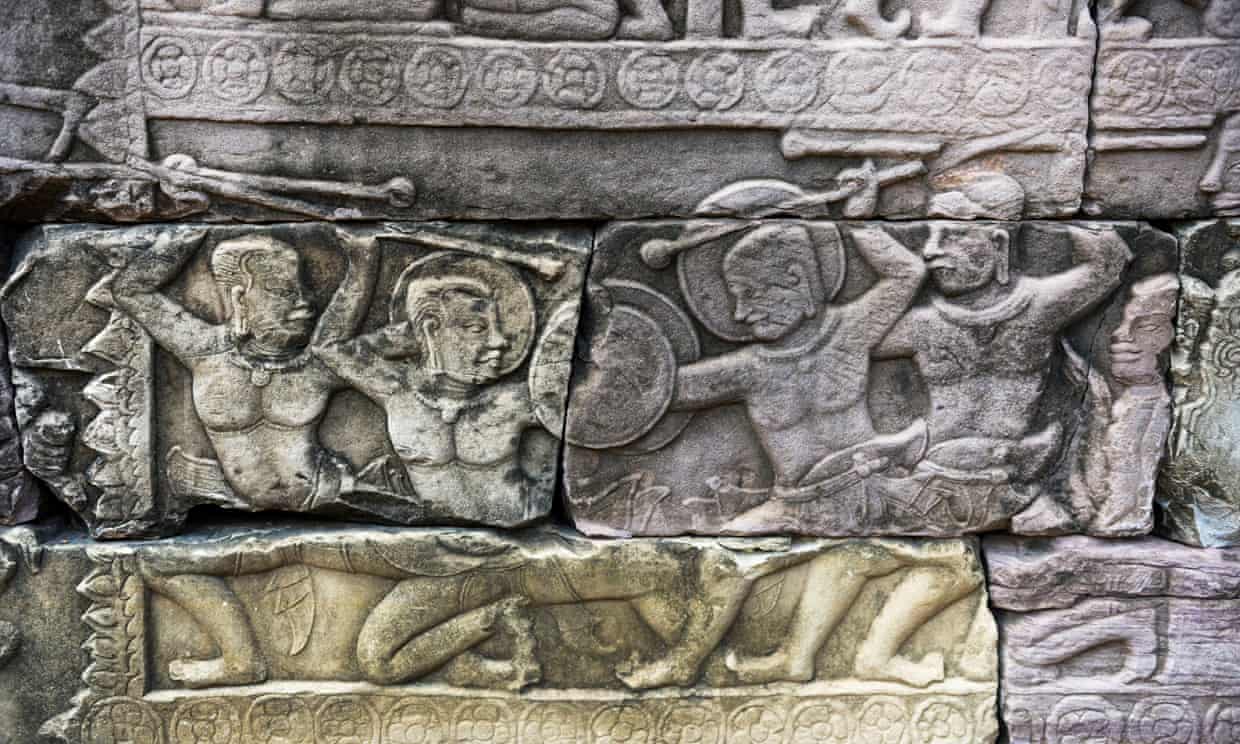
Vast medieval cities of Cambodia

Just after World War II, when there are plenty of airplanes sitting around doing nothing in particular, archaeologists started using aerial photography to map and explore wide swaths of the ancient and medieval landscapes.
Well, both photography and air travel have improved a lot since World War II, and aerial surveys are used all the time for many purposes. Archaeologists are still part of this process. As a result things we never even suspected are being discovered all the time.
Do you know that Angkor Wat is hardly unique to medieval Cambodia? Well, nobody else did either. But now we see there are traces of cities as big as modern cities. And that is saying something because cities of the last two generations are huge on historic standards.
There are some really interesting maps, plans, and pictures of this work in the Guardian.
Image: A twelfth-century deed of arms in Cambodia. How would William Marshal do against these guys? Hint: armor.

Friday, February 26, 2016

If you are really interested in Viking archaeology...

or early medieval Poland, consider this:


Buko, Andrzej, ed. Bodzia. A Late Viking-Age Elite Cemetery in Central Poland. East Central and Eastern Europe in the Middle Ages, 450-1450. Leiden: Brill, 2015. Pp. xxxi, 624. $293.00. ISBN: 978-90-04-27829-5.

A lavish and detailed work aimed at a wide audience, published even before the excavation report. But the publishers have narrowed down that audience, as the  reviewer, Neil Price, points out:


However, given such an impressive catalogue of achievement, there sadly remains one truly glaring problem, which is not the fault of editor or contributors: as ever with Brill's otherwise excellent early medieval volumes, this book is priced far beyond the pockets of students, academics or even libraries [SM]. If it really does cost nearly three hundred dollars to viably produce a volume like this, then one wonders if a pdf on Open Access might honestly be a better solution, or at least breaking it up into two or three more affordable paperbacks.

Sunday, September 29, 2013

Rant: digging up Richard III

It's not my rant but Howard Williams' of the University of Chester, referred to me by Guy Halsall.  Here is part of it:

Worshipping Dead RoyalsThe third objectionable aspect of the excavation of Richard III is the royal cult of personality that surrounded the excavation and the respect shown to his remains. I personally don’t have time for those that fawn over present-day living royals and their sprogs, but it seems somehow cut-rate and sordid to be fawning over long-dead royals in the hope of ‘rewriting the history books’ or getting to know their true person through their bodies. I can imagine the same sensitive facial reconstructions done for the butchers of the 20th century and imagine cult followers shedding tears over their sensitive small moustaches and their kind eyes.
Now I am sure Will, Kate and little baby George are all lovely. Even the Duke of Edinburgh makes me laugh. However, this royal necrophilia gets right up my archaeonose. Rather than the scientific study of human remains to understand life and death, this becomes a faux-forensic investigation into the individual’s life and death. Whether hero or villain, it is ironic that our obsession with the remains of the individual cadaver of Richard III flies in the face of the aspirations we have as a discipline for writing about the past in a social and humanising way.  Implicated in this view is that only rich and powerful people in the past matter today. In other words; the bones of toffs are venerated today as sacred, the bones of plebs are trowel fodder.
There is a strong case for Leicester cathedral to create a medieval equivalent to Westminster Abbey’s ‘tomb of the unknown soldier’. If you want to spend a million, select one of the many thousands of medieval graves we archaeologists have dug up – an old woman who died of leprosy, an infant who died in childbirth – and create a monument for them that makes us reflect on present-day poverty in the rest of the world and how many millions live in poverty today and die in agony from curable diseases. Don’t honour a warmongering royal, honour humanity.

Wednesday, January 30, 2013

Online intellectual content – the real thing!

Two interesting posts from long time correspondents (what do you call a person whose blog you read on a regular basis?).

Over at Hammered Out Bits, Darrell Markewitz, the Norse reenactor and craftsman, brings his own perspective to the question of interpreting small objects. This artifact sparked a discussion about what it actually represents or how it can actually be used to establish details of Norse costuming.


Says Darrell:
...no matter how much you work with artifacts, you never really understand then until you see them in life, actually before you. Reading the measurements does not really impact you. Almost everything is either way SMALLER, or way LARGER in actual truth, than what you imagine it is.
That's the core of his post, but it's actually worth looking at it to see why Darrell thinks this. Well illustrated!

Then there is Professor Grumpy over at Historian on the Edge. He is writing a new book about how historians have not only lost control of history, but are in danger of being excluded from it. Sounds cranky? More like appalling, actually. In the sense that he is describing an appalling situation.

This reminds me of a time maybe twenty years ago when a well-known Canadian scholar, an historian actually, was arguing that we should reorganize Canadian academia on the model of "real countries." Reading this summary of how a real country (UK) does things, I am just glad that we have avoided reality so far.

Anyway, I highly recommend Prof. Grumpy's first chapter, and I congratulate him on maintaining his calm in the face of a situation that he must find intolerable.


Saturday, November 26, 2011

Digging the lost harbor of Theodosius

This week the CBC TV show The Nature of Things had an episode on the discovery and archaeological rescue of one of the major harbors of Constantinople.  I missed it, but fortunately the whole episode is on the web.

The reason that this harbor was found was the construction of a train tunnel across the Bosphorus.  Both the construction of the tunnel and the archaeological rescue are technological wonders.  This is a technological nerd-fest.

And the photography of Istanbul is great, too.

Did I mention that they found 37 medieval ships?

Image:  rescue archaeology.

Tuesday, May 31, 2011

Migration and ethnicity and why the 5th century matters today

Guy Halsall gave this paper --Archaeology and Migration: Rethinking the Debate -- at the conference on The Very Beginnings of Europe? Cultural and Social Dimensions of early Medieval Migration and Settlement (5th-8th centuries) that took place in Brussels on 17-19 May.

Obscure? Irrelevant?  See what Halsall has to say:
Moving from the demonstration of migration to the explanation of the downfall of the Roman Empire through appeal to migration can be highly irresponsible, at best.  Southern German newspapers have, for example, reviewed a museum exhibition set out in the traditional migrationist paradigm as showing how ‘the Roman Empire fell because it could not keep out the immigrants’ and that we can learn from this.  When a British historian places an argument that the Roman Empire fell because of the immigration of large numbers of barbarians next to arguments that the end of Rome was the end of civilisation and that we need to take care to preserve our own civilisation, when another British historian writes sentences saying ‘the connection between immigrant violence and the collapse of the western Empire could not be more direct’, and especially when the arguments of both involve considerable distortions of the evidence to fit their theories, one cannot help but wonder whether these authors are wicked, irresponsible or merely stupid.  Are they setting themselves up as ideologues of the xenophobic Right or have they simply not realised the uses to which such careless thinking and phrasing can be put?  I have already drawn attention to the worrying implications of the use of genetic data to study this period, and they do not stop with implications about monolithic ethnic identities based upon genetics.
If we accept that it is fundamentally misguided to start looking at the archaeological record primarily in terms of whether or not it demonstrates migration, broad new interpretative horizons are opened up for us.  In particular, new horizons are presented and, simultaneously, ways of contributing in more humane fashion to current debates about immigration, if we break down the set of binary oppositions that bedevil the study of the period: Romans against barbarians; Saxons against Britons; (especially importantly) the Roman empire against barbaricum; the Roman period against the Migration period; Britain versus the mainland of Europe; the Saxon migration moving simply from east to west.
You do want to read the rest now, don't you?

Monday, January 10, 2011

Everything you know is wrong

Thanks to WJBD Radio's site, via Explorator, we hear news of a, uh, counter-intuitive discovery:


An Iuka man who believes the lost Tomb of Alexander the Great may be located in Romine Township in extreme southeast Marion County encouraged the county board's Community Relations Committee Tuesday night to pursue development of the site a tourist attraction.

Harry Hubbard, presented artifacts he said were earlier looted and sold from the underground cave, along with a number of books and maps that he says confirm the location of the cave.  "The county could be rolling in revenues coming in from the outside.  Any country in the world would love to have this repository within their boundaries.  Any state, any municipality.  The county has it within its boundaries and it can be exploited," Hubbard explained.  He believes there are still gold and riches buried in the cave, even after what he calculated was the removal of over five thousand pieces and over six-million dollars in gold by Russell Burrows.  Hubbard believes Burrows was led to the site with the help of local residents in 1982. 

Hubbard outlined how the artifacts were sold through Olney antique dealer Thelma McClain and Museum Curator Jack Ward of Vincennes, Indiana, both of whom have passed  away.  Hubbard had the opportunity to go through a filing cabinet where Ward had kept an extensive record of the sales of items taken from the cave as well as photographs.   He also showed a listing of items he believes were taken from the cave sold at McClain's estate auction.  Hubbard says authenticity of some of the artifacts has been confirmed by a Forensic Lab in Sante Fe, New Mexico.


Hubbard says even with all the information he has not been able to get any state historic officials interested.  As a result, he used his own money to pay for geological equipment that was used to pinpoint the location of the man made cave.    He believes he has found the location, but feels the opening was sealed by Burrows or the entrance collapsed on its own.  Hubbard says the current property owner is from Belleville and has not expressed interest in helping with the investigation.

Hubbard feels the county can act because of the historical significance as well as reports of skeletal remains in the cave.  "There is eminent domain.  There was a crime committed.  If I had the second Burrows book, which my burned up, and even in the red book he talks about finding skeletons.  Well, that's a crime.  You can rope the whole thing off with police tape for that matter and say 'okay, we want to get to the bottom of this crime'.  Our thing is if someone went to Burrows that had a badge and said 'hey you're coming with me, show us where these things came from'." Hubbard suggested.  He says Burrows has never been cooperative in showing the location of the cave.   Burroughs has since moved to Colorado....
More at the site.

This must have been the most interesting meeting those county councillors had experienced in a long time.  And the reporter, too.

Sunday, December 05, 2010

Sunday morning, and Explorator comes to my mailbox...

...full of archaeological goodies.  Thanks, David Meadows!

One of the nice things about this e-mail news compilation is that it supplies me with links to the little stories.

For instance, I don't get excited about the power, wealth and claims to divinity of Greco-Egyptian queens, but who would not want to see this amazing coin/medallion on Sunday morning?

And I find it pleasant to have nonsense about "Roman Chinese" systematically dealt with.

I'm grateful both to David and the originating sources.

Thursday, September 09, 2010

Some -- a little -- maybe -- better news from Iraq, thanks to McClatchy and Christian Science Monitor

Gold earrings made for an Assyrian queen, a sacred 4,000-year-old statue and 540 other looted pieces of Iraq's ancient history went on display in Iraq on Tuesday in what was billed as a triumph of justice and international cooperation.
"This is a very happy day -- we are making progress in the very important field of returning Iraqi history to its rightful home," said Iraq's ambassador to Washington, Samir Sumaidaie, who said the objects had been found through a combination of Iraqi and American efforts. "Iraq cannot be summarized by 30 years of problems and wars -- it can stand and it can reclaim its history."
But... 
...He noted, however, that a previous shipment of 632 stolen pieces recovered in the U.S. had gone missing after being delivered to Prime Minister Nouri al Maliki's office last year.

Read more: http://www.mcclatchydc.com/2010/09/07/100218/looted-treasures-returned-to-iraq.html#ixzz0yteP8y49

Thursday, July 22, 2010

They just keep finding more Stonehenge

What impresses me is not so much the construction, as the size of the whole complex which rather implies a huge social investment over a large area. A very large area. I am tempted to speculate on the existence of a "Stonehenge civilization." Read all about the new discoveries.

Tuesday, June 22, 2010

Carnivalesque returns, and brings us Antioch

Carnivalesque, the carnival of early history blogs, is back -- over at Cranky Professor. And the first of its links takes us to Zenobia: Empress of the East, whose author Judith Weingarten, a fan of all things associated with the Eastern Empire, left in May to travel to Hatay (or Antakya), the city that now arises from the spot where the ancient Antioch once stood. To let us abandoned readers share in some of the fun she looks at an interesting Turkish initiative to reconstruct the old city. It is some challenge, because the current incarnation of the settlement is entirely modern -- if you stretch the idea of modern just a little bit. Certainly there is nothing there to suggest a city that once thought of itself as Rome's rival.

Apparently that has not stopped the Turkish scholar, Dr Kayhan Kaplan of the Department of Landscape Architecture at Mustafa Kemal University in Hatay, who at this site has posted reconstruction of what the old city may have looked like, from four different angles. It looks like the site is entirely in Turkish, but you don't have to read Turkish to enjoy this.

As Judith Weingarten points out, there are limits to this kind of reconstruction, but it gives people something to argue about, and progress is possible:
Needless to say, archaeologists and historians are going to argue about his recreations for a good many years. In fact, Antiochepedia has already thrown down the gauntlet on nine points of topography (e.g., were the river branches narrower? should the island's southern tip be more pointed? that kind of stuff). For the rest of us, it is simply stunning and gives us a real "feel" of ancient Antioch.
I agree entirely with Antiochepedia: "In the good old days, Dr Kaplan might have been cheered along the Colonnaded Street for this job!"

There is more good stuff at Zenobia, and at Cranky Professor for that matter.

Image: Antioch as depicted on the Peutinger map, a medieval copy of a Roman original.

Tuesday, May 25, 2010

Caveat lector!


"Let the reader beware!"

Jonathon Jarrett over at A Corner of Tenth-Century Europe critiques a supposed breakthrough in our knowledge of the Pictish language. This excerpt explains why such a critique should be of interest to people who don't care much about Pictish, but might care about some other obscure, pre-modern historical problem:

Okay, here’s another thing I wanted to write up before I went to Kalamazoo. You may have seen, if you are following Archaeology in Europe as you all should be, that there was a recent paper in Proceedings of the Royal Society A that apparently decodes the Pictish language or something similar. I confess to initial scepticism, not least because they inexplicably persist in using the term `Iron Age’ for a people only attested under the name ‘Picts’ from the Roman period onwards, and whose glory days are most definitely early medieval, but I am interested in the Picts, I am in favour of Science! in history and so I thought I’d better have a look. After all, I am developing a blog-tradition of critiquing scientific papers on matters historical, and I’d hate to pass up another opportunity. Now, if those instances have taught me anything, it is these things:

1. articles based on the press release usually massively exaggerate the impact, and indeed the intent, of the actual research;
2. the actual research is usually more interested in proving a method than in its applications, otherwise it would have been published in a historical forum not a scientific one; and,
3. it is unfortunately rare for the authors of that research to have read enough in the field to which they’re supposedly contributing to have an accurate sense of whether or not they really are.

And this particular case ticks all three boxes, which is to say it’s interesting, appears scientifically rigorous at first glance, but sadly isn’t going to add much to the historical or linguistic debates, even though the news coverage would have you believe it’s a revolution in the field.


Like I said, let the reader beware.

One of the problems with work done by "scientists" in historical fields is that they tend to think that one simple procedure or test will cut through all the problems that have puzzled scholars for decades or centuries. But scientific evidence is usually as incomplete as any other kind.

Image: The Pictish symbols.

Sunday, November 01, 2009

Ah, the good old days of divine monarchy and mass murder!

From the New York Times, an article on happier days at Ur:

A new examination of skulls from the royal cemetery at Ur, discovered in Iraq almost a century ago, appears to support a more grisly interpretation than before of human sacrifices associated with elite burials in ancient Mesopotamia, archaeologists say.

Palace attendants, as part of royal mortuary ritual, were not dosed with poison to meet a rather serene death. Instead, a sharp instrument, a pike perhaps, was driven into their heads.

Archaeologists at the University of Pennsylvania reached that conclusion after conducting the first CT scans of two skulls from the 4,500-year-old cemetery. The cemetery, with 16 tombs grand in construction and rich in gold and jewels, was discovered in the 1920s. A sensation in 20th century archaeology, it revealed the splendor at the height of the Mesopotamian civilization.

The recovery of about 2,000 burials attested to the practice of human sacrifice on a large scale. At or even before the demise of a king or queen, members of the court — handmaidens, warriors and others — were put to death. Their bodies were usually arranged neatly, the women in elaborate headdress, the warriors with weapons at their side.

C. Leonard Woolley, the English archaeologist who directed the excavations, a collaboration between Penn and the British Museum, eventually decided that the attendants had been marched down into burial chambers, where they drank poison and lay down to die. That became the conventional story....

The researchers, led by Janet M. Monge, a physical anthropologist at Penn, applied forensic skills to arrive at the probable cause of death in both cases.

There were two round holes in the soldier’s cranium and one in the woman’s, each about an inch in diameter. But the most convincing evidence, Dr. Monge said in an interview, were cracks radiating from the holes. Only if the holes were made in a living person would they have produced such a pattern of fractures along stress lines. The more brittle bones of a person long dead would shatter like glass, she explained.

Dr. Monge surmised that the holes were made by a sharp instrument and that death “by blunt-force trauma was almost immediate.”...


But what did this "process" smell like?

Monday, October 19, 2009

Wimps?

I would love to hear some informed commentary on this article from Reuters and The Independent:
Modern man 'a wimp', says anthropologist

Many prehistoric Australian aboriginals could have outrun world 100 and 200 metres record holder Usain Bolt in modern conditions.

Some Tutsi men in Rwanda exceeded the current world high jump record of 2.45 meters during initiation ceremonies in which they had to jump at least their own height to progress to manhood.

Any Neanderthal woman could have beaten former bodybuilder and current California governor Arnold Schwarzenegger in an arm wrestle.

These and other eye-catching claims are detailed in a book by Australian anthropologist Peter McAllister entitled "Manthropology" and provocatively sub-titled "The Science of the Inadequate Modern Male."

McAllister sets out his stall in the opening sentence of the prologue.

"If you're reading this then you - or the male you have bought it for - are the worst man in history...."

...

Manthropology abounds with other examples:

* Roman legions completed more than one-and-a-half marathons a day carrying more than half their body weight in equipment.

* Athens employed 30,000 rowers who could all exceed the achievements of modern oarsmen.

* Australian aboriginals threw a hardwood spear 110 meters or more (the current world javelin record is 98.48).

McAllister said it was difficult to equate the ancient spear with the modern javelin but added: "Given other evidence of Aboriginal man's superb athleticism you'd have to wonder whether they couldn't have taken out every modern javelin event they entered."

Why the decline?

"We are so inactive these days and have been since the industrial revolution really kicked into gear," McAllister replied. "These people were much more robust than we were.

"We don't see that because we convert to what things were like about 30 years ago. There's been such a stark improvement in times, technique has improved out of sight, times and heights have all improved vastly since then but if you go back further it's a different story.

"At the start of the industrial revolution there are statistics about how much harder people worked then.

"The human body is very plastic and it responds to stress. We have lost 40 percent of the shafts of our long bones because we have much less of a muscular load placed upon them these days.

"We are simply not exposed to the same loads or challenges that people were in the ancient past and even in the recent past so our bodies haven't developed. Even the level of training that we do, our elite athletes, doesn't come close to replicating that.

"We wouldn't want to go back to the brutality of those days but there are some things we would do well to profit from."
Well, he sure knows how to get interviews and onto talkshows. But such interviews aren't necessarily the whole story. This may make more or less sense when spelled out in detail. It sounds oversimplified to me. Were early factory workers "inactive?" More likely worn out by too much repetitive, body-destructive work.

Image: Women making artillery shells in Quebec in World War II. Active or inactive?

Has there been, in his theory, a decline in womankind?

Update: In addition to the substantial comments below, Will McLean has weighed in on this. Indeed, see his recent blog entries for other good material.

Sunday, October 18, 2009

King Hrothgar's hall?

Is there anything to this story from the Copenhagen Post?

Could a large mud building unearthed in Lejre have been a cult place or beer hall of the ancient Viking kings?

The hall, 48 metres long and seven metres across, overlooks the site of a Viking palace unearthed in 1986 in what is an historic area of Denmark.

‘We are sure we have found a royal building of some sort,’ said Tom Christensen, curator of Roskilde Museum at the time. ‘The odd thing about the site is that it is littered with bits and pieces of exquisite golden jewellery, glass and bronze broaches, high quality artifacts, such as drinking glasses and ceramics, which all seem to have been deliberately smashed in some ritual.’

‘There is also a huge pile of cooking stones from primitive ovens. This was obviously a place frequented by the upper classes of the Iron Age. Maybe it was some sort of beer hall or a sacred site where cult or religious activities were carried out. The building’s post holes are over a metre deep, so it must have been an impressive construction,’ said Christensen.

...

Set in the period of the Germanic migrations in the fourth to seventh centuries, the poem [Beowulf] places the Scylding King Hrothgar’s Hall, Hereot, at Lejre, while Saxo Grammaticus, a 13th century chronicler who compiled a history of both legendary and historical Danish kings, also identified Lejre as an ancient royal seat.

Many modern Beowulf scholars identify Hereot with Lejre and, with the discovery of the hall, Danish archaeologists believed they had finally found the site. ‘The date of the cult place fits perfectly with the era of the Scyldings,’ Christensen said.

In 1986 archaeologists discovered a major upturned boat-shaped Viking longhouse, but only the foundations of the huge hall and outhouses remained as the original construction had been of wood. The 50-metre-long, 10-metre-high longhouse was twice the size of any similar hall discovered in Denmark, leading archaeologists to believe they had stumbled on a royal palace from the time of the sagas.

The dimensions of the hall were calculated from 200 posthole marks on the ground from the huge oak beams that supported the walls and roof. There were signs on the site of earlier constructions, dams, windmills and other buildings including a bronze foundry, workshops and outlining fencing, underlining the importance of the Lejre settlement.

A museum now occupies a plot of land near the site. The English web address for the Lejre Museum is www.english.lejre-centre.dk