Showing posts with label Ancient Civilizations 2055. Show all posts

Thursday, April 02, 2009

News from Kaffiristan


The Big Picture
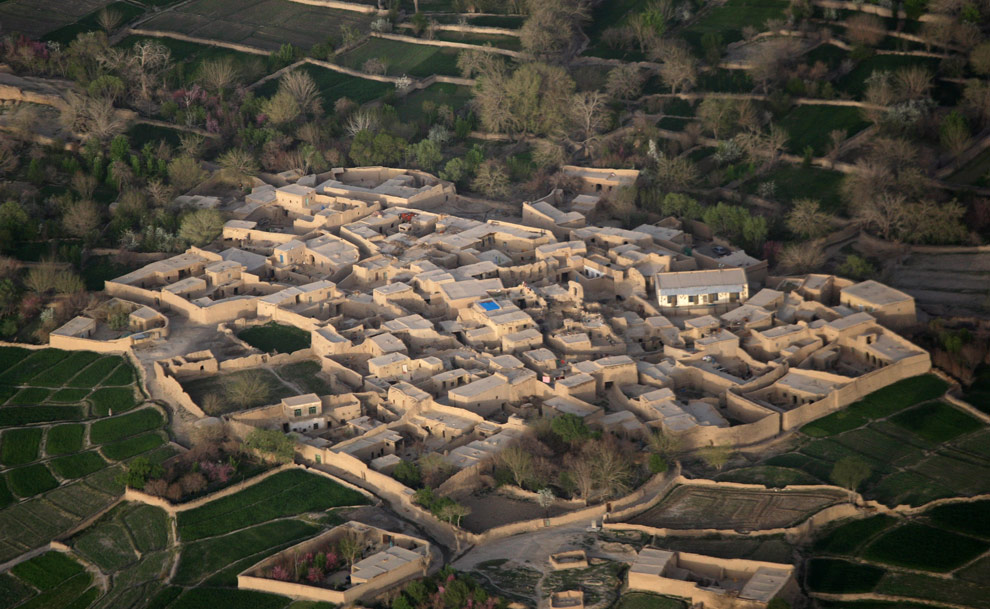
has a portfolio of pictures from Afghanistan, including a number from Nuristan (formerly Kaffiristan). Lots of poppy fields, Canadian troops, and debris from explosions.

Image: Doesn't this have an uncanny resemblance to Catal Huyuk?

Tuesday, April 22, 2008

Job satisfaction

I am now in the home stretch of my grading of winter term final examinations. This is the part of academic life teaching professors hate the most, and it is grueling. It is very difficult to be consistent and fair when you're reading similar material time and again, and there is no mistake so gruesome or flabbergasting that somebody will not eventually make it on the paper you are grading.

But this year, grading exams that are made up of short or long essay questions, I am feeling a good deal of job satisfaction. Grading these essays has assured me that the courses I presented succeeded in inspiring some insight and even passion in some of my students. It's hard to say how much they got from me, or how much is original in their thinking, but actually I don't care what the balance is. Students who never had much reason to think about medieval English or ancient history, I guess, have presented me with evidence that they found things in the course material that they actually cared about.

I've done my job.

Wednesday, April 02, 2008

Resurrection of the Iraqi National Museum

Five years ago, during the invasion, the enormously significant archaeological collection at the Iraqi National Museum was plundered. (I'm sure there is a big story behind that plundering, not that we are likely ever to know it.)

Now, some good news: progress is being made towards restoration. The Globe and Mail has a short video report here.

Tuesday, March 18, 2008

Dacia, Decebalus, and Sarmizegetusa


Today in Ancient Civilizations class I will be discussing the era of the Officially Good Emperors and will touch on the emperor Trajan's conquest of the kingdom of Dacia (roughly modern Romania over the Danube). About a year ago a good friend of mine was trekking through Dacia and visited the ruins of its pre-Roman capital, Sarmizegetusa. His account and reflections on Dacia are here. The various episodes are in blog-order: You have to start with the entry for May 12 or 13 and work up the page.

Image: The ruins of Sarmizegetusa today.

Tuesday, March 04, 2008

Roman games


Ancient Civilizations students who want to follow up on today's lecture on The Arena might want to look at this book in our collection: Gladiators and caesars : the power of spectacle in ancient Rome edited by Eckart Köhne and Cornelia Ewigleben.

It is well illustrated and has insights born from systematic re-enactment efforts.

Film clips from the Ben Hur chariot race sequences from 1925 and 1959 can be found at Youtube.com. Those must certainly count as re-enactments.

Female gladiators


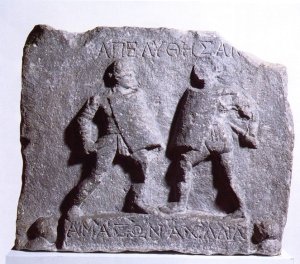
For students who can't wait for today's lecture on the Roman arena, why not have a look at this article on a possible grave find of a female gladiator discussed by Steven Murray in the Journal of Combative Sport?

Or a short article in Discover Magazine about archaeologist Steven Tuck's research into death in the arena?

Read both articles and come to lecture and you'll have a "Steven hat-trick."

Image: from the JCS article, two female gladiators, Amazon and Achillea.

Wednesday, February 27, 2008

A druid grave?


A friend sent me this very sensible article from Spiegel Online International about what might be the grave of a druid. The archaeological site, in Essex, sounds very interesting, but what might be the best thing about the article is how the author explains why archaeologists have to be careful in using labels like "Druid."

Image: Some of the utensils found in the grave.

Thursday, February 14, 2008

Laughing along with Cornelius Tacitus

The Roman historian Tacitus (wrote circa AD 100) is not usually associated with humor -- and no wonder, since he chronicled the bloody intrigues of the Julio-Claudian emperors. Mordant, or bleak might be better words. However, I was recently reading Michael Grant's lively Penguin translation, and it occurred to me that he sometimes might have been going for laughs, and not just a sour little chuckle.

Read these two passages and see what you think:

Pharasmanes [leading a group of Iberian mountaineers against the Parthians] reminded his troops that they had never submitted to Parthia -- the loftier their aspirations, he said, the greater the honour of victory, and the disgrace and peril of defeat. Contrasting his own formidable warriors with the enemy in their gold-embroidered robes, he cried: "Men on one side -- on the other, loot!"

OK, maybe that's a doubtful case (though whether you laugh or not, it does sound like something out of 300), but consider this:

[An honorary triumph was awarded to Curtius Rufus, a commander in Upper Germany:] He had sunk a mine in the territory of the Mattiaci to find silver. Its products were scanty and short-lived, though the troops suffered and toiled, digging channels and doing underground work which would have been laborious enough in the open. This forced labour covered several provinces. Worn out by it, the men secretly appealed to the emperor, in the name of all the armies, begging him to award honorary triumphs to commanders before giving them their armies.
What do you think now? (NB: no blood was shed in either anecdote.)

Sunday, January 27, 2008

Irbil as tourist attraction

Irbil in northern Iraq -- or if you prefer, Kurdistan -- is the best existing example of how continuous occupation of sites resulted in the creation of "tells," hills made up of the rubble of previous layers of settlement. Irbil (sometimes spelled Arbil) is one city that after maybe 8,000 years is still sitting perched on all that rubble.

Alas, Irbil, at least the old central part of the city, is crumbling and few of the buildings there are still occupied. Bet that's happened before! The municipal authorities, according to this Associated Press/MSNBC story, see an opportunity here. Given a certain amount of investment and peace and quiet, this could be a unique tourist attraction!

I'd go in a heartbeat.

Thanks to Explorator for bringing this to my attention.

Saturday, January 26, 2008

Amarna finds: religious reform can be hard work


Well, I was just talking a bit ago about "the old con games," wasn't I? So today I saw over at Archaeoastronomy a post on an upcoming BBC TV show on recent work at Amarna, the city/religious center founded by the "monotheist" pharoah, Akhenaten. Here's the key passage:

One of the most shocking findings are the ages at death. There’s a chart you can look at and it’s pretty clear that Amarna was a lethal place. The 2007 report has a chart of its own. This shows that aging a skeleton isn’t always possible, but both charts indicate that a life in Amarna would likely be over at 35. The report by Melissa Zabecki, also from Arkansas, is grim. They had dental caries but probably didn’t complain too much about toothache as they were also likely to have extremely bad backs. Zabecki has found evidence of osteoarthritis and spinal trauma in many of the skeletons. Zabecki’s conclusion is that these people were worked to death. Akhenaten wanted to change Egyptian religion overnight, and that can’t be done without a lot of work. The twisted bones of the workers of Amarna show some of the cost of turning from the old gods.
I've been skeptical for a long while about Akhenaten's reputation as a "worthy heretic" and exemplar of religious progress; I've seen his religious regime as the product of a theological power grab in a heavily-ecclesiasticized society. This is not the first evidence that lots of people died in religious conflicts, either at his hands or those of his opponents.

For more detail on recent work, see the Amarna Project site.

For an aerial view of the ruins, see this BBC presentation.

Image:
Tomb #9 at Amarna, photo copyright Ross Day.

Cornelius Tacitus speaks

One of the old greats, the Roman historian Tacitus ("I, Claudius" is derived from his vision of the early empire) says it all, or at least something significant:

Contradictory rumours have raged around [an imperial death] among contemporaries and later generations alike. Important events are obscure. Some believe all manner of hearsay evidence; others twist truth into fiction; and both sorts of error are magnified by time.

Of course, Tacitus himself has often been seen as the greatest of those who "twist truth into fiction."

The translation is by the prolific Michael Grant.

Tuesday, January 22, 2008

Alexander: a king or THE King?


See A Corner of Tenth-Century Europe for one whacko theory.

Image is copyright by the Fitzwilliam Museum, Cambridge.

Sunday, January 20, 2008

News from Catal Huyuk


I've always been fascinated by the early town site (representing maybe the earliest town) of Catal Huyuk (Çatalhöyük), in southeastern Turkey (Anatolia), and in my Ancient Civilizations course, I talk about its significance at length.

Well, recently the Turkish Daily News has published a good article on the work that has been done at Catal Huyuk since 1993.

I am pleased to see that my lecture material is still not obsolete, despite this interesting work.

Thanks to Explorator for this.

Image: Recent excavations, from TDN.

Friday, December 21, 2007

The challenges of cultural history

Students of mine who have struggled to make sense of ancient or Anglo-Saxon history, when the evidence is severely limited, may be interested or amused at what seems to be a controversy about the origins of heavy metal music.

I was alerted to this debate by an article in the British newspaper the Guardian, in which Joe Queenan, commenting on a film documentary called Metal: A Headbanger's Journey, by Sam Dunn and Scott McFadyen, casts doubt on the filmmakers' contention that an obscure, one hit wonder band called Blue Cheer deserves to be recognized as the originators of heavy metal. I was flabbergasted that anyone should think this. We are talking about 1968, when I was about the age of many of my students now: in other words, the age when music really matters. I was a big fan of loud, "hard rock," "psychedelic" music and the San Francisco sound, and today when I read Queenan's article, I couldn't even dredge up the slightest memories of Blue Cheer (and no, it has nothing to do with my non-existent drug-taking). Though I remember their hit Summertime Blues, a cover of an earlier rockabilly (!) record.

But sure enough, you can find on the Web the many champions of the claim that these guys were the source of heavy metal (see, for instance, the Wikipedia entry for Blue Cheer). I don't buy it; if the patriarchs of metal are not Black Sabbath, then there are plenty of people in 1967-8 who contributed more to the metal sound. Let me cite only three: Jimi Hendrix, Jimi Hendrix, and Jimi Hendrix. (As this web-site points out, Blue Cheer were pretty derivative of Hendrix.) I'm not excluding any influence, but others surely were more influential (Iron Butterfly, even maybe the pretty laughable in retrospect Vanilla Fudge).

Why is this on Early History? It strikes me that if we can't agree on something this recent and well-recorded as this phenomenon, how well can we do for the 8th century, or the 8th century BC? How many jokes, to take one point, lie undetected in our sources?

Yet despite our problems with determining facts and influences, I still say, Blue Cheer, bah. Just look at that album cover.

Saturday, December 15, 2007

HIST 2055, assignment for the second paper


Here is the assignment for Ancient Civilizations, HIST 2055. I promised to distribute the evaluation sheet for the paper, but I haven't composed that yet.

Image: Creating an ancient (piece of papyrus) paper.

Sunday, December 02, 2007

Thucydides on ancient Greek politics

In my Ancient Civilizations class, I referred to the famous Funeral Oration of Pericles as "the one passage in Thucydides' History of the Peloponnesian War that makes the Greeks look admirable." I was only 3/4 of the way through a rereading of the History when I said that, but I'm still looking for the second. More typical (though to my sensibilities more repellent than many others) is this incident from Book 8, chapter 41, page 560 of the Penguin translation:

On his voyage along the coast he landed at the Meropid Cos. The city was unfortified and had collapsed in an earthquake which was certainly the greatest one that can be remembered. He sacked the city, the inhabitants of which had fled to the mountains, over-ran the country, and made off with everything in it except the free men, whom he let go.

One could rant for hours about this passage. Even the Soviets would be ashamed to admit to this kind of behavior.

BTW, I have left the war criminal anonymous here; he's got enough publicity over the last 2 1/2 millenia. I have a similar policy for famous assassins.

Friday, November 23, 2007

Historical treasures, imagined and real


Over at Blogenspiel, Another Damned Medievalist has posted Carnivalesque XXXIII, a collection of links to interesting Ancient/Medieval items from recent blogs. Aside from cutting remarks about Beowulf and Neil Gaiman's role in it (go look it up!), there is a fine item from Tony Keen on what he'd like to see recovered from Pompeii if further digs discover more lost literature on the lines of the Greek library already found there. Posts like this can be tiresome but I liked Tony's so much that I followed his link to a post by Mary Beard, who earlier asked her readers for their wish lists.

It may seem that this wishing is ridiculously unrealistic. Well, wishes almost never come true in the way you'd like them to. But this week has shown that the unexpected can occur in a stunning manner. At least, I was stunned by two discoveries.

The first was a seemingly 7th-century royal cemetery in the North of England, the only such, with some individual pieces reminiscent of the Sutton Hoo material from East Anglia. This is really hot stuff, which will be analyzed for a long time to come.

Even better, if you are interested in Rome, is the apparent discovery of the Lupercale in Rome. To quote the Guardian, it's

a large vaulted hall beneath the Palatine hill ... almost certainly the fabled Lupercale - a sanctuary believed by ancient Romans to be the cave where the twin boys Romulus and Remus were suckled by a she-wolf.
The Guardian site has some video footage. You see, the cavern is in bad shape, and has only been seen via a probe-camera inserted from above. Watching it, you can imagine the excitement of the archaeologists and technicians who first saw it. The lead archaeologist, Andrea Carandini, said it's ""one of the greatest discoveries ever made" and whose to say that's wrong?

One story I saw said this shrine was accessible until the 16th century. Does any reader know more about this, and how the Lupercale was lost?

Let's call this Good News Friday and leave it at that.

Image: The English finds, from the BBC story.

Common questions about the term tests

I'm excerpting a letter I got from a student in HIST 2055, Ancient Civilizations, and answering the writer's questions here for others in this course and the other two:

First of all, I was wondering if all of the terms and essays will be on the exam, or if you are selecting a few from the given list to actually be on the exam.

I will be choosing a number of terms and essay topic from those I put on the study sheet.

Also, I have started preparing the essays, and I was wondering if you wanted the essay to address the questions which were at the top of the lecture notes and extra readings or is there another format you would like us to follow.

In HIST 2055 and 3425 the essay questions are based on source material we looked at in class, and in preparation for class discussion I suggested some questions to think about. It wouldn't hurt to look at those questions again, but you aren't restricted to reacting to them only. After a term of lectures and discussion, you may have a good idea of your own to write about.

And last, but not least, are the actual documents going to be on the exam, or just the titles and we create our essay from what we know!
The documentary material that was on the study sheet will also be on the exam paper.