Showing posts with label racism. Show all posts

Tuesday, October 29, 2019

Portrait of Pocahontas


I was reading a Globe and Mail article on the inappropriatness of using (mainly indigenous)
imagery and costumes in a racist manner on Halloween.  Then I remembered this engraved portrait of Pocahontas in Jacobean English formal (court) clothing.  And I also remembered how astonished I was the first time I saw the portrait.

Quick quiz: So what was she calling herself at this point (1616)?

Enjoy!

Monday, January 29, 2018

Hijacked!

A recent article in the Public Medievalist makes me feel that someone just walked over my grave.

The author, Paul Sturtevant, has done us a service by giving a name -- "Schrödinger’s medievalism” -- to ambiguous phenomena that may or may not  be the product of racism.

While at the beach in Ocean City, Maryland he spotted an unfamiliar pseudo-Scandinavian flag, which he soon discovered was the "Vinland" flag, Vinland being the shortlived Viking settlement  in Newfoundland ( A.D.1000), and the flag a product of the goth metal scene.  The inventer of the flag was not an obvious racist  But the flag has come to mean more than its perhaps lighthearted origins, at least to some:


I was suddenly confronted with two equally likely possibilities:
  1. on the one hand, the Vinnland flag waving at me could be yet-another appropriation of the medieval (or in this case, a medievalism) by white-supremacists in order to push their hateful agenda;
  2. on the other hand stood the possibility that someone in the shop was not a neo-Nazi at all but simply a fan of Type O Negative Was it a racist dog whistle? Or was it simply a band flag?
Following the ADL’s advice of judging carefully in its context didn’t help either; the shop was an innocent-seeming place, full of flags and toys and kites and no obvious signs of white supremacy. On the other hand, one of the flags they flew outside was the “Thin Blue Line” flag. This flag was originally created to honor the sacrifices of police officers, but, you guessed it, the flag has subsequently been appropriated by those advocating that “Blue Lives Matter” in opposition of the Black Lives Matter movement.
So was this flag a white supremacist appropriation of the Middle Ages? I don’t know. And without more information about the person who chose and raised that flag, I can’t know.
That’s why I call it a Schrödinger’s Medievalism.

Sturtevant explains in more detail:

In the famous “Schrödinger’s cat” thought experiment, Erwin Schrödinger said(entirely theoretically)that because of quantum mechanics, if you put a cat in sealed box with a flask of poison and a radioactive trigger, you cannot tell what state the cat is in—whether it is alive or dead—without opening the box. So, without more information, the cat can, weirdly, be considered both alive and dead at the same time. 
  So, that Vinnland flag was a “Schrödinger’s medievalism.”  
To my mind, a Schrödinger’s medievalism is a piece of medieval culture found in the wild that you know has been appropriated as a symbol by right-wing nationalists or racists. But, that piece of culture also has a broader, potentially benign, meaning. You can’t tell which is it until you get more information—and sometimes doing so is impossible. So, sometimes you are left in the uncomfortable position of having to treat it as both benign and hostile at the same time. 

.

Sturtevant  gives an example of the toxic potential of this phenomenon, when he takes us back to Maryland:

Another example: I attended the Maryland Renaissance Festival this year, and in the crowd I noted a small group of four young people. They were all cosplaying, and all wearing replica amulets of Thor’s hammer...
For some white-nationalists, Thor is an icon of white Aryan warrior masculinity. But Marvel’s Thor comic books and films have been reimagining the Norse mythological tradition in a way that is more inclusive than ever. And notably, three of the four cosplayers I saw were people of color. For them, it seemed that Viking religion was simply cool, and the amulets were part of a fun costume.
White supremacists try to appropriate these sort of symbols precisely for this reason: it’s easy for them to hide in plain sight, allowing them to slip under our radar. And even more insidiously, when it comes to light that these are sometimes used as symbols of hate, it can make white supremacists’ numbers seem greater than they really are.

The reference  to the cosplayers hits close to home for me, even though I'm not young, noticeably racist, or a person of color.  By today's definition I can be seen as a cosplayer, since I have been dressing up and re-enacting the Middle Ages for nearly 50 years.  Now I and my non-racist fellow members of the SCA, generally seen as harmless eccentrics, are in severe danger of being reclassified as harmful eccentrics.  Take a look at some of the alt-right demonstrators last summer and you will see a fair number of them are wearing leather armor and round shields and various ambiguous symbols.  How many non-SCA people will be able to distinguish these characters from the SCA.

As Sturtevant says:

Why we can't have nice things.
There's more to the article.  Read it.


Wednesday, June 24, 2015

Eric Foner on the special status of South Carolina

Salon was smart enough to interview Eric Foner, the leading historian of Reconstruction in the post-US-Civil-War era. A sample.
One-hundred-and-fifty years later, we still have a problem in this country coming to terms with the existence of slavery. There’s no museum of the history of slavery in the entire United States. There’s a Holocaust museum; there’s plenty of other museums [about tragedies and atrocities], but there’s no memorial to the victims of slavery in the U.S. We have memorials to the victims of the Irish famine; why don’t we have a memorial to the victims of slavery somewhere? What I want people to learn from history is the depth and importance of slavery, and then 100 years of segregation, in shaping the way American society is today.

Saturday, October 26, 2013

Plunder in history: more from Coates

Ta-Nehisi Coates:

In Postwar, Tony Judt evokes the chaos of living under the thumb of Nazi Germany: It is misleading to think of the German occupation of continental Europe as a time of pacification and order under the eye of an omniscient and ubiquitous power. Even in Poland, the most comprehensively policed and repressed of all the occupied territories, society continued to function in defiance of the new rulers: the Poles constituted for themselves a parallel underground world of newspapers, schools, cultural activities, welfare services, economic exchange and even an army—all of them forbidden by the Germans and carried on outside the law and at great personal risk. But that was precisely the point. To live normally in occupied Europe meant breaking the law: in the first place the laws of the occupiers (curfews, travel regulations, race laws, etc) but also conventional laws and norms as well. Most common people who did not have access to farm produce were obliged, for example, to resort to the black market or illegal barter just to feed their families. Theft—whether from the state, from a fellow citizen or from a looted Jewish store—was so widespread that in the eyes of many people it ceased to be a crime. ...

As occupying forces, both Nazis and Soviets precipitated a war of all against all. They discouraged not just allegiance to the defunct authority of the previous regime or state, but any sense of civility or bond between individuals, and on the whole they were successful. If the ruling power behaved brutally and lawlessly to your neighbour—because he was a Jew, or a member of an educated elite or ethnic minority, or had found disfavour in the eyes of the regime or for no obvious reason at all—then why should you show any more respect for him yourself? Judt is, I think, in speculative but interesting territory. There's nothing about a social contract that necessitates equality among shareholders. What happens when some shareholders pay in more, but get out less? What is the message that a Power sends to its subjects when it says to them "Some members of society enjoy the protection of the State, and others are outside of the law?" And what happens when a whole sector of society is effectively branded as the rightful field for plunder?.... 

The ‘right’ of possession was shown to be fragile, often meaningless, resting exclusively on the goodwill, interests or whim of those in power. There were winners as well as losers in this radical series of involuntary property transactions....hundreds of thousands of ordinary Hungarians, Poles, Czechs, Dutch, French and others became complicit in the Nazi genocide, if only as its beneficiaries. It is important to remember the ordinary beneficiaries who do not always wear the swastika. It is important to remember that atrocity is not simply insanity, that it is often not insanity at all, but hard interest, that even in the Holocaust there were interests, that there were winners and that they saw themselves as such. 

In our own land, we have long observed this. To better avoid the painful fact that there were "winners" in a slave society, that those winners were not merely great planters, to avoid the fact that ordinary Americans are indicted in all that came from slave society, we discuss the "race problem" as though it were a problem of manners and civility. I am sure the average African-American in 1963 could empathize with the dream of little white boys and little black girls hold hands. But he likely would have settled for a day when white people would no longer see he and his family as a field for plunder. Judt is not wrong to focus on property. Theft is the essence of atrocity--if only the theft of dignity and life. Indeed, where I forced to to offer one word to sum up black people's historical relationship to the American state, "Theft" is the first that would come to mind. Theft of labor and theft of family in slavery. Theft of life through lynching and pogrom. Theft of franchise in half the country. Theft through mortgages for some and contract loans for others. Theft through unemployment insurance for some, and debt-peonage for others. Theft of tax dollars which support "public" libraries that do not want you, "public" pools that will not have you, "public" schools that will not teach you and "public" universities that will riot at the sight of you. 


Should we conclude that theft is the marker of the black human's interaction with his government, that she lives, not under the aegis of the state, but in its cross-hairs, we head into dangerous waters. No. They went that away. These are not the facts you're looking for. Better to move along and go about your own private business. Better to forget this entire ugly everything. Better to focus on civility, your local diversity workshop and the reduction of harsh and intemperate language. Better to forget that indigestible truth--behind every great atrocity, stands some particular winner.

Wednesday, October 23, 2013

Some of the best stuff on the internet


 But it's fairly clear that hate that made the Shoah was neither an invention nor the magic of false-consciousness, but a reflection of the people themselves:


In the same poll of November 1946, one German in three agreed with the proposition that ‘Jews should not have the same rights as those belonging to the Aryan race’. This is not especially surprising, given that respondents had just emerged from twelve years under an authoritarian government committed to this view. What does surprise is a poll taken six years later in which a slightly higher. percentage of West Germans—37 percent—affirmed that it was better for Germany to have no Jews on its territory. But then in that same year (1952) 25 percent of West Germans admitted to having a ‘good opinion’ of Hitler.


Attendant to all of this was something that any student of white supremacy in America will recognize--a strong propensity toward national amnesia:


 In Italy the daily newspaper of the new Christian Democrat Party put out a similar call to oblivion on the day of Hitler’s death: ‘We have the strength to forget!’, it proclaimed. ‘Forget as soon as possible!’ In the East the Communists’ strongest suit was their promise to make a revolutionary new beginning in countries where everyone had something to forget...


It's worth taking a moment to think about this "strength to forget" notion. National forgetting is always a selective endeavor. Italy had no more intention of dismissing its Roman heritage as "the past," then Americans have of dismissing George Washington as "the past." "The past" is whatever contributes to a societies moral debts. "Heritage" is everything else. 


Judt is making a very disturbing argument--that postwar Europe was built on  a willingness to only push deNazification but so far. There is here something not wholly dissimilar to our own reunion accomplished on an agreement to "forget" what the War was over. So far does the myth advance that Judt finds president Eisenhower lauding the Wermacht--"The German soldier fought bravely and honorably for his homeland."
We are confronted with a series of awful questions: What are the actual limits of human justice? How much of human justice, ultimately, rests on the accumulation of guns? What is one to do when the people, themselves--not sinister hidden forces are the engines of persecution? Of useful killing? Of genocide? ...


Man.  Such hate. What can we do against such reckless hate. Don't study history to boost your self-esteem. Study history to lose your religion. Or maybe in the end, to gain it. I am not religious at all. But seeing the limits of all of us, you start to understand why people might appeal to some higher, more certain, more fierce, invention.

Thursday, May 02, 2013

This was segregation, 2

One of the great racist lies that has distorted North American politics since 1865 is that African-Americans, once they got there formal freedom from exploitation by the masters, suddenly turned into welfare bums, exploiting in their turn the story of past injustices to get handouts from the government. But it would be a brave person who could honestly say that the injustices have even stopped yet. Who got talked into subprime mortgages and then got punished for the crimes of the people who lent them the money? (Before you object read story of contract buying below.) Ta-Nehisi Coates spells out the systematic economic exploitation of the black population by both official and unofficial white actors, in areas where segregation was the law of the land, and areas where it was not on the books. It's one more part of a continuous story reaching back to the first slave sales in Jamestown Virginia.
Coates:
I spent the last week interviewing men and women, and the children of men and women, who bought their homes on contract in Chicago during the 1950s. Contract buying sprang up in Chicago after the federal government effectively refused to insure mortgages for the vast majority of black homeowners, even as it was insuring the mortgages of white homeowners, and encouraged banks to redline black and integrated neighborhoods. The import of mid-20th century housing policy -- along with private actions (riots, block-busting, contract lending, covenants) -- has been devastating for African Americans. 
Buying on contract meant that you made a down-payment to a speculator. The speculator kept the deed and only turned it over to you after you'd paid the full value of the house -- a value determined by the speculator. In the meantime, you were responsible for monthly payments, keeping the house up, and taking care of any problems springing from inspection. If you missed one payment, the speculator could move to evict you and keep all the payments you'd made. Building up equity was impossible, unless -- through some Herculean effort -- you managed to pay off the entire contract. Very few people did this. The system was set up to keep them from doing it, and allow speculators to get rich through a cycle of evicting and flipping.
I spent some time talking to a 90-year-old man who'd come up from Mississippi. His family had been reduced to sharecropping after the county government took their land. "In Mississippi, there was no law," he told me. There was no law in Chicago either. The gentleman purchased his home for $26,000. He later found out that the deed-holder had purchased the same home -- only weeks before -- for $9,000.
...
Jim Crow -- Northern or Southern -- is usually rendered to us as an archaic system in which people irrationally decide to separate from each other just based on skin color. There's a reason that so many of us remember Martin Luther King's line about little white boys and little black boys holding hands. It's comforting to us. Less comforting is that fact that Jim Crow amounted to the legal pilfering of resources from the black communities to advantage white people across generations. In Mississippi, it meant the right to reduce someone to sharecropping, or to benefit politically from their census numbers while not giving them any representation, or to tax them for services they did not enjoy equal access to. In Chicago, it meant the legalized theft of black wealth by white agents.
It is very hard to accept this -- the wealth gap is not a mistake. It is the logical outcome of policy and democratic will. From the streets of Cicero on up, the point was to imprison black people in the black belt and then exploit them. The goal was pursued through public policy, private action, and open terrorism. The goal was accomplished.
If you want to know more, see the reading list here, specifically Beryl Satter's Family Properties.
In Canada, we have a similar situation in regard to native peoples, who are treated as outsiders (sovereign nations) only insofar as it benefits everybody else. The vast benefits that we immigrants have gotten in our dealings with native communities are undeniable; benefits for the natives are generally inadequate and hedged around with exceptions and limitations that leave northern communities swimming in sewage. I can American treatment of African-Americans, the impoverishment of native communities is no accident.

Wednesday, April 17, 2013

This was segregation


David Frum reviews Crespino's book on arch-segregationist Strom Thurmond :
The old Democratic South was not a very democratic place. In 1932, South Carolina gave 98.03% of its vote to Franklin Roosevelt. Roosevelt gained a further half point in 1936. Yet that astonishing percentage was produced by an equally astonishingly tiny electorate: in a state of 1.7 million souls, only 105,000 cast a ballot in 1932 and only 115,000 in 1936. The one-party landslide was produced by one-party methods: I learned from Crespino that South Carolina did not adopt the secret ballot until the year 1950.The all-white electorate of South Carolina enthusiastically welcomed government intervention in the economy, so long as that intervention concentrated its benefits on whites. Crespino:Southern congressmen were among the most devoted supporters of New Deal largesse, yet they never failed to safeguard the prerogatives of Jim Crow. Categories of work in which African Americans were heavily represented, notably farmworkers and maids, were excluded in the 1930s from laws that created modern unions, set minimum wages and maximum work hours, and instituted Social Security. Southern congressmen ensured that local officials administered New Deal programs, and they defeated efforts to include anti- discrimination provisions in New Deal legislation.(p. 36.)As a state senator in the 1930s, Strom Thurmond aligned himself with this program of energetic government for white benefit. He supported federal job creation programs like the Civilian Conservation Corps and the National Youth Administration, so long as participation was restricted to whites. He supported New Deal farm programs on the same condition.

Monday, February 25, 2013

Racism as a political ideology and its tactics

Ta-Nehisi Coates:
One of the great contributions of Arnold Hirsch's Making The Second Ghetto is the conception of racism, not as deviancy, moral degeneracy, nor stupidity, but as a political ideology whose employers tactics differ according to class, but whose goals remain the same. 

The goal of post-war white Chicago was to keep African-Americans sealed in the ghetto. Working class and ethnic whites worked toward this goal through what Hirsch calls "communal violence" which is to say entire communities angling toward terrrorism:

Rioting was undertaken for particular reasons and not as a generalized expression of racial hostility. Those reasons, and not the external forces of social control, were primarily responsible for the development, intensity, and duration of disorder.
This politicized violence erupted with some regularity between the 1940s and 1960s in Chicago. It was it's most spectacular in Cicero. But it occured throughout the city--at the Airport Homes, in Fernwood Park, in Englewood, in Bridgeport, in Park Manor. Violence was not restricted to "working class" areas. African-American chemist Percy Julian was named Chicagoan Of The Year in 1949. In 1950 white terrorists firebombed Julian's new home in suburban Oak Park. Twice. 

This kind of terrorism was never as effective as the kind of racist power deployed by those of the upper classes-- at the University of Chicago, for instance. Indeed, Hirsch's study left thinking of terrorism as a weapon of the weak--the unsubdued weak--but the weak all the same.  Still terrorism was a kind of power in Chicago and Hirsch shows how it made it significantly harder for the advocates of integration to create housing across the city.  Think of it like this: Al Qaeda can't end air travel, but it can certainly alter it. Likewise, The White Circle League couldn't stop black succession. But they could seal blacks in and thwart integrations. 

The point here is two-fold: First, terrorism in the mid-20th century, in the cradle of the North, was common. Second, this terrorism was at least partially successful, and when considered as a compliment to the structural violence of developers and the forces of urban renewal, it was wholly successful.

The ghetto is not a mistake. The racism of white ethnics in Chicago was not due to brainwashing, false consciousness  or otherwise being too stupid to recognize their interests.  On the contrary it was the political strategy of one community, attempting to subvert the ambitions of another. The strategy

Saturday, December 17, 2011

The History of White People, by Nell Irvin Painter

I am in the middle of this very interesting book. You might expect that the book would have a lot to say about the history of dividing black from white. But there is much more about American theorizing about the differences between the various "European" races, and about which were superior or inferior. I was not completely unaware of the disapprobation of "native" (white) Americans for poor, Catholic Irish immigrants (among them some of my ancestors), but I was taken aback by the amount of energy during the 19th century into proving that the "Celtic" race was at the bottom of the stack, and a menace.

And there's this note on page 107:

Rhode Island delayed ratification of the Fifteenth Amendment to the Constitution until 1870, because legislators feared that it might enfranchise members of the Celtic race. Black men had been able to vote there since 1840.

Thursday, May 20, 2010

Focus on what they do -- and their priorities

Paul Rand is a Libertarian/Republican candidate for a seat in the United States Senate. Having won his local primary election, he has been making statements about policy and political philosophy as fast as he can. In one such statement he went back as far as 1964 and said that he always opposed any kind of discrimination, but his belief in the limits of government power meant he could not support the ban on discrimination by private businesses contained in the Civil Rights Act of 1964.

This led people to wonder whether he was a racist. He is, after all, running for the Senate in a state where Jim Crow legislation existed back in 1964. One of the people who commented on Paul's statement was Josh Marshall, founder and editor of talkingpointsmemo.com, a progressive Democratic news and commentary site. What he said and his reply to the criticisms of some of his readers are well worth looking at. You will seldom get this kind of instruction at a university.

First post:

TPM Reader SW wrote in this morning cautioning that we make clear that opposing all civil rights legislation on libertarian grounds doesn't mean you don't support civil rights. I think this is far from an uncontested claim. ...

First here's SW's email.

You write that Rand Paul is "...against the Civil Rights Act of 1964, the Americans with Disabilities Act and supporting abolishing the Department of Education..."

It's worth noting that Libertarians are against the Civil Rights Act, but not against civil rights. Indeed you'll find no stronger defender of civil rights of any type than libertarians. For us its a matter of approach. ...

He's not against civil rights, people with disabilities, or against educating today's youth.

Let's start the conversation by agreeing that as a technical matter, this is true. Libertarianism is a political philosophy rooted in a belief in radical limitations on state power. And I'm inclined to follow my friend Mike Lind's argument that unlike a lot of mishmash conservative claptrap libertarianism is a political philosophy I can disagree with but still recognize as internally consistent and rooted in important principles. As Mike wrote once, I simply think its assumptions and understanding of human nature are off. But this is hardly the end of the story.

Political philosophy can never be free of history. And there is no denying that similar states rights or libertarian arguments have been the arguments of choice for those who want to defend racial discrimination since avowed defenses of racial prejudice and subordination became publicly unacceptable outside some parts of the South in the early second half of the last century. That's simply a fact. In principle, it doesn't delegitimize libertarian political philosophy. But we don't live in classrooms or treatises. We live in an actual world where history and experience can't be separated from philosophy.

When he ran for President in 1964 Barry Goldwater ran on opposition to federal Civil Rights legislation on what he claimed were states rights grounds. And there's some reason to believe that for him that really was what it was about. But it is entirely clear that his political punch came from supporters in the South who wanted to keep Jim Crow in effect. Again, that's just a fact.

So that's the history.

Then there is the simple matter of priorities. To a degree the argument Paul is making is something like saying that I don't like rape or murder, I just don't believe in a police force to prevent it or a judiciary to punish the offenders. The reason we, albeit imperfectly, have equality before the law and in the society at large (in terms of public accommodations and so forth) on racial grounds in the whole of the United States is because of federal legislation that forced that to be the case. The reason we don't have white and colored drinking fountains or pools for whites only, etc. You can say you think all those things are awful and you may be telling the truth. But what are you going to do about it? The variant of libertarianism which Paul espouses, while internally consistent in theory and separate from race, has you saying, I wouldn't do anything about it -- though I'd decry it as an individual.

Folks who espouse this kind of philosophy deserve to be held to account for that fact, whatever their inner beliefs about race and equality may be.

His follow-up post:

In response to my previous post on this topic, a number of you have written in to ask whether I'm not offering a rationalization of what are simply egregious views. I'm not. I would hope that that is clear.

What I'm arguing is something different: It's very hard to know what's in people's hearts, especially if they're making no clear efforts to make it clear. And in any case it can be a fruitless endeavor in the realm of public debate. It's also true that there are libertarians who believe in radical limitations on state power for reasons that have nothing to do with any personal animus on race issues, even if those beliefs dictate policies that would be disastrous for civil rights.

These I think are the bounds of the relevant conversation. And within them, the important point -- the one I was trying to make -- is that we shouldn't get distracted by what people feel in their hearts and focus on what their preferred policies would actually do and what that says about their priorities.

Thank you, Josh.

Wednesday, April 14, 2010

American political debates and (world) history

I often have trouble restraining myself from commenting on US politics in this blog. The USA is a big, important country and no matter what definition of "world history" you adhere to, just ignoring it would wildly distort my commentary. On the other hand, we have so much American news available that it's easy to look at everything from a US point of view.

Sometimes, however, internal historical-political debates in the USA are really important for outsiders to have some acquaintance with, simply because some positions adopted by Americans are a little hard to believe. And American readers of this blog may find it interesting to consider why outsiders might feel that way.

So much for prologue. Today's example comes from the debate over health insurance reform in the USA (I consider that a more accurate term than "health care reform.")
Opponents of HIR have made all sorts of dire claims for the evil consequences of the Obama program, to the point that some of them are harking back to the policies of nullification and secession that defenders of slavery championed, in the name of liberty, in the early 19th century. Some justify their hostility by appealing not so much to "conservative" principles (since many American "conservatives" have proved to be pro-big government) but to "libertarianism."

Self-proclaimed libertarians tend to be cranky individualists, so it's hard to say how much common ground any group of libertarians have. So maybe some of you readers will find it interesting to look at a debate that has spilled out over some forums in the last little bit.

It started at Reason.com with David Boaz writing an article on the theme "There's no such thing as a golden age of lost liberty," which the editors of Reason paired with a critique by Jacob Hornberger which included this passage:

Let’s consider, say, the year 1880. Here was a society in which people were free to keep everything they earned, because there was no income tax. They were also free to decide what to do with their own money—spend it, save it, invest it, donate it, or whatever. People were generally free to engage in occupations and professions without a license or permit. There were few federal economic regulations and regulatory agencies. No Social Security, Medicare, Medicaid, welfare, bailouts, or so-called stimulus plans. No IRS. No Departments of Education, Energy, Agriculture, Commerce, and Labor. No EPA and OSHA. No Federal Reserve. No drug laws. Few systems of public schooling. No immigration controls. No federal minimum-wage laws or price controls. A monetary system based on gold and silver coins rather than paper money. No slavery. No CIA. No FBI. No torture or cruel or unusual punishments. No renditions. No overseas military empire. No military-industrial complex.

As a libertarian, as far as I’m concerned, that’s a society that is pretty darned golden.

And that really got people going. There were a number of responses, notably at Crooked Timber in this post and its many comments. I think the critics have the better arguments, but whatever you think you may find the debate itself instructive.

Let's go back to the moment to nullification and secession. Some state governors in the USA have found this an appropriate moment to celebrate or even revive Confederate History Month, while of course doing their best to disengage their proud heritage from slavery and Jim Crow. Of all the responses, this one byTa-Nehisi Coates, "The Ghost of Bobby Lee," may be one of the best possible. It's very thoughtful and no one passage can catch its high quality and complexity, but here's one I put on Facebook because I felt it had something to say about how the living use all kinds of history:

What undergirds all of this alleged honoring of the Confederacy, is a kind of ancestor-worship that isn't. The Lost Cause is necromancy--it summons the dead and enslaves them to the need of their vainglorious, self-styled descendants. Its greatest crime is how it denies, even in death, the humanity of the very people it claims to venerate. This isn't about "honoring" the past--it's about an inability to cope with the present.

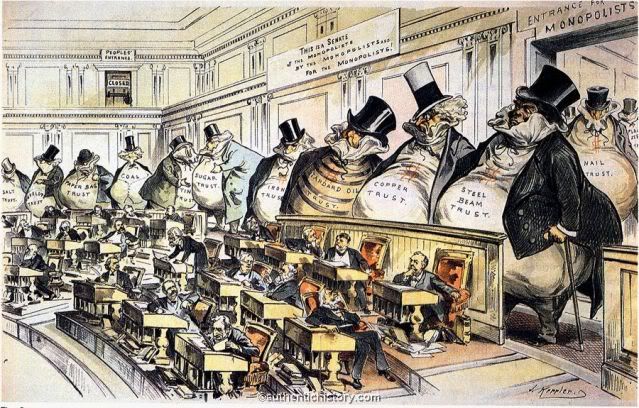
Image: Politics in the American golden age (it actually is called The Gilded Age): "Bosses of the Senate" by Joseph Keppler, 1889. Click for a larger, more legible image.

Update: a punchy cartoon comment on Confederate History Month.

Sunday, January 25, 2009

Blood and Oil: Memoirs of a Persian Prince, by Manucher Farmanfarmaian and Roxane Farmanfarmaian

Manucher Farmanfarmaian is a brother of Sattareh Farman Farmaian, author of Daughter of Persia, an autobiography that my students in the History of Islamic civilization are reading is the basis for a paper. Blood and Oil is also an autobiography, and it is at least as well-written as Sattareh's book. Manucher, as a boy, had quite a different experience of their mutual father, and of course quite a different career. Can he ever tell a story! (Roxane, his co-author, is his daughter.)

This book is recommended to anyone who read enjoyed Daughter of Persia, or is interested in Iran, or in global oil politics and the formation of OPEC. Unfortunately, the Nipissing University library does not have a copy. I got mine through interlibrary loan.

Manucher has an eye for telling detail. Here he remarks about the extraordinary generosity of friends in England who, though hardly rich, helped him with a loan when his father's death cut off his fund transfers from Iran temporarily:

Their generosity was all the more poignant because in England at the time racism was rampant. At university foreign students were shunned. We were not allowed to hold student office, and the college deans, at a meeting held at the beginning of each year, went so far as to warn girls away from us, insinuating that we were from base cultures.... it was not just the university but British society in general that held such views, from the foreman of the garage where I worked one summer to the rich lady with the Daimler who had her butler repeat everything I said because it was below her dignity to converse with me directly. All the more extraordinary, then, were the Philipses' confidence and goodwill.


And on his return trip via India during wartime:

Though in England Persians were looked upon as darkies from an inferior race and religion, here [in Bombay] we were regarded as esteemed guests -- of England of course, not India. We were invited to stay in the toniest hotels, and the doors of every chic restaurant were open as long as we wore dinner jackets or tails (which we invariably did)-- though an Indian would be thrashed were he to venture even a glance inside.