When you are trying to get into a meditative state and all you can think of is how contemptible Ron Paul is, it is time to LET IT OUT!
Ron Paul seems to be this generation's Eugene McCarthy, a politician brave enough to oppose American imperialism and denounce its destructive effects, who has attracted a deal of support from young people, and who otherwise has a rather eccentric record. The American political system has niches for politicians with unusual views, and sometimes they rise out of obscurity and have a real effect.
Ron Paul is giving libertarianism (so called) a much higher profile than it has ever had. I say so-called libertarianism because Paul's brand seems to be focused entirely on assuring, through decentralization of political power, that those who have won wealth and privilege by fair means or foul, get to keep their goodies. Is that libertarianism? If so you can keep it.
Actually, there are more objectionable parts of Ron Paul's program. For instance, "liberty" doesn't reach as far as women controlling their own bodies. It seems to me that there is a religious agenda lurking behind the libertarian facade. Liberty doesn't include the First Amendment ("no establishment of religion")?
But the one that gets me where I live is Paul's opposition to the civil rights legislation of the 1960s. It mightily offends me to hear the dishonest segregationist arguments of my youth recycled in the 2010s.
Dishonest? Paul and his son and his other supporters present their opposition to racial equality in the public sphere as a simple matter of preserving freedom of association. In fact segregation in the south was a prime example of the historic winners using state power, economic domination and terror to secure the continuation of privilege won by force of arms. And calling the result liberty. Or "states' rights."
Segregation was not a matter of individual choice, it was a policy designed and enforced by the enfranchised at the expense of the disenfranchised. To talk about segregation without acknowledging that is deeply dishonest. When (apparently) young people talk about this issue in abstract terms, I think they may have been suckered. But I don't give Ron Paul the benefit of that doubt.
Showing posts with label favorites 2011. Show all posts
Showing posts with label favorites 2011. Show all posts
Wednesday, December 21, 2011


Friday, December 02, 2011
Hard times in Attawapiskat and the government blame game

In some peculiar way, I think of Attawapiskat, a First Nations reserve, as a neighboring community, even though it is a fly in community way up on James Bay, and I can drive to Toronto or Ottawa easily on reasonably good roads. Why? Because we share the same regional CBC radio service, and for 20 years I have been hearing weather forecasts for Attawapiskat.
Currently, a lot of people are hearing about Attawapiskat and it is all bad news. People are living in shacks and tents – this is up at James Bay mind you– and the sewage situation is in a state of collapse. The band government has had to work very hard to attract the attention of senior levels of government and the general public, and now that they have, they are being blamed for bad management and wasting the money that the government gives them.
When I said the government "gives" them money, you have to remember that what the First Nations "give" in return is – Canada. People are always saying that we non-natives "give" money to natives, but you seldom hear people talking about the money senior levels of government "give" to Toronto or the Township of Bonfield, even though those "gifts" are a very significant part of the budget of both municipalities.
Our Prime Minister wants us to believe that this is all to be blamed on native mismanagement. If you want a better understanding of the roots of the problem I recommend this blog entry. Or you could just look at the band documents. Apparently the Prime Minister has not bothered yet.
Sunday, November 20, 2011
Smarter protest, please
Phil Paine, continuing this earlier post:
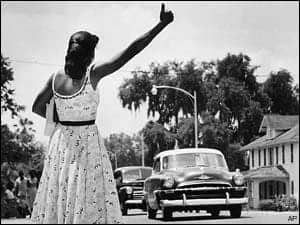
 Image: Boycotting the segregated bus system, 1955
Shakespeare didn’t have Romeo and Juliet commit suicide in the first act, and then let the remaining characters pitch tents on the stage and chat aimlessly for the remaining four acts. That was because Shakespeare was a dramatist. His aim was to move people to emotion, to make them think, to shock, horrify, or delight them. Let us, for the sake of argument, assume that he was pretty good at it. Today’s protesters could learn a thing or two from him.Read the whole thing.
As I mentioned in Part 1, the Occupy protest movement began by taking advantage of new methods (the social media), and then quickly reverted to an old formula. The advantage that social media offered was the ability to bring people together quickly to do some strategic and dramatic thing —- to surprise. The “flash mob” is the appropriate template for a protest using social media. The flash mob originated as an amusement —- one in Toronto called people to a pillow fight in front of the Eaton Centre. There have been some political protests using this technique, and these have been dubbed “smart mobs,” but their use has been very limited, so far. The key to the flash mob’s effectiveness is its ability to end as dramatically as it begins. This leaves those in authority disconcerted, and makes them look incompetent. It has the same advantage in protest that guerilla tactics can have in military conflicts.
The Occupy movement has squandered the opportunity to move into the modern age of protest. Social media were used to bring people together, but once there, power reverted to the traditionalists, and the only thing they could think of doing was squatting down and staying put. The smart mob turned into a “sit in,” a protest relic from a generation ago that is notorious for its ineffectiveness and tendency to alienate the very people that the protest is supposed to convince.
...
If you speak to these old-schoolers, it won’t be long before you hear them prattle nonsense about how they are continuing the traditions of the Civil Rights Movement in the 1950’s and 1960’s. They are deluding themselves. The Civil Rights activists were not amusing themselves. They did not go out on picnics. They were dealing with the Ku Klux Klan, and with corrupt and violent state governments in the American south. They were in constant danger. Civil Rights activists faced the serious possibility of being tortured or killed. Everything done was aimed at projecting an atmosphere of seriousness of purpose, and of clearly delineating the moral issues involved. Anyone who wants to see real protest in action could do no better than to study the events of the Montgomery Bus Boycott of 1956. Protests like this led to a gigantic transformation of American society, one of the most dramatic in world history. Take note of the fact that Martin Luther King, Jr. and Ralph Abernathy did not organize catfish fry-ups, sponsor watermelon eating festivals, or instruct their followers to dance the madison. They did not paint themselves blue. They rationally, intelligently, and bravely, calculated which actions would produce the desired results, and undertook them, making huge personal sacrifices to do so. The American public came to realise that it was the State Governments and the Klan who were the savages, the forces of chaos.
I have become progressively more annoyed with the Occupy movement because of its utter failure to heed these simple and obvious facts. We desperately need to get the American and Canadian public to understand the trouble we are in, and the dangers we face over the coming years. Intelligent protest is one of the things that has to be done. I’ve outlined some of the reasons why the protest we are seeing is not intelligent or effective. Next, in Part 3, I will discuss the types, dynamics, and structure of protest.
Sunday, November 06, 2011

Tuesday, October 18, 2011
The taking of Jerusalem, 1099
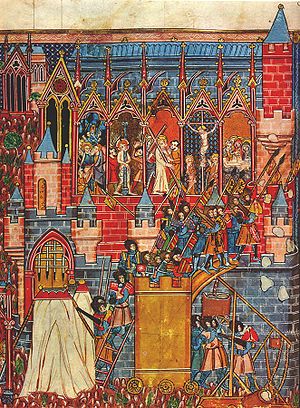
People often wonder how medieval Christians could have taken part in holy war, given Jesus's well-known pacifistic pronouncements. Here are excerpts from a lecture I gave yesterday on the taking of Jerusalem, which ended in a massacre, which touches on the issue:
Here’s what Tyerman (page 31) says about a famous Christian account of the massacre:
Raymond of Aguilers… who witnessed the fall of Jerusalem in 1099, described the ensuing massacre on the Temple Mount: "it is sufficient to relate that in the Temple of Solomon and the portico crusaders rode in blood to the knees and bridles of their horses." What ever the atrocities performed that day, Raymond was quoting Revelations 14:20 "and the winepress was trodden without the city and the blood came out of the winepress even to the horse bridles."
Two further points:Comments? [No comments from students.]
Here are my comments. Massacres of garrisons and the civil population of fortifications and cities that had resisted for a long time were pretty common in medieval times. According to the laws of war (or the customs of war) those who resisted, even if they were not armed and had no authority or say in the waging of war, brought the consequences of such resistance upon themselves. It was kind of a no-win situation because people who surrendered too quickly to a threat of siege might invite the revenge of their rulers if the rulers won the war eventually. But to focus on the other situation: we've already seen in this course that a siege was a hard task and a dangerous one even for the people outside. I sometimes joke that it is no real joke that sieges came down to who caught dysentery first, the people outside in their squalid camps, or the people inside crowded together in bad conditions. Besiegers died in significant numbers in a hard siege, and the numbers went up significantly if there were a number of unsuccessful assaults. Besiegers became targets for missiles thrown at them from above, and insults meant to break the morale and boost morale on the other side. When besiegers swarmed into a city through a gap in the walls or by the treachery of the tower commander, that they were not in a good mood all. All the anger fear and hardship came together in a murderous rage and perhaps a sudden feeling of invulnerability. Like hunters, they fell upon their prey, animate and inanimate.Further remark is necessary in the case of Jerusalem, however. Modern observers from the historically Christian environment often expressed wonder that the religion of peace and my kingdom is not of this world could have inspired warfare. Forgetting entirely about Muslim and Jewish accounts of the slaughter of Jerusalem, we can see just from Christian accounts that not only did nominal Christians take part in mass murder like anyone else, they felt more justified in doing so in this case because they had scriptural authority behind them. Those who took part and had read their Bible knew that this was God's will.
- Any important and popular religion contains a multitude of contradictory elements that can be used to justify all sorts of actions.
- People who study religion or are particularly pious or are opposed to some specific religion often act like a person or group can be completely characterized as "Christian" or "Muslim" or "Shiite" or whatever. Not so. Those Crusaders at Jerusalem liked to think of themselves as Christians, bound by the law of God, but also as warriors, subject to the customs of war. This should be obvious, but the way people talk, it clearly isn't.
Sunday, October 02, 2011

Saturday, October 01, 2011
The threat of sectarian violence in Syria
From Foreign Policy, via Brian's Coffeehouse:
From the start of the Syrian revolution, the Assad regime's media have portrayed the overwhelmingly peaceful grassroots protest movement as a foreign-backed military assault. Its preferred catchall term to describe the tens of thousands of patriots it has kidnapped and tortured, as well as the thousands it has murdered, is "armed gangs." Despite a series of televised "confessions," the regime has not provided any serious proof of the supposed American-French-Qaeda-Israeli-Saudi-Qatari plot against the homeland. Nor has it explained the evident contradictions between its narrative and the thousands of YouTube videos and eyewitness accounts of security forces shooting rifles and artillery straight into unarmed crowds.
Of course it hasn't. Yet its propaganda is taken seriously by Russian and Chinese state media, certain infantile leftists, and a vaguely prominent American academic.
Tragically, the propaganda is also taken seriously by members of Syria's minority sects -- not by all of them by any stretch, but perhaps by a majority. It's tragic because perceived minority support for this sadistic regime will inevitably tarnish intersectarian relations in Syria in the future.
Those Sunni Syrians who are (understandably) enraged by the minorities' siding with the dictatorship should remember first that many Alawis and Christians, as well as many more Druze and Ismailis, have joined the revolution and that many have paid the price. Second, Sunnis should remember that Alawis and Christians have good reason to fear change, if not to believe the propaganda.
Alawis have a complex, esoteric religion that throughout history has been savagely denounced, and its adherents savagely oppressed. Ultimately it's a matter of political interpretation whether or not Alawis are to be considered Muslims. The Ottoman Empire didn't even consider them "People of the Book," which meant that unlike Christians, Jews, and mainstream Shiites, Alawis didn't enjoy any legal rights. The ravings of the influential medieval scholar Ibn Taymiyya (who thought Alawis were "greater disbelievers than the Jews, Christians, and Indian idol-worshipping Brahmans") contributed to their oppression and justified the theft of their lands around Aleppo and their forced retreat into the mountains. Until the 1920s, the Alawis were stuck in those mountains. Antakya (Antioch) was the only city where Alawis lived with Sunnis, and Antakya was gifted by France to Turkey before the independence of the modern Syrian state.
Most Alawis today are not particularly religious. Far from pushing Alawi tenets on the general populace, the Assads discouraged the study of the faith and repressed the traditional Alawi clerics. As a result, if individual Alawis do turn to religion, most tend to practice Sunni or mainstream Shiite rituals.
Of course, as far as the business of state is concerned, it should be entirely irrelevant whether or not Alawis are Muslims or even People of the Book. As Syrian citizens they should be guaranteed the same rights and the same access to political office as anyone else. It would help a great deal if revolutionary leaders and Sunni clerics were to state this as clearly and as often as possible. The blatant anti-Alawi sectarianism of Sheikh Adnan al-Arour (given prominence by Saudi Arabia) and Sheikh Yusuf al-Qaradawi (given prominence by Al Jazeera), both supposed friends of the revolution, does not help at all. Speaking to "those [Alawis] who stood against us," Arour recently promised, "I swear by God we will mince them in grinders and feed their flesh to the dogs."
The one thing the regime has done intelligently in the last six months is to play on minorities' fears. ...
The two scenarios that most terrify the minorities (and almost everyone else) are, first, the rise of intolerant Islamism, and, second, sectarian civil war. Unfortunately, both scenarios become more likely with every moment the regime remains in power. The experience of being shot at, besieged, and tortured will inevitably drive some toward more extreme views. In addition, the military units slaughtering the people are overwhelmingly Alawi and commanded by Alawis. The regime's shabiha militias in Hama, Homs, and Latakia are Alawis recruited from the surrounding villages. These are the people torturing Sunni women and children to death, burning shops and cars, beating and humiliating old men. Their actions will have consequences. If the regime falls soon, the consequences will be legal and targeted solely at the guilty. If the regime doesn't fall soon, the consequences may be violent, generalized vigilante "justice." Then Iraq and Lebanon will become Syria's models.
Friday, September 16, 2011
Not to be missed: conjuring up Rome in AD 600

Dr. Beachcombing imagines the near-ghost town it must have been:
Let’s take the lowest sensible estimate for classical Rome – half a million – and the highest for Rome c. 600, about 50,000. That means that the population has not only been decimated, but that it had been decimated nine times over. And what is more these heirs of Rome (as fashionable ‘late antique’ historians call them) were resident in an echo box; a city that they no longer had the technology to repair, let alone recreate, where nine out of every ten residences were empty, where three and four story buildings gradually keeled over into the streets and where the Parthenon and the Coliseum looked down mockingly on the little people below, not so much dwarfs on giants’ shoulders, as blue-bottles buzzing around a cow’s backside.
Then, remember, perhaps the actual population of Imperial Rome was more like a million and the population of Rome c. 600 was more like ten thousand, a hundredth of what it had been. The psychopathic Anglo-Saxon guard, the tourist from Scythia and the Pope and his tiny administration could shout as loud as they wanted and no one would have heard them in their ghost town. No one was listening, not even the red baked tiles made in a happier age.I have recently lived across the river from Detroit...so this is evocative. Detroit is not, however, quite so echoic.
Parthenon presumably should be Pantheon (above).
More on ancient population estimates in a later post.
Saturday, September 10, 2011
A taste of revolution
Football fans taunt the police in Cairo:
Discussed in detail and translated at Arabist.net.
Update: Chanting, voting, and ancient church councils.
Discussed in detail and translated at Arabist.net.
Update: Chanting, voting, and ancient church councils.
Sunday, August 28, 2011
There was a time in this fair land when surveyors were national heroes

Not to mention engineers.
I'm talking Colonel By, children.
There is a World Heritage site in the province of Eastern Ontario that most Canadians are oblivious to -- the Rideau Canal that connects Kingston on Lake Ontario to Ottawa on the Ottawa River. It was built in the 1820s and 30s as a military route that would be less vulnerable to American attack. The job was entrusted to an English army engineer who accomplished the task of connecting lakes and rivers with canals and dams, thanks to the efforts of many navvies (= "navigators"), in short order (only to find himself being investigated for overspending).
And it is still all there in all its 19th century glory!
All but three of the locks are worked by human beings turning iron cranks by hand. One of the explanatory signs canal-side calls this "brute force," but really there is nothing brute about it. The locks are so well-engineered that they move quite elegantly, and it really doesn't look like that much work -- though I am sure that it builds core strength in the university-age people who are there for the summer season.
In lovely contrast to the iron, timber and stone tech is the landscape that it goes through. Parts of the canal system goes through intensively cultivated areas, but lots goes through what almost looks like wilderness. Only very occasionally do roads cross the canal, and so if you are on a boat you feel like you are in a world apart from busy 21st century Canada.
Image: Crabs or hand winches at Davis Lock; photo thanks to Paul Watson.
Monday, July 25, 2011
Ideology
Boris Johnson in the Telegraph, on the Norwegian "Templar:"
But then read the comments...
It is not enough to say he is mad. Anders Breivik is patently mad: no one in their right mind would behave as he has done. Nor is it enough to say that he is evil. If the word evil has any meaning at all, then it must obviously apply to a man who can go to a lake island summer camp, call innocent young people to run towards him – and then shoot 85 of them with an automatic rifle.
We will never be satisfied with simple words like “mad” or “evil”, and for the days and weeks ahead we can expect exhaustive psychoanalysis of this dreary and supercilious 32-year-old sicko. We will summon and interview all the potential hobgoblins of his mind. With the help of the Norwegian investigators, we will try to understand how these demons persuaded him to engage in an act of such premeditated cruelty; and as our guide we will use the 1,500-page manifesto of hate that he (and possibly his accomplices) have posted on the internet.
It is in many ways a preposterous document, with its plan to revive the ancient order of the Knights Templar, with Breivik as “Justiciar Knight”. The idea is to mobilise an army of similar loathsome berks and to liberate Europe of immigrants by 2083. It seems that this is the 200th anniversary of the death of Karl Marx, whom Breivik blames for egalitarianism, feminism, multiculturalism and all manner of other things he dislikes. Breivik’s attempt at Mein Kampf is awash with Wikipedia-generated teenage ruminations about Gramsci, Adorno and Islam, and I must confess I have not slogged all the way through to the end.
But I have read enough to grasp the gist – and there is something both curious and troubling in his obsessions. He goes on and on about the EUSSR and “Eurabia”. He attacks multiculturalism as a “big lie”, and asserts that “political correctness now looms over Western European society like a colossus”. “Can the European Union be reformed?” he asks. “I doubt it. The EU is bound together by a self-serving class of bureaucrats who want to expand their budgets and power, despite the harm they do.” He claims that Europe has been systematically betrayed by mass immigration from Muslim countries, and that the method of this immigration has been concealed from the electorate. He cites a great many British commentators to make his points. Indeed, it is fascinating to see how rooted is this Norwegian extremist in the political discourse of the Anglosphere.
My friends, there is no easy way of saying this: a lot of what this evil nutcase says could be drawn from the blog-post threads that you will find in the media, especially the “conservative” media, in Britain. Some people will read his dismal expectorations and conclude that this inflammatory guff is what really drove him on. They will say that his barbarism was spurred by fury at the EUSSR and immigration, just as the murders of 9/11 were triggered by the various tenets of Islamic extremism.
It is certainly true that on the face of it he has much in common with some recent Islamic suicide bombers. He is disturbed by female emancipation, and thinks women would be better off in the home. He seems to be pretty down on homosexuality. Above all – and in this he strongly resembles an Islamist – he believes that his own religious leaders are deeply decadent and have deviated from orthodoxy. He is repelled, like so many Muslim terrorists, by anything that resembles the mingling of cultures.
People will say that we are looking at the mirror image, in fact, of an Islamic terrorist – a man driven by an identical but opposite ideological mania. There is certainly a symmetry here, and yet in both cases, Breivik and the Muslim bomber, I don’t think that ideology is really at the heart of the problem. Yesterday the television reporters found an acquaintance of his from Norway, a fellow called Ulav Andersson, who said that he had known Breivik pretty well. He was surprised by all the Knights of Templar stuff, because he had never really been religious, and he wasn’t aware that he had been interested in politics.
“He didn’t seem opinionated at all,” he said. He just became chippy and irritable, said Ulav Andersson, when some girl he had a crush on jilted him in favour of a man of Pakistani origin.
It wasn’t about immigration, or Eurabia, or the hadith, or the Eurocrats’ plot against the people. It wasn’t really about ideology or religion. It was all about him, and his feeling of inadequacy in relation to the female sex. The same point can be made (and has been made) about so many of the young Muslim terrorists. The fundamental reasons for their callous behaviour lie deep in their own sense of rejection and alienation. It is the ideology that gives them the ostensible cause, that potentiates the poison in their bloodstream, that gives them an excuse to dramatise the resentment that they feel in the most powerful way – and to kill.
There is an important lesson, therefore, in the case of Anders Breivik. He killed in the name of Christianity – and yet of course we don’t blame Christians or “Christendom”. Nor, by the same token, should we blame “Islam” for all acts of terror committed by young Muslim males. Sometimes there come along pathetic young men who have a sense of powerlessness and rejection, and take a terrible revenge on the world. Sometimes there are people who feel so weak that they need to kill in order to feel strong. They don’t need an ideology to behave as they do.
Michael Ryan had no ideology in Hungerford; Thomas Hamilton had no ideology in Dunblane. To try to advance any other explanation for their actions – to try to advance complicated “social” factors, or to examine the impact of multiculturalism in Scandinavia – is simply to play their self-important game. Anders Breivik may have constructed a portentous 1,500 page manifesto, but like so many others of his type he was essentially a narcissist and egomaniac who could not cope with being snubbed. We should spend less time thinking about him, and much more on the victims and their families.
But then read the comments...
Wednesday, July 20, 2011
An 18th century challenge between the armies
At the historic site called Beamish, in County Durham, there is a gentleman's house recreated to the era of the 1820s. It's not very big or very impressive, but it has pretention. Part of that is mediocre but fashionable -- or maybe just past fashionable -- art in the form of engravings.
One of them is a single sheet illustrated and captioned recording the 18th century military careers of Belgrade and Clumsy. Belgrade was a widow (?) who continued to follow the British army after she lost her husband. The engraving celebrates her role in rescuing and caring for wounded soldiers.
Clumsy was her dog. And what a dog! At the battle of Dettlingen, as French and English armies faced each other, a dog emerged from the French lines and began to berate the English in dog fashion. Clumsy was having none of it. He went out, beat up the French dog, chased him away, and then calmly returned to the English lines.
The English went on to win the battle.
You can't make this stuff up. Well, I didn't. But just as I saw every modern re-creation and restoration at every historical site I visited in Britain, I can't help seeing Deeds of Arms everywhere.
One of them is a single sheet illustrated and captioned recording the 18th century military careers of Belgrade and Clumsy. Belgrade was a widow (?) who continued to follow the British army after she lost her husband. The engraving celebrates her role in rescuing and caring for wounded soldiers.
Clumsy was her dog. And what a dog! At the battle of Dettlingen, as French and English armies faced each other, a dog emerged from the French lines and began to berate the English in dog fashion. Clumsy was having none of it. He went out, beat up the French dog, chased him away, and then calmly returned to the English lines.
The English went on to win the battle.
You can't make this stuff up. Well, I didn't. But just as I saw every modern re-creation and restoration at every historical site I visited in Britain, I can't help seeing Deeds of Arms everywhere.
Sunday, July 17, 2011
Beamish and Puffing Billy!
In County Durham there is an amazing outdoor museum called Beamish, where various structures have been relocated and restored.
So there is an Edwardian high street, a coal mine of the 1850s, a "home farm" of the late 19th century, a Georgian-era gentleman's country house of the 1820s, and more.
Somehow I managed to miss this amazing place until now.
One of the best parts for me were the vehicles and the steam engines. The high point, a ride on an 1820s train pulled by Puffing Billy!

So there is an Edwardian high street, a coal mine of the 1850s, a "home farm" of the late 19th century, a Georgian-era gentleman's country house of the 1820s, and more.
Somehow I managed to miss this amazing place until now.
One of the best parts for me were the vehicles and the steam engines. The high point, a ride on an 1820s train pulled by Puffing Billy!

Thursday, July 07, 2011
Goodricke and Constantine without honor in their own city
Today I went on a free guided tour of York, provided by one of the many volunteers who have been providing this service since 1950 (!). Well worth the time and I'm grateful to the organization and our guide.
However, I must say that he had me biting my tounge more than once with his version of York history (and of his weakness for terrible folk etymologies no more will be said). My faith in his knowledge of his home town's history -- and he called himself a local historian -- was given a shock when he called Athelstan a Viking king. I mean, is there a more (Old) English name? If, dear reader, you were a volunteer guide at York, I believe you would not make this mistake.
Nor, I hope, would you try to be relevant by saying that Henry VIII used the loot from the Dissolution of the Monasteries "to found the Oxbridge Consortium." Would you?
It's odd what people include, and don't. Maybe there was no archaeological or architectural hook to bring in the Pilgrimage of Grace, but I bet I could find one. (Just sitting here I now have one.) But how can you say that the late Roman HQ was found under the Minster in the late 1960s, and not mention that Constantine was elevated to the emperorship in York? This has got to be one of the most important things, on a world-historical scale, to ever happen in the city. But it went unmentioned.
And about the same time Constantine was being ignored, we were standing in front of the Treasurer's House in the old ecclesiastical enclave, also ignoring a sign that said John Goodricke worked there in the 1780s on Cepheid variables, the discovery of which eventually provided an astronomical yardstick to estimate the size of the universe. Talk about world-historical.
I should study up and volunteer myself...
Challenge: look up Henrietta Swan Leavitt, who should have got a Nobel Prize. No York connection.
However, I must say that he had me biting my tounge more than once with his version of York history (and of his weakness for terrible folk etymologies no more will be said). My faith in his knowledge of his home town's history -- and he called himself a local historian -- was given a shock when he called Athelstan a Viking king. I mean, is there a more (Old) English name? If, dear reader, you were a volunteer guide at York, I believe you would not make this mistake.
Nor, I hope, would you try to be relevant by saying that Henry VIII used the loot from the Dissolution of the Monasteries "to found the Oxbridge Consortium." Would you?
It's odd what people include, and don't. Maybe there was no archaeological or architectural hook to bring in the Pilgrimage of Grace, but I bet I could find one. (Just sitting here I now have one.) But how can you say that the late Roman HQ was found under the Minster in the late 1960s, and not mention that Constantine was elevated to the emperorship in York? This has got to be one of the most important things, on a world-historical scale, to ever happen in the city. But it went unmentioned.
And about the same time Constantine was being ignored, we were standing in front of the Treasurer's House in the old ecclesiastical enclave, also ignoring a sign that said John Goodricke worked there in the 1780s on Cepheid variables, the discovery of which eventually provided an astronomical yardstick to estimate the size of the universe. Talk about world-historical.
I should study up and volunteer myself...
Challenge: look up Henrietta Swan Leavitt, who should have got a Nobel Prize. No York connection.
Wednesday, June 22, 2011
Foreign Policy cover story: explaining the fall of the Soviet Union
Some of my readers will surely want to read Leon Aron's article in Foreign Policy,
Everything You Think You Know About the Collapse of the Soviet Union Is Wrong*And why it matters today in a new age of revolution.
A sample:
Everything You Think You Know About the Collapse of the Soviet Union Is Wrong*And why it matters today in a new age of revolution.
A sample:
LIKE VIRTUALLY ALL modern revolutions, the latest Russian one was started by a hesitant liberalization "from above" -- and its rationale extended well beyond the necessity to correct the economy or make the international environment more benign. The core of Gorbachev's enterprise was undeniably idealistic: He wanted to build a more moral Soviet Union.
For though economic betterment was their banner, there is little doubt that Gorbachev and his supporters first set out to right moral, rather than economic, wrongs. Most of what they said publicly in the early days of perestroika now seems no more than an expression of their anguish over the spiritual decline and corrosive effects of the Stalinist past. It was the beginning of a desperate search for answers to the big questions with which every great revolution starts: What is a good, dignified life? What constitutes a just social and economic order? What is a decent and legitimate state? What should such a state's relationship with civil society be?
"A new moral atmosphere is taking shape in the country," Gorbachev told the Central Committee at the January 1987 meeting where he declared glasnost -- openness -- and democratization to be the foundation of his perestroika, or restructuring, of Soviet society. "A reappraisal of values and their creative rethinking is under way." Later, recalling his feeling that "we couldn't go on like that any longer, and we had to change life radically, break away from the past malpractices," he called it his "moral position."Does this sound like some of the stuff coming out of the Arab Spring? You betcha:
In a 1989 interview, the "godfather of glasnost," Aleksandr Yakovlev, recalled that, returning to the Soviet Union in 1983 after 10 years as the ambassador to Canada, he felt the moment was at hand when people would declare, "Enough! We cannot live like this any longer. Everything must be done in a new way. We must reconsider our concepts, our approaches, our views of the past and our future.… There has come an understanding that it is simply impossible to live as we lived before -- intolerably, humiliatingly."
The fruit-seller Mohamed Bouazizi, whose self-immolation set off the Tunisian uprising that began the Arab Spring of 2011, did so "not because he was jobless," a demonstrator in Tunis told an American reporter, but "because he … went to talk to the [local authorities] responsible for his problem and he was beaten -- it was about the government." In Benghazi, the Libyan revolt started with the crowd chanting, "The people want an end to corruption!" In Egypt, the crowds were "all about the self-empowerment of a long-repressed people no longer willing to be afraid, no longer willing to be deprived of their freedom, and no longer willing to be humiliated by their own leaders," New York Times columnist Thomas Friedman reported from Cairo this February. He could have been reporting from Moscow in 1991.
"Dignity Before Bread!" was the slogan of the Tunisian revolution.I can't help thinking of something else I read today, from a satire on American politics by Jim Wright:
Hell, Huntsman [a newly-announced GOP candidate for President] is even an Eagle Scout.
But, he’s far too liberal for conservatives.
And he’s far too conservative for liberals.
Maybe he could overcome that.
But this morning, in front of the Statue of Liberty, he committed an unforgivable sin. Beneath the shining symbol of America Jon Huntsman called for polite political discourse and promised to run a civil campaign.
Huntsman didn’t vilify his former boss, instead he claimed that both he and President Obama love their country, but have different visions for its future.
As outrageous as that was, Huntsman went even further. He crossed the line and said 2012 is about “who will be the better president, not who’s the better American.”
That’s when the crack appeared in the earth and an ominous rumbling began as the flying monkeys stirred in the fiery deep.
Huntsman said, "Our political debates today are corrosive and not reflective of the belief that Abe Lincoln espoused back in his day, that we are a great country because we are a good country."
Can you imagine?
Can you imagine a civil campaign. Can you imagine how boring it would be? Without the vitriol and exaggerations? Without the lies and hyperbole? Who would we hate? Who would we cheer?
Act like civilized adults? That’s no democracy!
Americans don’t want civil discourse.
And they sure as hell don’t want to see candidates who refuse to engage in mudslinging, brawling, and fear mongering. Fight you bastards, don’t just stand there! Fight! Fight!
Americans don’t want moderates! We want extremists!
We demand to know who is the better American!
There can be only one.
Oh, and we want flying monkeys.
Saturday, June 04, 2011
Rethinking the Crusade environment in the light of the Arab Spring

(And the other thing that stuck with me from recent reading about Syria is the fear and loathing that so many have for the idea of an Islamic Republic; as logically follows.)
Well, I knew about many of these internal religious divisions, but hearing people discussing it NOW, and urgently, has made a big impact on my effective understanding of the "Muslim Middle East," to wit, I now think a lot, in the front of my mind about the fact that however important Islam has been in the Middle East since the 7th century, and however sweeping the claims various Muslims have made, and whatever wishes for an Islamic society have been wished, it's always been at least this divided. The divisions haven't always been active, but like so many fault lines in an earthquake-prone region, they've been there.
Think about the religious history of the United States, as another instance. So many people think it can or should be summed up in a phrase. How wrong they are.
So what does this have to do with the Crusade era, which I will again be teaching in the fall? I will have to think about something that Christopher Tyerman has said in a couple of places -- that the rulers and political and military actors "on both sides" were immigrants or recent descendants of such. And if religious justifications for their actions and regimes were important (if not always appealed to), it is just wrong, wrong, wrong to attempt to explain the developments of the era merely by casting it as two religiously homogenous societies battling it out. Even if that was the way some contemporaries, and influential ones at that, visualized reality.
It will be a challenge to strike the right balance.
Image: The Assad family, late 20th century -- Syria's most famous Alawis, a term you should look up.
Thursday, June 02, 2011
War in heaven
A Turkish Facebook friend linked to this. I have a strong suspicion that this is how the beautiful billionaires and their beautiful acolytes actually live -- and compete.
Update: I know what this reminds me of -- the movie Blood of Heroes...not the fighting, but the Podunk aristocrats who hung around the competitors.
Update: I know what this reminds me of -- the movie Blood of Heroes...not the fighting, but the Podunk aristocrats who hung around the competitors.
Tuesday, April 26, 2011
A tragic Civil War?
Ta-Nehisi Coates says no:
Yesterday, Robert Zimmerman was kind enough to link this podcast on the Civil War, and the reasons soldiers, Union and Confederate, offered up for fighting. It's a good segment which I heartily recommend, especially for those of us in the Effete Liberal Book Club. That said, one thing struck me about the conversation, which inevitably comes through any time smart people gather to discuss the Civil War. The conceded common ground was the following--The Civil War was a tragedy.
I think that ground is generally accepted by almost everyone, and for good reasons. Six hundred thousand people died in the Civil War, a shocking figure which doesn't really capture the toll that this sort of violence took on the country at large. And yet when I think about the Civil War I don't feel sad at all. To be honest, I feel positively fucking giddy.
And I don't think I'm abnormal because of this. Twenty-two thousand people died in the Revolutionary War, and we celebrate that with hot dogs and hamburgers every year. I'm sure that while Jews feel fairly horrible that the Holocaust happened, very few of them consider the fighting it took in order to liberate the death camps, "tragic." The Holocaust is tragic. Ending the Holocaust is not.
In that fashion, from my perspective, the most trenchant facts of the Civil War is not that it turned "brother against brother," or that it produced a plethora of great military minds, or even that it produced arguably our greatest leaders. In sum the most trenchant facts, for me, are as always t emanate from this:
Our position is thoroughly identified with the institution of slavery-- the greatest material interest of the world. Its labor supplies the product which constitutes by far the largest and most important portions of commerce of the earth. These products are peculiar to the climate verging on the tropical regions, and by an imperious law of nature, none but the black race can bear exposure to the tropical sun. These products have become necessities of the world, and a blow at slavery is a blow at commerce and civilization. That blow has been long aimed at the institution, and was at the point of reaching its consummation. There was no choice left us but submission to the mandates of abolition, or a dissolution of the Union, whose principles had been subverted to work out our ruin.
this:
Our new government is founded upon exactly the opposite idea; its foundations are laid, its corner- stone rests, upon the great truth that the negro is not equal to the white man; that slavery subordination to the superior race is his natural and normal condition. This, our new government, is the first, in the history of the world, based upon this great physical, philosophical, and moral truth...
And this:
You cannot make soldiers of slaves, or slaves of soldiers. The day you make a soldier of them is the beginning of the end of the Revolution. And if slaves seem good soldiers, then our whole theory of slavery is wrong.
It's really simple for me. One group of Americans attempted to raise a country on propoerty in Negroes. Another group of Americans, many of them Negroes themselves, stopped them. As surely as we lack the ability to see tragedy in violently throwing off the yoke of the English, I lack the ability to see tragedy in violently throwing off the yoke of slaveholders.
For most Americans, the Civil War is sudden outbreak of a existential violence. But for 250 years, African-Americans lived in slavery--which is to say perpetual existential violence. I don't know what else to call a system that involves the constant threat of your children, your parents, your grandparents, being sold off, never for you to see them again. That is death.
Malcolm X was fond of saying that that there was no such thing as a "bloodless revolution." I don't know if that's true, but it surely was true of black people. The Civil War is our revolution. It ended slavery, and birthed both modern America, and modern black America.
That can never be tragic to me.
Thursday, March 10, 2011
A queen of Carnival
The Big Picture has a collection of striking pictures of Carnival celebrations in a number of places around the world. They are all worth looking at, but I was particularly taken by these two pictures of Carmen Eneida Carballo Rivero of Tenerife in the Canary Islands, featuring her costume Flashes of Atlantis:

 For any of a number of reasons, wow.
Don't forget to click to see the pictures large size.


Don't forget to click to see the pictures large size.
Wednesday, March 02, 2011
You've gotta watch out -- don't even trust yourself
During a long car ride last weekend I was listening to CBC One. What should come on but a series of mini-interviews with young kids about how they would improve the world if they could.
One youngster said he/she would get rid of everything bad. How?
"Lots of cops and cameras everywhere."
From idealistic kid to Robespierre in about 15 seconds.

Image: St. Just, Robespierre's young sidekick.
One youngster said he/she would get rid of everything bad. How?
"Lots of cops and cameras everywhere."
From idealistic kid to Robespierre in about 15 seconds.
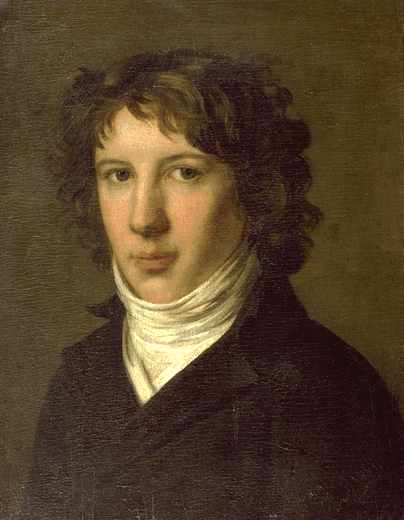
Image: St. Just, Robespierre's young sidekick.
Subscribe to:
Posts (Atom)