Gotta hand up by Dear Old Dad. Actually his predecessor was his UNCLE Justin who has to be accounted a self-made man. It would be ludicrous to attach the same adjective to the older man.
Persecution of heretics and Jews -- admittewly pretty standard activity of Christian and evew some pagan emperors; indulged in by the Persians, too. I'd rate "compiling an enemies list," reasonably comparable to persecution I'll state right at the beginning that I'm not inclined to give monarchs the benefit of the doubt, especially if they have reputations as great comquerors. especially when the ministers of the crown have no evidence and act on malice, to please the monarch. Reconquest of Italy, Sicily, North Africa (Tunisia and part of Algeria). Justinian had very talented generals, Belisarius and Narses, but when war broke out with Persia resources ran short and Italy was wrecked. Comparison --too many wars? The Art -- especially the basilica of Hagia Sophia (Holy Wisdom) and the mosaics at Ravenna Justinian claimed credit for the basilica in grandiose terms by asserting his superiority to Solomon, who built the Temple of God at Jerusalem. That statement makes sense, since monuments of this sort are often credited to the people who finance them. Justinian however comes out on top in on taste. We can't be sure about Old Justinian's personal taste or influence on design (but do you really think he didn't have the final word on every aspect of the project?). The new emperor's taste seems to involve breaking old stuff he disapproves of and slapping more gold on things he thinks need it. Showed contempt for the institutions and precedents of the Roman legal tradition. Sure, it's called the Code of Justinian, but he didn't write it. The lawyers who created it produced a lasting and influential compilation. Justinian's personal contribution to lawmaking included changing the laws of marriage to enable him, a respectable senator (appointed by Justin!), to marry a notorius actress/courtesan (Theodora). During his own reign he abolished the office of consul, the oldest and formerly the highest position in the state ever since the abolition of the kingship. A contemporary speaks. Procopius, a courtier, wrote three works on the m Justinian regime, a massive book on the wars, a shorter the bbuildings and a third on the Secret History, which told the readers the TRUTH: the emperor was a demon. Now Procopius in his public works comes across as very educated in the Greek classical tradition; his "secret" (real?) opinions make him look malicious or hysterical. I don't know if any writer or commentator who is part of the current regime, puts a good face on it, but will be revealed as hysterical when his true opinions are revealed in the post-Trump era. There will be a famous work on the current regime, but can it be written by a talented insider? Is there such a person? Hardly seems possible. LOTS MORE COULD BE SAID.
Showing posts with label roman empire. Show all posts
Showing posts with label roman empire. Show all posts
Tuesday, February 17, 2026
The New Justinian
I have been writing a history of the Middle Ages, meant for people who are interested, bright but not necessarily well-informed. It's going to have many pictures and maps, selected quotations by famous or interesting medieval people.
But not footnotes. I'm not going to use all the academic structure. I'm lazy, in poor health, and my intended readers wouldn't care.
Just today it occcured tp me that there are more than a few resemblances between the Roman (Byzantine) emperor and Justinian I (527-565 CE) and Donald Trump.
Justinian is basically known for his conquest of important provinces that the empire had lost in the previous century and some spectacular official and religious art.
Let's have a look at some of these accomplishments, and make some rough comparisons.


Thursday, January 26, 2023
Taylor Swift and Theodora Augusta
Lots of people complaining the last little while about the Taylor Swift concert and the role of Ticketmaster in distributing tickets for her first live appearance since before the outbreak of COVID-19. Lots of people blamed Ticketmaster and its near-monopoly position in the live entertainment business for their inability to get tickets. Earlier this week a high-ranking officer of Ticketmaster was summoned before a Congressional committee to justify the company’s role in the fiasco. Ticketmaster was sarcastically congratulated for bringing together the two parties to work on a common solution for a common problem.
The radio report I heard today also noted that Taylor Swift had 11 costume changes in the course of the show.
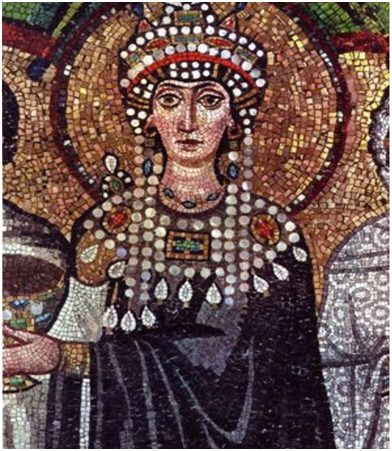
Maybe it was this, or the idea that Taylor Swift was the one unifying factor in the public life in the Disunited States, but I immediately thought of Theodora, empress to Justinian in the mid-6th century.
Theodora was a scandalous figure or a giant among Roman rulers, take your pick. She started out poor and did many low-class jobs until her looks got her into prostitution and acting. She drew attention from the kind of rich and important men who wanted a really striking courtesan or mistress. The man who got Theodora (or vice-versa) was Justinian, part of a nascent military dynasty. He was so enamored of her that he married her, despite laws that supposedly forbade a senator (J) from marrying a prostitute. When Justinian became emperor, Theodora became a major influence on him.
We have no idea what her stage costumes looked like in her acting days, but we get an idea of her tastes from a famous mosaic in Ravenna, Italy.
Next, Taylor Swift.
Not likely to end up as empress, but her ability to shake up the dysfunctional
American Congress is remarkable. I wonder if actor Theodora had some really
skimpy bejeweled outfits, 11 or more, and that was enough to get the rich inhabitants of
Constantinople charged up.

There's a certain fantasy element to the Taylor Swift-Ticketmaster discussion, If Ticketmaster had done its job perfectly and fairly, how many fans would have been left out? And how would they have reacted? With sweet reason?
Wednesday, September 06, 2017
St. Catherine's monastery delivers again
 At the base of Mount Sinai in Egypt there is a very ancient monastery, St. Catherine's, which may have been patronized by Constantine's mother Helena and was apparently built by the emperor Justinian. The monastery is best known for its collection of manuscripts, which include some of the most important sources for the text of the Bible.
The most famous manuscripts from St. C's were discovered and studied in the 19th century, while other mss (=manuscripts) were found in caves in the 20th. Now scholars are using advanced technology to read the original texts of reused mss. The Independent explains:
The scholars seem to be most excited by finding writings in obscure or dead languages, like the one spoken in Caucasian Albania (not the same as the Albania next to Greece). But I find this mindblowing:Monks originally wrote their texts down on parchments which were later scrubbed off and used to write the Bible by future generations who spoke more modern languages. But a new technique developed by researchers allows them to see the original text hidden from the naked eye in a development hailed as a “new golden age of discovery”.
Researchers took photographs of the material using different parts of the light spectrum and put the electronic images through a computer algorithm.
The method allows them to see the first writing laid down on the parchments, which at the time were highly valuable; before they were re-used in later years.
“I don’t know of any library in the world that parallels it,” said Mr Phelps [from the Early Manuscripts Electronic Library in California]. “The monastery is an institution from the Roman Empire that continues operating according to its original mission.”
“I don’t know of any library in the world that parallels it,” said Mr Phelps [from the Early Manuscripts Electronic Library in California]. “The monastery is an institution from the Roman Empire that continues operating according to its original mission.”
Image: By Berthold Werner - Own work, CC BY-SA 3.0, https://commons.wikimedia.org/w/index.php?curid=12215773
Wednesday, March 22, 2017
La fin de l'Empire romain d'Occident. Rome et les Wisigoths de 382 à 531, by Christine Delaplace,
I return to my old interest in Late Antiquity today, thanks to Michael Kulikowski, who has written an illuminating review of Christine Delaplace's La fin de l'Empire romain d'Occident for the Medieval Review. A boring title, says Michael, and one would not be surprised if the interpretation offered was a hundred years out of date.
Ah, but it's not. Says Michael:
Perhaps the single most important thing here is the authorial willingness to define terms and exercise a realistic parsimony of interpretation with the evidence. For instance, her exhaustive treatment of treaties and their related vocabulary (pax, foedus, deditio, amicitia) usefully demonstrates that the frequent scholarly attempts to normalize the semantic content of that vocabulary are completely untenable; so too is reading back a normative definition from Procopius and Jordanes into the fourth and earlier fifth century. Such observations are not wholly new, but actually applying their analytical insight to the narrative evidence exposes the role that fixed definitions of Roman treaties/foedera play in traditional narratives of Gothic history--thus producing a spurious aura of inevitability stretching from 382 to the settlement of some Goths in Aquitaine forty years later and on into the sixth century. In a similar vein, Delaplace correctly notes that Alaric and all the barbarian generals and condottieri of the late fourth and fifth centuries were primarily leaders of armies; their royal status was secondary, indeed often quite notional, and rarely a meaningful factor in their power. In this approach she strengthens Guy Halsall's demonstration that only Roman military office and magisteria constituted success for such people. To fall back on claims to royalty signified failure. Perhaps the most insightful part of Delaplace's account of the early fifth century follows from the recognition that--whether or not you read Alaric's following, or those of other barbarian leaders of the time, in ethnic terms or instead as relatively heterogeneous mercenary armies--you cannot read them in terms of external diplomacy, or foreign foes. The more precise historical analogy is the late Roman Republic, when the Senate had to deal with rival armies loyal primarily to their generals rather than the state. Mutatis mutandis (for "Senate," read "imperial court"), the endless back and forth of 395 to 418 operated according to the same dynamic. Ethnic difference, still less "foreignness," are not what was at issue. The book's systematic successes are in a similar vein. A ruthless refusal to retroject later evidence means that the Gothic settlement in Gaul is judged at its correct worth: there was nothing new about 418 that had not been at least implicit in the treaty of the king Wallia and the magister militum Constantius in 416. Wallia's (and then Theoderic I's) Goths were in effect a mercenary army, contracted by the Roman state because they were less likely to slip into the usurpation to which rebellious Gallic armies had long been prone. The Gothic zone of action effectively displaced the western Rhine limes south to the Loire, where, from Aquitaine, the Gothic army could operate in any direction necessary, against barbarians and potential usurpers alike. Thus, there was no kingdom of Toulouse for the better part of a century. There was a Gothic rex (who very rarely used that title) and there were sortes Gothicae, but there was no regnum till the fifth century had run its course. Again, Delaplace has a firm grip on later fifth-century events. In particular she rejects the lionisation of the general Aëtius as "the last of the Romans," a sort of incomparable bulwark against the encroaching barbarian tides. Aëtius, she demonstrates, fundamentally weakened the Roman state, perpetuating constant rivalries in Gaul and Italy that militated against coherent policy. She shows how the "Gothic wars" of the 430s and 440s should not be read as a Roman defence against aggressive barbarian expansion, but rather as an extension of the civil war that brought Aëtius to power, the initial rivalry of Boniface and Aëtius, allied respectively with Theoderic and the Amal Berimond, was perpetuated in the next generation by Sebastianus (son of Boniface) and Witteric (son of Berimond), supported respectively by Theoderic and Aëtius. The peace of 439 is not a Romano-Gothic peace, nor a taming of the unruly federates by Rome, but rather a final settlement of two decades of rivalry: Sebastian was expelled by Theoderic, Witteric disappears from the pages of history (murdered, one imagines), and Aëtius married a daughter of Theoderic, having repudiated his second wife Pelagia, herself the sister of Berimond and widow of Boniface. ... The book concludes with a more cursory survey of the period from 477-531, but here too, the guiding principles are correct. In particular, Delaplace considers the battle of Vouillé as a stage in the sorting out of post-imperial factions that characterizes the earlier sixth century, rather than as a caesura in Gothic history. Greater detail in this section would have been welcome, but that was not the author's primary goal. One would not have thought it possible to write a strikingly novel history of the last century of the western empire, but that is precisely what Delaplace has done. It is a grand accomplishment.Think of Attila as John Hawkwood!
Subscribe to:
Posts (Atom)