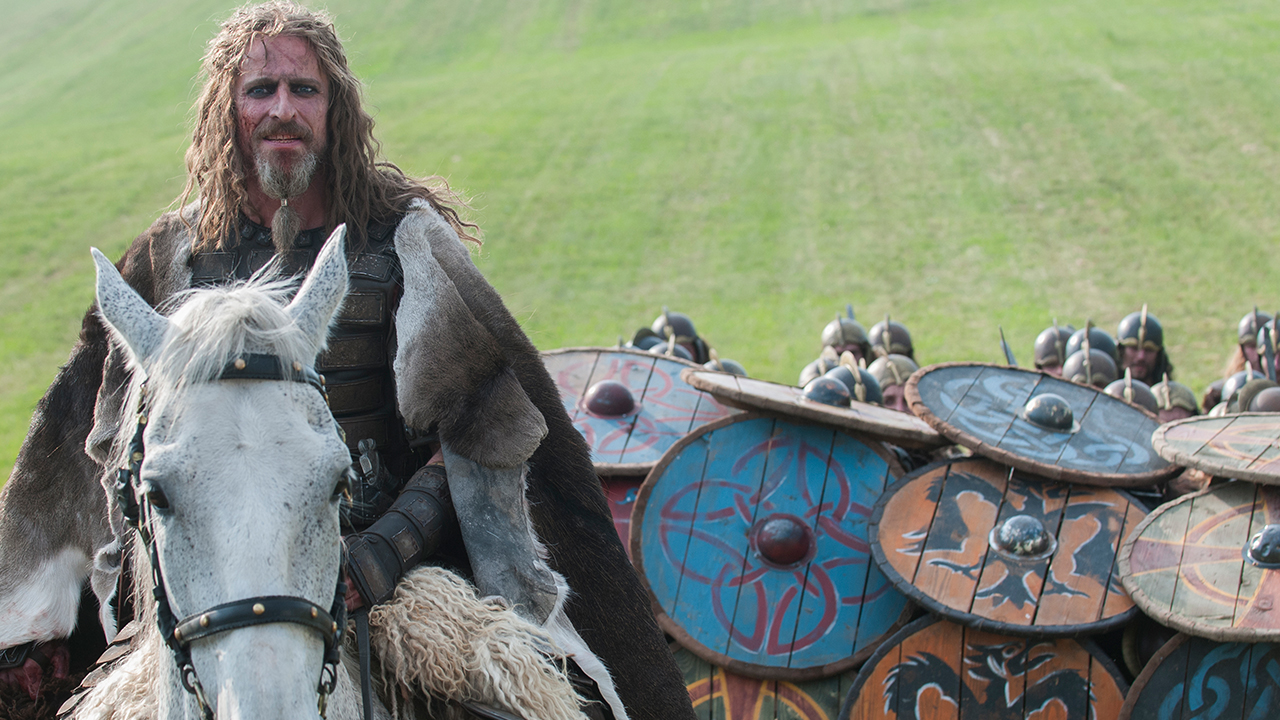
VIKING: Well, where are we?
VIKING LEADER (ROLF, i.e. Richard Widmark): Civilization.
VIKING: Huh?
VIKING LEADER: You wouldn't understand that..,
Ancient, medieval, Islamic and world history -- comments, resources and discussion.
Saturday, May 26, 2018
Welll, where are we? The Long Ships (1964)
Saturday, June 04, 2016
Not a horned helmet among them
A couple or three weeks ago I had a look at the Last Kingdom, a TV series depicting the period of Alfred the Great and his wars with the Danes. I was referred by friends to a critique of the authenticity of this film put on YouTube by a man named Lindy Beige. Mr. Beige is repeatedly offended by the fact that ninth century warriors wore soft leather armo and all sorts of inexplicable fur and leather accessories. And even the kings are dirty. One of them wears the same clothes for 10 years!
Fair enough – but I have to say that I found the series inexplicably good. When was the last time you saw a commercial video depiction of the Vikings that has nobody wearing horned helmets? In my case I think I can say "never!"
It's also surprising to me that the treatment of Alfred the Great, a man who was very eccentric in terms of his own time, is reasonably believable.
Mr. Beige says sense somewhere in his critique that he has no trouble with the plot or the acting of the last kingdom. Indeed? And you want more?
Friday, February 26, 2016
If you are really interested in Viking archaeology...
Buko, Andrzej, ed. Bodzia. A Late Viking-Age Elite Cemetery in Central Poland. East Central and Eastern Europe in the Middle Ages, 450-1450. Leiden: Brill, 2015. Pp. xxxi, 624. $293.00. ISBN: 978-90-04-27829-5.
A lavish and detailed work aimed at a wide audience, published even before the excavation report. But the publishers have narrowed down that audience, as the reviewer, Neil Price, points out:
However, given such an impressive catalogue of achievement, there sadly remains one truly glaring problem, which is not the fault of editor or contributors: as ever with Brill's otherwise excellent early medieval volumes, this book is priced far beyond the pockets of students, academics or even libraries [SM]. If it really does cost nearly three hundred dollars to viably produce a volume like this, then one wonders if a pdf on Open Access might honestly be a better solution, or at least breaking it up into two or three more affordable paperbacks.
Tuesday, August 19, 2014
A Canadian Viking in the Governor-General’s Court: Medievalism in Pre-war Canada, by Janice Liedl
Monday, September 06, 2010
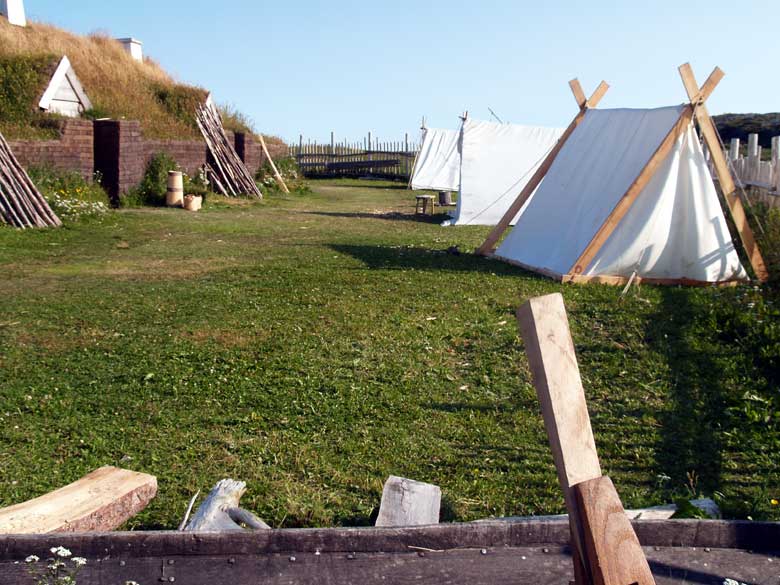
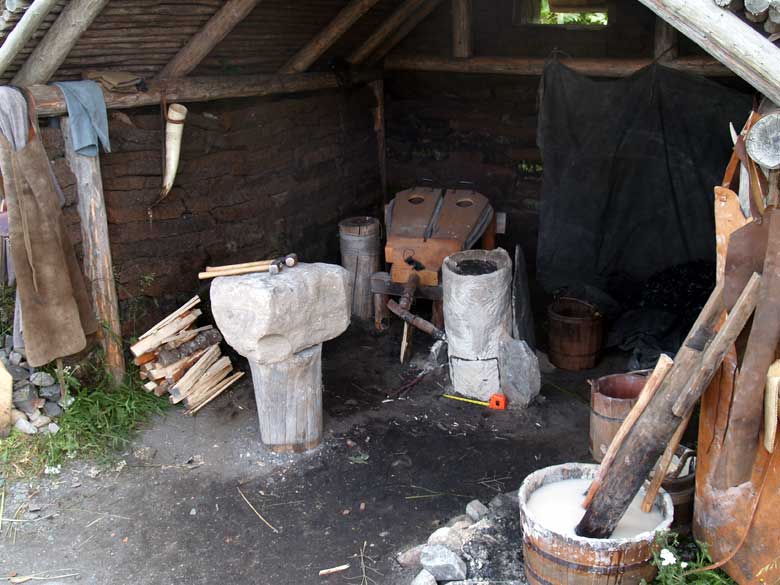
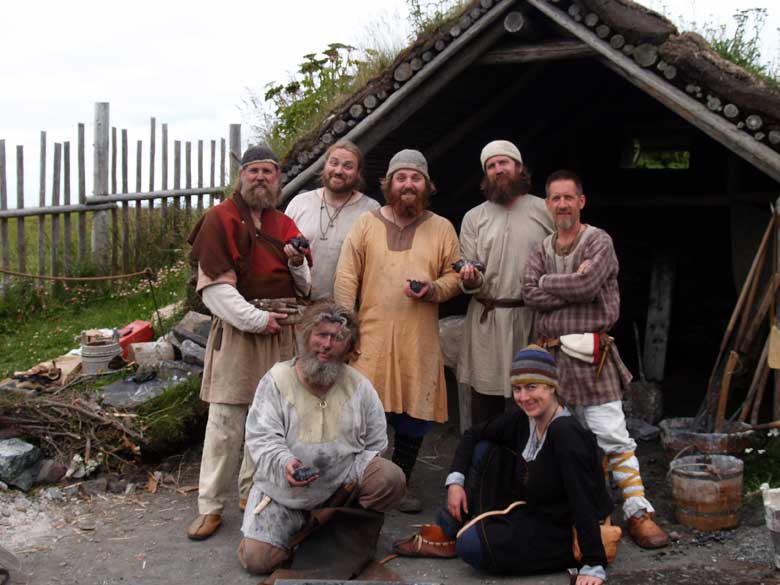
Notes and pictures from L'anse aux Meadows, August 2010
Friday, April 16, 2010
Pattern welding

For all you Viking sword fans, Darrell Markewitz at Hammered Out Bits explains the mythology and the reality of the pattern-welded blade. Lots more down-to-earth metalworking lore where that came from!
Image: 205 layers of twisted and hammered iron. DM sez: "Expect to see some images of the finished knife in about a week."
Friday, December 04, 2009
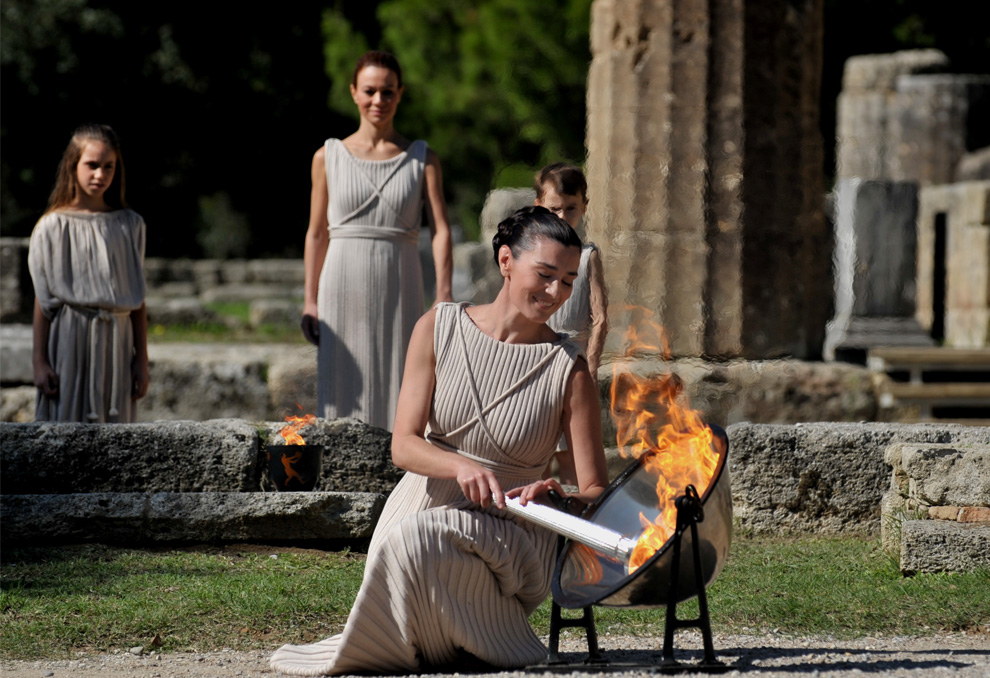
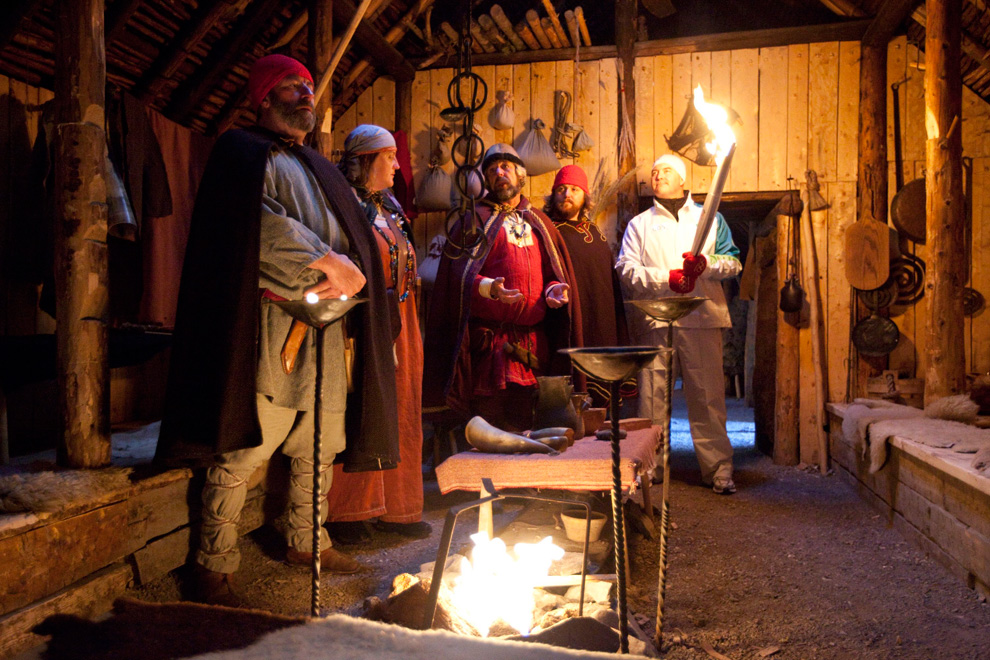
Re-creation and the Olympic torch -- from The Big Picture
Then: Vikings keep it burning at L'Anse aux Meadows.
Too cool.
More here. Or click on the pics.
Saturday, August 29, 2009
A big Viking hoard may rewrite the history books
This post from the Independent (UK) has two very interesting points. First, the discovery is being called the "largest and most important" Viking hoard found in Britain since 1840, which is a long time. Second, responsible metal detectorists found and properly handled the discovery. Hooray!
As for rewriting the history books:
Some of the coins shed new light on the period – parts of Britain such as Staffordshire and Yorkshire were already believed lost by the Vikings and under Anglo-Saxon dominion, yet there are coins which show the Vikings were still creating their own currency in these regions. One such coin, with the word "Rorivacastr" on it, is believed to have originated from Roceter, in 10th-century Staffordshire, on the border of Viking and Anglo Saxon control.Image: a small part of the hoard.Gareth Williams, curator of early medieval coins and Viking expert at the British Museum, said this particular coin revealed that the region may still have been under Viking control, despite Anglo Saxon spin that it was under their rule. He added that it was a truly remarkable find, with a vast array of coins from as far afield as Scandinavia, continental Europe, Tashkent and Afghanistan.
"There's been nothing like it for over 150 years. The size and range of material gives us an insight into the political history, the cultural diversity of the Viking world and the range of cultural and economic contact at that time," he said. Priceless lessons in history would further be revealed in four years time after careful study, he added.
Saturday, June 27, 2009
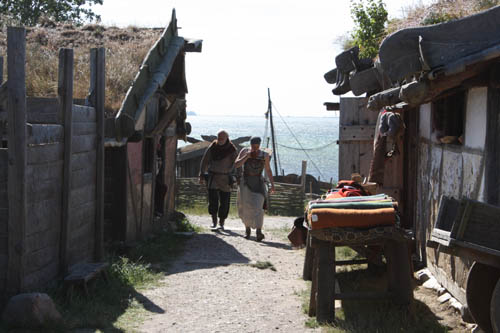
Foteviken open air Viking Museum
Randy and Ann Asplund have been visiting southern Sweden, including this open air museum in Foteviken. They took some great pictures!
Sunday, May 31, 2009
Viking Weapons and Combat Techniques, by William R. Short
Tuesday, March 17, 2009
Feeling insecure? Blame the Vikings!
Magistra et Mater, a real medieval historian, was struck by a UK press denunciation of supposed efforts to supposedly minimize Viking rape and pillage. She asked:
I want instead to ask another question: why is it so necessary to modern Britain that the Vikings were violent? This can’t simply just be put down to right-wing prejudices about immigration (although this crops up in the Daily Mail): Simon Schama had pretty much the same attitude to Vikings in his History of Britain (BTW, the best takedown of Schama’s TV history style I’ve yet seen is here).So there you have it, cherry-picking of useful images once again...
There is a very interesting contrast here with an earlier British attitude. If you look at some of the classic popular histories from the first half of the twentieth century, such as Our Island Story or 1066 and All That, then the Danes (not yet the Vikings) are simply one among many violent attackers of early Britain. There is nothing that particularly distinguishes their violence from that of Romans, Saxons or Normans. The same attitude is still shown by Terry Deary’s Horrible Histories. But generally in Britain, it is now the Vikings alone whose violent reputation must be defended or revised: no-one outside history facilities really cares how violent the Saxons were or whether Hengist was coarser than Horsa. Why does Viking violence now spark the imagination in a way it didn’t 100 years ago? There’s been the discovery and display of much more material culture (as in Jorvik), but we’ve got more Saxon stuff as well.It’s also not a reflection of modern politics in the normal sense: there are no significant anti-Scandinavian prejudices here. If you’re going to demonise the EU via the past, then Normans as proto-French and Saxons as proto-Germans are a better bet. But if you look at which aspects of the Vikings are remembered, you get the clue. It’s not Canute/Cnut or even the Danelaw which strike the modern imagination, and King Alfred is surprisingly absent. It’s the raids, from Lindisfarne in 793 onwards. What this country remembers about the Vikings is the sudden alarm of longboats appearing at a ‘peaceful settlement’ (this was the main trope in Simon Schama). It’s not the threat of invasion and conquest (Britain being ‘overrun with fire and the sword’) that sends a thrill of terror up British spines now. It’s the small-scale, unprovoked, seemingly random and meaningless violence that does that: the Vikings as the first terrorists.
Image: Re-enactors at the Dublin Viking Festival.
Tuesday, December 30, 2008
Prehistoric burial mounds in southern Sweden
Wednesday, December 24, 2008
Need something to read?
I've saved up two posts I liked just for this occasion.
The first is Karl Steel posting his final exam for an undergraduate course in medieval romance literature. I am fascinated by the format and wonder if I should revisit what I habitually do. My students, past and present, are welcome to chime in on this issue.
Then there is a "material culture" contribution from Darrell Markewitz on "How widespread were blacksmithing skills in the Viking Age?" Lots of fun in the grubby details.
Image: "Viking Smith," a photo by Wolfgang Arnold.
Saturday, December 20, 2008
Exploring the Viking Age in Denmark
Wednesday, December 17, 2008
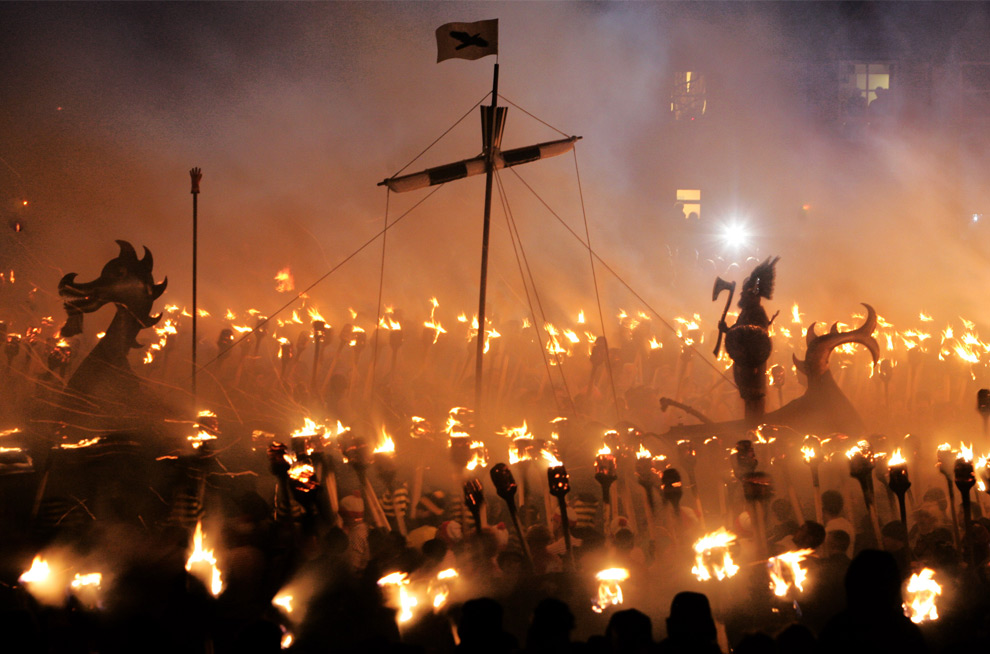
Viking-era celebrations might have looked like this
This is one picture from installment one of the Big Picture's "best of 2008" collection. Here is an astonishing Aussie contribution that has nothing to do with war or natural disaster.
Friday, September 19, 2008
Viking shield discovered in Denmark
Reenactors and re-creationists of all sorts will be happy to hear this news: a Viking era shield found in Denmark, reported here from Yahoo news.
It will be some time before such data as original weight and construction will be available. The reason the shield is still around, long after all the others have been beaten to flinders, is that it was found waterlogged in wet soil. Much effort will have to be put into removing and preserving it.
Wednesday, September 03, 2008
Viking-era glass bead making
Here is a detailed discussion of one of the activities at the SCA event at my property this past weekend.
Friday, August 22, 2008
The problems of really serious historical reenactment
Darrell Markewitz was involved in the design of the Viking living history site at L'Anse aux Meadows, and now he hears news that they are trying some ambitious projects there. I am sure he is intrigued, but the most interesting thing about this blog post is his fear that the site is tackling more than it can handle.
Darrell will be on my property on Labor Day weekend taking part in an SCA re-creation event. Last I heard there will be on-site glass bead making. If you come, come dressed in medieval fashion, as best you can do.
Image: see the post.
Thursday, July 03, 2008
Sea Stallion from Glendalough
A fascinating, detailed and intelligent article from the Smithsonian Magazine on one of the most elaborate re-creations of a Viking ship.
Friday, April 25, 2008
More on Viking ship burial
Thanks to Dave for this tip.
Image: the discovery of the Oseberg ship in 1904. That guy on the left looks like he's about to start the Russian Revolution.