Showing posts with label favorites 2016. Show all posts

Monday, December 26, 2016

Superintellligence


This talk, by Maciej Cegłowski, which reached me through a number of links, is one of the most interesting things I've seen on the web in a long time. I warn you that it's long, but it's not boring. The topic is superintelligence, the idea that computer-based intelligence is growing so fast that it will soon be dominant in our society. The proponents of this idea think this is a wonderful thing. Our author is not so sure.

Here are some short excerpts:
AI Cosplay
The most harmful social effect of AI anxiety is something I call AI cosplay. People who are genuinely persuaded that AI is real and imminent begin behaving like their fantasy of what a hyperintelligent AI would do.
In his book, Bostrom lists six things an AI would have to master to take over the world:
  • Intelligence Amplification
  • Strategizing
  • Social manipulation
  • Hacking
  • Technology research
  • Economic productivity
If you look at AI believers in Silicon Valley, this is the quasi-sociopathic checklist they themselves seem to be working from.
Sam Altman, the man who runs YCombinator, is my favorite example of this archetype. He seems entranced by the idea of reinventing the world from scratch, maximizing impact and personal productivity. He has assigned teams to work on reinventing cities, and is doing secret behind-the-scenes political work to swing the election.
Such skull-and-dagger behavior by the tech elite is going to provoke a backlash by non-technical people who don't like to be manipulated. You can't tug on the levers of power indefinitely before it starts to annoy other people in your democratic society.
I've even seen people in the so-called rationalist community refer to people who they don't think are effective as ‘Non Player Characters’, or NPCs, a term borrowed from video games. This is a horrible way to look at the world.
So I work in an industry where the self-professed rationalists are the craziest ones of all. It's getting me down.,

Incentivizing Crazy

This whole field of "study" incentivizes crazy.

One of the hallmarks of deep thinking in AI risk is that the more outlandish your ideas, the more credibility it gives you among other enthusiasts. It shows that you have the courage to follow these trains of thought all the way to the last station.
Ray Kurzweil, who believes he will never die, has been a Google employee for several years now and is presumably working on that problem.

There are a lot of people in Silicon Valley working on truly crazy projects under the cover of money.

Religion 2.0
What it really is is a form of religion. People have called a belief in a technological Singularity the "nerd Apocalypse", and it's true.

It's a clever hack, because instead of believing in God at the outset, you imagine yourself building an entity that is functionally identical with God. This way even committed atheists can rationalize their way into the comforts of faith.
The AI has all the attributes of God: it's omnipotent, omniscient, and either benevolent (if you did your array bounds-checking right), or it is the Devil and you are at its mercy.

Like in any religion, there's even a feeling of urgency. You have to act now! The fate of the world is in the balance!

And of course, they need money!

Because these arguments appeal to religious instincts, once they take hold they are hard to uproot.


Saturday, December 24, 2016

Favorite entries 2016

Not much dross this year, since the less important stuff got redirected to Facebook.

Tuesday, December 13, 2016

"A city in heaven, inhabited by angels."

That is what a Sudanese refugee called London, Ontario in a CBC broadcast of an event raising money for a foodbank.

Yes, it seems rather unlikely to me, but it's all a matter of perspective.

At the moment, at least most of us, are on the right end of the telescope.

Sunday, November 20, 2016

American Gods, Supernatural, and Jesus

Recently I have been reading American Gods by Neil Gaiman, as well as watching the TV show Supernatural, which has been on for pretty close to 15 years now. I am finding both of them quite enjoyable. They have strong similarities, specifically they both take place in America (Trump's America?) where behind the scenes of ordinary life (a pretty dreary ordinary life mostly in the country or very small towns) biblical or pagan gods, culture heroes, and etc. pursue their own agendas, generally with bad effects on human beings who stumble across them.
American Gods has a high reputation and it is very entertaining and well-written. The specific plot of the story is that many of the ancient gods of European or Middle Eastern origin are trying desperately to make a living, generally by running some kind of scam. They are old and weak because nobody much believes in them anymore more and sacrifices are hard to come by.
There is one very noticeable weak point in American Gods, and that is the complete absence of Jesus in the storyline. When the human hero of the story comes across these gods and goddesses, many of them talk about how things are not nearly as good as they were back in the old days. They are upset about the current condition and talk about it in some detail. But Jesus never comes up. Churches, priests, ministers, huge suburban ministries with a strong television presence likewise. Jesus should be there in that landscape, but he isn't, not even as a figure on whom to blame the sad plight of the old gods. It is fully in line with the tone and logic of American Gods that the old guys should take a new human ear as an opportunity to pour out their troubles.
Supernatural is a bit different. A lot of biblical and semi-biblical mythology is strongly present in the main plot line. You can kind of understand how the makers of the TV series might back off from including any commentary whatsoever on Jesus.
But it is very odd that a novelist who likes think of himself as innovative, would censor himself in this way. Or is there some other explanation for his strong desire to ignore the most important American God?

Friday, November 04, 2016

Woodpiles as art


Anyone who has heated a house with wood can't help but pay attention to woodpiles.  Just seeing a good pile ready for use stirs emotion; this kind of creative effort is truly fine.


Sunday, October 23, 2016

Jokerman wins the Nobel Prize

Dylan!
I am extraordinarily pleased that Bob Dylan won the Nobel Prize for Literature.
I am not a hard-core Dylan fan, and I know little of his work from the past 40 years. But I was witness to his phenomenal early career, and that's why I feel confident in concurring with the Nobel Prize committee, probably for entirely different reasons.
Here is a guy who by most standards could not sing worth a damn, was only a moderately good instrumentalist, and whose lyrics by popular or folk music standards were more often than not pretty obscure. When it came to evaluating Bob Dylan's place in the musical universe, Dylan saw himself as a uniquely important singer, and the rest of the world -- at least at first -- saw him as someone who was not even worth listening to, with his terrible voice and his incomprehensible lyrics.
Well, guess who won that confrontation? Guess who was right?
Hat's off to the Nobel committee for recognizing Dylan's unique importance, whatever excuse they offered for doing so.
Their official reasoning for the prize, by the way, is also, quite rightly, a recognition of the importance of the American contribution to the explosive creativity of the late 20th century.

Sunday, October 16, 2016

Canadian ideals, 1957

This is how the Minister of Citizenship and Immigration greeted a new Canadian citizen in 1957:
Dear Madam,
I wish to take this opportunity of congratulating you personally upon the attainment of Canadian Citizenship. By this certificate of citizenship you have been granted the rights and privileges of the citizen of Canada. These rights and privileges entitle you to freedom of speech, religion, thought and action, the right to vote as you choose, and the right to be secure in your possessions.
Your citizenship carries with it the obligation of defending your adopted country in time of need, of living in peaceful brotherhood with your fellow Canadians, and of doing your part in the preservation of Canadian ideals and institutions.
I extend to you a warm welcome on this solemn occasion and I invite you to share with us the ancient liberties of a free people living together in harmony, under a democratic government which recognizes the rights of all its citizens.
Ellen L. Fairclough,
Minister
Note: this certificate of citizenship (?) looks like a letter from the Minister and has no date. Note that the Queen is not mentioned. Nor is the recipient named.

Sunday, October 09, 2016

Purge those evil foreigners

From the Guardian:
Leading foreign academics from the LSE acting as expert advisers to the UK government were told they would not be asked to contribute to government work and analysis on Brexit because they are not British nationals.
The news was met with outrage by many academics, while legal experts questioned whether it could be legal under anti-discrimination laws and senior politicians criticised it as bewildering.
“It is utterly baffling that the government is turning down expert, independent advice on Brexit simply because someone is from another country,” said Nick Clegg, the Liberal Democrats’ EU spokesman.
“This is yet more evidence of the Conservatives’ alarming embrace of petty chauvinism over rational policymaking.”
Sara Hagemann, an assistant professor at the London School of Economics who specialises in EU policymaking processes, EU treaty matters, the role of national parliaments and the consequences of EU enlargements, said she had been told her services would not be required.
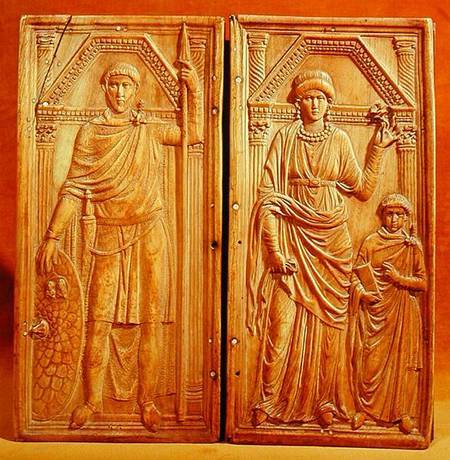
It's the end of the British Empire, at the hands of its own people. Late Roman historians, think of this.
Image: Stilicho, an obvious evil foreigner.

Wednesday, October 05, 2016

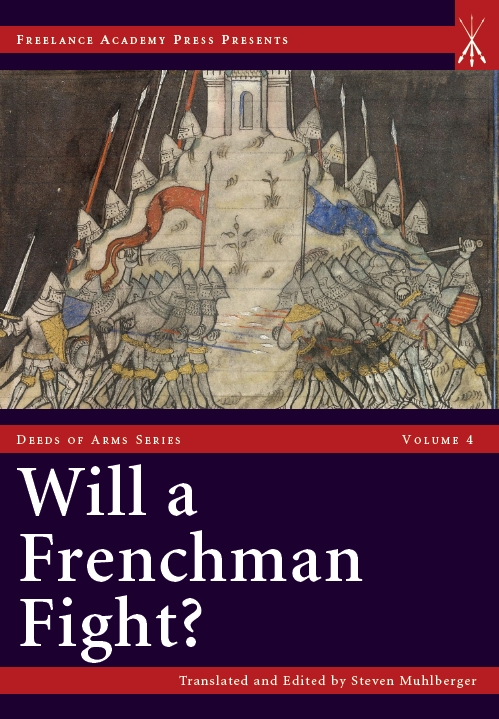
Review of Will a Frenchman Fight? ed. Steven Muhlberger Deeds of Arms, 4.

I'm grateful for this positive review but I wish the reviewer had said more about the main theme of the book, the often conflicting demands of military effectiveness and individual honor in the minds of men at arms of the time.
Muhlberger, Steven, ed. and trans. Will a Frenchman Fight?. Deeds of Arms, 4. Wheaton, IL: Freelance Academy Press, 2015. Pp. viii, 102. $24.95. ISBN: 978-1-937439-17-0.

Reviewed by Katherine Hodges-Kluck
University of Tennessee, Knoxville
kthomp41@vols.utk.edu
Will a Frenchman Fight? is Steven Muhlberger's third contribution to the Deeds of Arms Series. This sourcebook focuses on the great chevauchée, or raid, led by Thomas of Woodstock, first earl of Buckingham, through French territory in 1380-81. The book opens with an 18-page introduction, followed by selections of Froissart's Chroniques and Cabaret d'Orville's 1429 Chronicle of the Good Duke. As Muhlberger explains, Cabaret received his information from the French knight Jean de Châteaumorand, who recollected the events of his youth. Together, therefore, these chronicles provide two contemporary perspectives on the raid. The book concludes with a short bibliography for further reading.
The 1380-81 chevauchée was a response to duke of Brittany Jean de Montfort's call for aid after he was exiled for opposing the French king's attempts to exert royal jurisdiction over the ducal succession in Brittany. Will a Frenchman Fight? does an excellent job of highlighting the precarious situation which de Montfort faced. Out of favor with Charles V of France and charged with treason, the duke turned to the English for assistance, only to be thwarted by his own lords who refused to accept foreign support against their fellow countrymen. The introduction and primary sources in Will a Frenchman Fight? highlight these overlapping and frequently conflicting layers of leadership and allegiances, which in turn shaped France's military response to the rebellious de Montfort and his would-be English allies.
Muhlberger's introduction begins by outlining some of the major events of the four decades leading up to Buckingham's raid, including the Black Death, the English victory at Poitiers, the capture of the French king Jean II, and the Jacquerie rebellion. Muhlberger effectively demonstrates the economic pressures that shaped Edward III's and Parliament's military decisions on the one hand, and Charles V's struggles to "re-establish royal authority" in France on the other (5). The rest of the introduction then breaks down the sequence of events for the chevauchée and discusses the varied motivations of the French and English soldiers involved in it. The author assumes some basic knowledge of the first phase of the Hundred Years War, and the major players involved. It is not until midway through the introduction, for instance, that the reader learns that Buckingham is the "son of the King of England" (13), and only in the color plate of Buckingham's coat of arms in the middle of the book that the reader finds the earl's full name and titles.
The primary source section of the book presents the events of the chevauchée in chronological order, following the English on their march through enemy territory, their largely unsuccessful attempts to engage their enemy in battle during the winter months, and finally their retreat back to the coast. The primary texts have been thoughtfully selected to highlight the nuances of the complicated political, as well as tactical, situations posed by the English presence in France. As the book's title suggests, the sources shed light on "a variety of different kinds of combat and different motives for fighting" (3). In particular, they depict the tensions between 1) open pitched battles like those of Crécy and Poitiers, which favored the English; 2) the pragmatic but unpopular scorched-earth tactics employed by both the French and the English armies at the expense of the French populace; and 3) the desire of individual knights and squires on both sides of the conflict to demonstrate chivalric honor through individual combat.
The sources are divided into eight sections, throughout which chapter numbers and titles from the original texts are included as subheadings. Six of the sections are drawn from Froissart, while the remaining two (which are relatively short by comparison) are from Cabaret's chronicle. In the first section, titled "Buckingham's Campaign Begins," Froissart describes the exchange of ambassadors between Brittany and England, and Edward III's subsequent plans for an armed expedition into France. The chronicler discusses the deployment of troops, the effects of international alliances on events, and the capture of prisoners of war. The next section, "The Confrontation at Troyes," describes the skirmishes between French and English forces outside that city. The third section, "The Deeds of Arms at Toury and Marchenoir," follows the English army's travels into Brittany and the reception that the English received in various towns along the way, a reception that ranged from lukewarm to outright hostile. This section also includes Froissart's account of the death of Charles V. In "Buckingham in Brittany," Froissart shows the complicated political situation facing Jean de Montfort. He also describes the siege of Nantes and the coronation of the child king, Charles VI. The next passage, "The Siege of Nantes," is drawn from Cabaret's chronicle. It describes how the French defenders of the city used a variety of tactics to drive back and defeat the English besiegers. The next two selections, both titled "The Deeds of Arms at Vannes," give first Froissart's and then Cabaret's descriptions of individual combats between some of the knights and squires of the two armies. The final section, "Nicholas Clifford and Jean Boucinel," turns again to Froissart's text, outlining the peace concluded between Jean de Monfort and Charles VI, the English retreat out of Brittany, and an individual chivalric combat between Clifford and Boucinel.
While English translations of portions of Froissart's Chroniques have long been available, Cabaret's chronicle is less familiar to English readers, and this book makes a welcome contribution by including passages from it (though one wishes they were longer). Muhlberger's translations are clear and appealing to readers of all levels. This book should be a popular one for use in college classrooms, as it is accessible, attractive, affordable, and offers many topics of potential discussion.
The weaknesses of the book are largely structural. There is no index, and although Muhlberger defines specialized terms such as a outrance within the text (17), a glossary of such terms, as well as of important names, would make the book more user-friendly. Moreover, the two maps that the book reproduces (France at the Treaty of Brétigny in 1360 and at the death of Charles V in 1380), while in full color, are antiquated--one dates to 1877--and rather difficult to read. The book would benefit from a map that clearly plotted the route taken by the English army during the raid and the locations of important cities and skirmishes specifically mentioned in the text. It would also be useful to have in-text references to the images in the color plates at the center of the book.
Ultimately, this source reader presents a detailed view into an exciting yet lesser-known episode of the Hundred Years' War. Rather than placing attention on the famous battles like Crécy, Poitiers, and Agincourt, Will a Frenchman Fight? shows the more common side of war: one marked by short skirmishes, inconclusive raids, prolonged sieges, individual desire for honor, bad weather and disease, and the vicissitudes of fortune and politics.
******

Monday, October 03, 2016

Short History of Reconstruction by Eric Foner

I have read other books by Eric Foner and have yet to find one that I didn't learn a great deal from. One of the things I learned from this one, which is a condensed version of a much larger work, is that the racial politics of the United States shows an amazing amount of continuity. Other works I have recently read have shown the discourse of immigration and religious identity now seen in the United States then was also present in the 1840s and 50s. Thinking about the 1860s and 70s shows a similar similarity between now and then. It just feels so familiar.
Years ago when I first started teaching 20th century European history and world history I came to the conclusion that for a great many people World War I did not end in 1918 – large parts of the world were still at war or at least in a chaotic condition until about 1922. I wonder if it makes sense to separate the Civil War from Reconstruction using the usual date of 1865 as a dividing line. The amount of violence that took place in various parts of the South is quite astonishing. The majority of conflicts were in fact initiated by Southern whites, and there are very few violent incidents where white casualties outnumbered black casualties.

Friday, September 23, 2016

Blogging medievalism: Sypeck and Gygax

Back about a decade ago, when I started this blog, I felt a bit like a Johnny-come-lately. Lots of professional medievalists, a pretty bright and eloquent bunch, were already churning out commentary or autobiographical reflections at a great rate. I had a long list of their blogs. Of course those days are pretty much dead, as bloggers have moved on to faster, simpler platforms like FB or Twitter &c. Blog lists at the side of many a blog link to forums that haven't been added to since 2011. But there are the honorable exceptions, for instance Jeff Sypeck's Quid Plura?. Jeff is a Charlemagne scholar who is both light and serious in his way of handling things, all sorts of things, including his own poetry. Long may Quid Plura? wave.
A good example of Jeff's virtues is the blog entry/review “Silhouettes and shadows watch the revolution…”. It is a discussion of the importance of Gary Gygax, a co-inventor of Dungeons and Dragons, and the significance of D&D itself. The focus of the post, however, is Sypeck's contention that despite the appearance of an interesting biography of Gygax, Empire of Imagination: Gary Gygax and the Birth of Dungeons & Dragons there is no full investigation of the life and thought of this key figure of the popular culture of the past half-century.
This passage says much:
Early on, Gygax supported his family as an insurance underwriter, but Witwer suggests that the main influence of this job on his game-writing hobby was the convenience of the office typewriter. I don’t doubt that the typewriter was handy—but isn’t it noteworthy that a guy who spent his days poring over actuarial data would go on to craft a game around pages and pages of probability-based tables? I wish Witwer had drawn this connection; there’s meaning in it. It’s charming that one of the quirkiest countercultural pastimes, now an endless wellspring of self-expression and creativity, has roots in a field that most people find utterly deadening.
The biggest surprise in Empire of Imagination pops up halfway through the book, when Witwer writes about conflicts between the Gygaxes and their children in the late 1970s:
Another point of dissension between Gary and his son was that Ernie had drifted away from his parents’ faith, the Jehovah’s Witnesses. In times past, Gary had made attempts to pull away from gaming in favor of devoting more time to his faith, but such efforts were always short-lived. And while not “devout” by Jehovah’s Witness standards, Gary and Mary Jo had maintained the religious affiliation and expected their children to follow suit.
Wait—what? The Prime Mover of geekdom and godfather of role-playing games, dogged by accusations of promoting demonology and witchcraft, was a Jehovah’s Witness? That’s a heck of a revelation not to poke with a stick. Was he born into the religion? Did he adopt it as an adult? Witwer doesn’t say. Twenty pages later, Gygax and his wife break from their church over gaming, drinking, and smoking, and that’s that. But how can it be that the co-creator of a game steeped in magic, mysticism, polytheism, and violence was active in a faith most of us think of as uncompromising and austere? Are there traces of the religion in the design of D&D, and if so, what are they?
It’s clear from Witwer’s lengthy sketch that Gygax demands a thorough intellectual biography. He was a complex autodidact whose inner life wasn’t easy to categorize or explain, the product of an unrepeatable alchemy of place, time, and personality—but unless someone can conjure a compilation of interviews, letters, and reminiscences by family and friends, Empire of Imagination may be the best glimpse of his life we’re going to get. It’s engaging and earnest; it just doesn’t feel done.

Monday, September 12, 2016

Acts of the Apostles and the riots of the Roman Peace


I am currently reading the New Testament more or less in the order that it was written. I began with the Acts of the Apostles, which discusses the missionary efforts of Jesus's followers after his ascension to heaven. Taking the Acts as a historical document, I am very impressed by how chaotic social religious and political scene was in this era of "Roman peace." Many of you know that during this apostolic era was characterized by strong opposition to the new Christian movement by a variety of better established Jewish and Greek/Roman parties. It is remarkable how nervous the established powers seem to have been – how quickly they ran to the Roman authorities to denounce the new religious movement. There is a lot of actual fighting described or implied, and of course sometimes the opponents of the Christians got them imprisoned, beaten up, and murdered.

We have to wonder-- at least I do – whether the reaction by the established religious authorities was justified or completely out of proportion. Is there a big difference between these two alternatives? Either way it's not exactly happy days in the Eastern Mediterranean in the first century A.D.

You might well come away with a much more sympathetic understanding of Pontius Pilate, the Roman governor who did his best to stay out of the conflict between the established Jewish authorities in Jerusalem and Jesus's movement. It may have been commonplace to credit the Romans and their representatives with peace and reform, but if you were one of the governors mentioned in Acts, you probably felt that your office was like a wild horse, and you would be lucky to stay on it.

Thursday, August 25, 2016

Afghanada


When Canada was supporting the "Coalition" war in Afghanistan, there was very little effort to bring the reality of that war, from any perspective, to the public. Canadians were shooting, getting shot, bombing and getting blown up. However there were no presentations to speak of what this conflict might mean to a real or even a fictional Canadian or Afghan.
Except Afghanada.
Afghanada was a radio drama series, part of a long tradition at the CBC. That tradition was being eroded by funding cuts. But somebody took a chance and commissioned a four-episode series about the war.
It took off. In the end, the CBC made 103 episodes. One hundred and three.
I am relistening to the series and it is, just as I remember, very down to earth and focused on Canadian soldiers, Canadian medics, Afghan civilians, casualties of all sorts.
You can go here and buy the majority of these episodes.
Image: The LAV III, practically a character itself.
By Allied Joint Force Command Brunssum - Exercise TRIDENT JUNCTURE, CC BY-SA 2.0, https://commons.wikimedia.org/w/index.php?curid=44818654

Wednesday, August 17, 2016

Not quite so welcome

Canada has got a lot of praise recently for its generous attitude towards admitting Syrian refugees. And rightfully so.

But Canadians are not so keen on another group: rich, mainly Chinese immigrants who have been moving into the Vancouver area for years and driving up real estate prices to a more than merely remarkable extent. That real estate boom (and a somewhat different boom in places like Toronto) has a major effect on the national economy as a whole. And it makes it easy to blame foreigners for this unbalanced, potentially perilous situation.

Of course, the word racism comes up, in part because British Columbia has a history of excluding Asian immigrants.

But it's not a simple situation. A recent article in the Globe and Mail discussed at length the fact that different groups of Chinese immigrants don't get along with each other; older immigrants and their children and grandchildren don't feel any great solidarity with new immigrants from other regions.
Here is one Globe and Mail article. There are plenty more. Like this one about the not exactly rich, not necessarily immigrant.

Sunday, August 07, 2016

The Loeb Classical Library saves civilization


The Loeb Classical Library is a bit over one hundred years old. It was meant to be useful to a wide group of readers -- each volume has not just the original text but also a facing translation into English. As you can imagine many people who had an excellent classical education scorned the project. The poet John Talbot is one of the defenders of the LCL:
I have a little apocalyptic fantasy that involves the collection of Loebs in my local library. It’s a complete set, from Homer’s rosy-fingered dawn to the twilight of Ammianus Marcellinus. The very sight of it is reassuringly tidy: all the sprawling energies of a thousand years of Greek and Roman thought and song, distilled and compacted into these snug matching volumes, the Greek bound in olive drab, the Latin in scarlet. Run your fingers over the spines. Here are The Classics.
Then comes a nuclear holocaust. My local library, like others around the world, is mostly pulverized, but an accident involving molten rubber preserves the case of Loebs intact within a sealed airtight cavity beneath the rubble. Centuries elapse and deposit their layers of sediment. Above ground, the descendants of the survivors plod on, speaking a crude version of English, and when their vestigial civilization is at last stable enough to permit cultivation of the liberal arts, their curiosity turns to the prior civilization, ours, whose evident sophistication is attested only in the occasionally exposed ruin, or in fragments of excavated texts. Of this second category, a half-page of Danielle Steele, the corner of a Dunkin’ Donuts advert, and the odd shred of Paradise Regained are all scrutinized, edited, and interpreted with equal zeal. The fragments are exasperating: they imply a vast literature, and behind it a teeming culture, all tantalizingly out of reach.
Until one day when excavation unseals that underground cavity, and for the first time in so many centuries, sunlight falls on those green and red spines. The whole Loeb Classical Library, dedicated to preserving whatever could be salvaged from an even earlier lost civilization, has itself survived intact. The excavators fall upon the cache and discover not only the English (which they can mostly make out, though it appears to them as remote as Chaucer to us) but also, to their astonishment, on the facing pages, two strange, even more ancient languages, one with an unfamiliar alphabet. Amid a storm of speculations it is posited that the English is the key to the other two tongues, and in time a latter-day Champollion steps forward and reconstructs the grammar of Latin and Greek. His successors, pioneer scholars of the recovered ancient languages, are at first awestruck—what are these voices speaking out of the dust?—and then electrified, as they begin to read and assimilate Homer and Sophocles and Lucretius and Augustine. These voices must be emulated; the standards are daunting but stimulating; though ancient, they point the way to something new. Academies are organized for teaching the new languages; young souls (they will become poets and historians and scientists) are once again smitten by the songs of Sappho and Catullus, the grave brilliance of Thucydides and Tacitus, the searching effervescence of Plato’s Socrates and Aristotle’s dogged earthbound inquisitiveness. The post-apocalyptic world shrugs off its torpor, hums with ideas and energy and hope. I suppose what I mean by all this is that it is good to know that the Loeb Classical Library is there, patiently waiting, in case any civilization (not least our own present one) should require a renaissance.

Monday, August 01, 2016

Kyrgyzstan: horses, camels and traditional costumes

Go see Oodarysh (or horse fighting).
I was wondering whether Oodarysh players or jousters would feel they owned the macho high ground, should they meet. But then I realized that if the jousters I know are typical, they would all want to try the other sport, as soon as anyone would give them 30 seconds of instruction.
Courtesy of the Globe and Mail.

Saturday, July 30, 2016

William Marshal

Some insight on the character of William Marshal. He is lying on his deathbed:
The Marshal called to John of Earley
and said "Shall I tell you surprising thing?"
"Yes my Lord, but do not tire yourself out."
"I don't know what it all means
But in truth I can tell you this,
That for the last three years or even longer,
As far as I know, I haven't had
Such a great lords to sing
As I've had these last three days;
I can truly say as much,
But I don't know that it will please God."
John replied: "My Lord, do sing
For the love of God, if you're capable
Of giving yourself to that. The heart would take comfort
In your body and that would be a good thing,
For your joy would be restored.
It please God, it would be helpful
For it might bring back your appetite."
"Be quiet, John," the earl said,
"Such a song would do me no good at all,
For the people here, I believe,
Would think I was a madman.
Most of them would think, hearing me sing
That I was out of my mind."
He would not sing, nor could he.
Then Henry Fitz Gerold said:
"My lord, in the name of our God of glory,
Send for your daughters,
And they will sing some piece
That will do you good and comfort you."
The daughters were sent for and they duly appeared,
For they were glad to obey his commands.
"Matilda, you be the first sing,"
He said. She had no wish to do so,
For her life at the time was a bitter cup,
But she had no wish to disobey
Her father's command.
She started to sing Since she wished to please her father,
And she sang exceedingly well
Giving a verse of a song
In a sweet, clear voice.
"Joan, sing on as best you can!"
She sang one verse from a routrouenge,
but timidly.
"Don't be bashful when you sing," said the earl,
"For, if you are, you will not perform well
And the words will not come across in the right way;
the words you've just sang certainly didn't."
So the marshal taught her
How to sing the words.
Once the song was finished, he said to them:
"My daughters, go in the name of Christ
Who guards and protects all those who believe in him;
I pray to him to grant you his protection."
As was fitting, they took their leave.
Once they had left his bedside,
He said: "There are five of my daughters,
I believe. If all of them hold together,
So it please God, it could well be
That great good could come of it."
-- From the S. Gregory translation of the History of William Marshal, Anglo- Norman Text Society

Friday, July 29, 2016

Why the Middle Ages Are Important

Back when I was still teaching medieval history at Nipissing University, I was asked to introduce a display on the Middle Ages put on by the North Bay museum @Discovery North Bay. I wrote this script but did not deliver it. Only a handful of people showed up for the opening, so I was able to lead them through the display and make the same points in a more personal way, while discussing the artifacts and reconstructions. It was fun, doing it that way. Nevertheless, coming across this script on my harddrive today, I found that I liked it. So here it is. Note the first paragraph, which explains what I found rewarding about working at a small, obscure university.
Why the Middle Ages Are Important
May 24, 2008
@Discovery North Bay, opening of "Once upon a time..."
I would like to thank @Discovery North Bay for the invitation to speak at today's opening. Nipissing University was founded by citizens of North Bay and the surrounding region because they believed their home region could make an original and worthwhile intellectual and cultural contribution to Canadian life. When the university and the community meet here on occasions like this, we are fulfilling the dreams of those founders.
Why are the Middle Ages important? I don't have to argue today that they are important because the exhibit itself is proof enough. It was not created by professional academic medievalists, but by museum staff who work with the public all the time, and their judgment was that people in Ontario want to know more about the Middle Ages. If their own contacts with the public were not good enough, they could point to such recent films as the Lord of the Rings, or the three different recent movie versions of Beowulf, or the wild success of the Da Vinci Code, book and movie both. None of these modern cultural products show the Middle Ages as they really were. They are all consciously or unconsciously legendary or mythological reworkings of medieval material. Tolkien knew medieval literature better than almost anyone, and was a brilliant and original analyst of Beowulf, among other things, but when he wanted to talk to a contemporary public, he created a whole new world, similar to northern Europe in the Middle Ages but in many ways vastly different. And it's not just modern people who have reworked the Middle Ages to make a point. The anonymous Beowulf poet didn't show his hero as a normal person in normal country in a normal time, but put him in a landscape full of monsters and superhuman challenges. Thus when modern film directors mess around with Beowulf they've got good precedent.
But “Once upon a Time,” even though its title evokes the Middle Ages as a source of modern dreams, is not a mythological treatment. Like scholarship in other forms, it tries to get behind the myths and legends and appreciate the people the Middle Ages in this case the later Middle Ages as the home of real people with real problems and real aspirations, who came up with solutions and created social institutions that are still alive in our own world.
“Medieval” is often used to mean something like “unfathomable cruelty,” a phrase I stole from Carl Pyrdum, a graduate student at Yale, but much that we are familiar with and value in the modern world originated in the Middle Ages. The people who invented the phrases “dark ages” and “middle ages” meant to put down the postclassical era, and inspire people to build a better modern world to rival the great accomplishments of antiquity. Yet we can hardly do without the heritage of the Middle Ages. To take two examples relevant to Canada, both parliament and universities came out of the efforts of knights and warriors on one hand and clerics on another to improve their own society. The original members of the House of Commons were knights, seeking effective and fair government, the original university students and teachers were members of the clergy, seeking to understand theology and law, universal and human order. The Middle Ages created things so large that we hardly appreciate their medieval origins: in pre-medieval times there was no England, no France, no Poland, no Russia. The Romans had fantastic public bathhouses but no mechanical clocks, yet by the end of the Middle Ages every important town in Europe had a public clock. Think of Big Ben next to the British Houses of Parliament and not far from Westminster Abbey or the University of London and you think about our practical medieval heritage.
I hope you enjoy “Once Upon a Time…” which highlights some of the more striking and beautiful accomplishments of the Middle Ages. But I hope you will take a moment, when looking at the artifacts and reconstructions, think about the people behind them: the real medieval people who are the subject of the exhibition, and the real modern people who put it together for you. You'll get a taste of the fascination of the Middle Ages today, but just a taste. I hope it will inspire you to look closer. One thing about history is that no matter how good a given reconstruction is, there's always more. Life is big and complicated and hard to describe. “Once upon a time..." can be the end of your journey to the Middle Ages, but I rather hope there will be a beginning or perhaps a new beginning.

Saturday, July 02, 2016

Among other things, perhaps the nicest thing ever said about Canada?

Two days ago the Globe and Mail published "Finding a home, away from home," perhaps one of the best articles that it has ever published in my nearly 40 years of reading the paper. It was by Ian Brown, who also showed himself in championship form, and it concerned Syrian refugees in Canada, and the Canadians who have helped them settle here. It struck me as a very balanced account. About halfway through the article this passage appeared, and it struck me as perhaps the most complimentary thing ever said about the country.
When Omer and Aliye register for their health cards, the clerk asks if they want to be organ donors. Islamic scholars are divided on the permissibility of organ transplants, although compassion and saving a life trump doctrine. For that reason live transplants tend to be more common in Islamic societies than the use of organs that have been harvested from dead bodies. It’s a rich and complicated subject. In any event, Aliye declines.
But Omer says yes. Aliye speaks to him in Arabic, and explains the situation, as she sometimes does. The translator checks twice, as well, to make sure Omer knows what is being asked of him. But Omer says yes again.
“This is what they do here, in Canada,” Omer replies. “I am in Canada.”
Of course there is room for a lot of ambiguity in interpreting this episode, but read the whole article, which is among other things about generosity.

Friday, July 01, 2016

Talking Erie Canal: Jack Kelly's Heaven's Ditch

Jack Kelly's Heaven's Ditch has the enticing subtitle "God, Gold and Murder on the Erie Canal." When I first saw it, I assumed that the important part of that phrase was "Erie Canal." I was wrong: the key word is "God."
The western arm of New York State was the stage for some of the most dramatic developments in the United States in the early 19th century. It was large and fertile and potentially one of the best routes connecting the Atlantic Coast to the new Midwestern states. The geographic advantages led ambitious engineers and politicians to dream of a huge artificial waterway, the largest in North America. The same kind of ambition, directed to a different goal, inspired a different kind of dreamer to build godly societies. Western New York became the incubator of many different religious and social movements. People poured into the region in high hopes of striking it rich. Some succeeded, others were disappointed, sometimes times again and again. But winners and losers alike refuse to be discouraged. Western New York, its economy energized by the building of the canal, nourished wild dreams. And among those dreams were dreams of salvation and the creation of a Christian society.
Elsewhere, I have seen this region called the Burnt-over district, a reference to the many religious revivals that sprang up here or came through. The young United States had had a fair number of skeptical irreligious people, with both ordinary people and people of ambition following the founding fathers in rejecting the established religions of the early American colonies. But in the wilderness areas being settled after 1800, there was a revival of enthusiastic Christianity.
Heaven's Ditch is rich in personality sketches and anecdotes that illustrate the religious flavour of social change that took place in the wilderness. No doubt this comes from contemporary newspapers, which the literate if not highly educated American public enthusiastically read. We learn about many self-appointed leaders who went from settlement to settlement preaching conversion to a born-again, Biblical Christianity. More often than not they taught ideas quite different from the mainstream Protestantism which had been dominant for so long. William Miller for instance became famous for predicting that the end of the world would take place sometime around 1843. His prophecies reached far beyond the districts around the Erie Canal. A famous and significant failure-turned-leader was Joseph Smith, the prophet of Mormonism. And there are many more. In the brand-new society by the canal there was a free market in preaching and teaching. It was possible to write a huge new biblical testament such as the book of Mormon, one revealed to you by angelic and magical means, and be seen not as a probable fraud, given your lack of biblical languages such as Hebrew, but as a wonder of the new do-it-yourself society.
Of course it was not all smooth sailing. Richer and more established members of society were very sceptical of the new religious leaders, who they saw as marginal characters with little legitimate qualification to teach or reconstruct society.
One of the most interesting conflicts of the 1820s and 30s was between the Masons and their opponents. The Masons were an old-fashioned movement, devoted to an Enlightenment-style skepticism. In the Revolutionary period many of the Founding Fathers and other patriots were Masons, and as time went on, many of the local leaders of society joined the organization. But as time went on, Masons came to be resented for their domination of local society. Their cult of secrecy was seen as a threat to republican liberty. And when the new revivalist Christianity began to grow, the religious movement of course opposed the Enlightenment Masons.
In September 1826, an apostate Mason named William Morgan was kidnapped by some of his former friends, who were angry with Morgan because he had published a book revealing many Masonic cult secrets. Morgan was never seen again, and no one who actually knew what had happened to him was willing to go public. Morgan's fate became a widespread popular mystery, and more. For critics of the Masons, it proved that the secret society saw itself as above the law. Outrage turned into a movement, and a new political party, the Anti-Masonic Party. The Morgan scandal was the beginning of a great decline of Masonry; as years went on Masons were seen not as an American Enlightenment movement, but as a dangerous conspiracy of vigilantes. The Anti-Masons went on to be a national party that contributed to the formation of the Whigs.
This is just a single example of how the new country on either side of the Erie Canal generated wild, enthusiastic projects which seemingly came out of nowhere but went on to contribute to the mainstream. (Even the Church of Jesus Christ of the Latter-Day Saints have to be regarded as such, given their nearly 200-year-long history and their prominence in the Mountain States.) And if American life and culture and politics seem wild and enthusiastic today, Jack Kelly's book reminds us that America comes by this kind of stuff honestly.
This is a very entertaining book, but I do miss a final discussion of how the Burnt-Over District settled down to be an unremarkable part of New York State.