Go see
Oodarysh (or horse fighting).
I was wondering whether Oodarysh players or jousters would feel they owned the macho high ground, should they meet. But then I realized that if the jousters I know are typical, they would all want to try the other sport, as soon as anyone would give them 30 seconds of instruction.
Courtesy of the Globe and Mail.
Showing posts with label Central Asia. Show all posts
Showing posts with label Central Asia. Show all posts
Monday, August 01, 2016


Saturday, April 30, 2011
Afghan invincibility -- an attack on the myth
I stumbled across this skeptical look at the myth of Afghan invincibility just now. I have to say that I share the skepticism myself. Otherwise sensible people have said that even Alexander the Great could not beat them. It's statements like this that rang an alarm for me. Alexander the Great beat everybody. Exactly how much control he and his successors and other pre-modern conquerors exerted in Afghanistan is a reasonable question; but if we grant the Afghans (if we can call them Afghans back then) were not beat by Alexander or really ruled by Greek kings, then we will end up granting invincibility to many other peoples, people who live in rough terrain usually, as well.
Here is an excerpt from Christopher Petersen at Through a Glass Darkly on this subject:
Here is an excerpt from Christopher Petersen at Through a Glass Darkly on this subject:
Not too long ago during some significant downtime for the platoon I indulged in a Rambo movie marathon which of course included Rambo III whose events in the movie occur during the latter end of the Soviet invasion of Afghanistan. It is easily the worst in the franchise (Rambo II remains my favorite even with its over the top, cartoonesque action sequences) for a number of cinematic reasons, but my principal problem with the film has to do with its simplistic portrayal of the Afghan people. Stallone's film falters for me because it engages in a gross romanticisation of the Afghans (the movie is in fact dedicated to them) by presenting them as a monolithic group of people who desire nothing more than to be left alone and to be free; honorable warriors who can do no wrong and who've never been defeated in war. It's this last emphasis on Afghan invincibility that I find particularly irksome and problematic historically.And there's plenty more where that came from.
However, this isn't a myth that's sui generis to Rambo III; rather it's a widespread belief held by the public and policy makers alike that has persisted since at least the 1980s and has been neatly packaged in such references to Afghanistan in popular thought as "the graveyard of empires". The narrative of the myth goes something like this: Alexander the Great had great difficulty in conquering this region as did the Muslims and Mongols; the British were defeated several times by the Afghans; the Soviets with its huge technological advantage were beaten by the Afghans by nothing more than WWI enfield rifles; and the United States is now finding that it too cannot conquer this country or its people. Now just to be clear I in no way wish to disparage the unique fighting ability of these people for they have indeed proven themselves on the battlefield repeatedly. Nevertheless, this notion that they have never been conquered or defeated is a myth and one that needs demolishing.
Unfortunately, there is a difficulty in attempting to survey a military history of Afghanistan because of the problem in pinpointing precisely when one can properly speak of a group of people called Afghans (even today this is problematic because you have a cluster of ethnic groups living in Afghanistan such as Pashtoons, Tajiks, Nuristanis, Uzbeks, et al.) because of its history of heavily mixed ethnic groups, tribal affiliations, and fluctuating borders. In addition, what we think of today as the political entity of Afghanistan didn't come into existence until the mid 19th century and even then its borders were essentially determined by British and Russian interests during their "Great Game" in Central Asia and not according to what would have been best demographically and/or geographically.
But for simplicity's sake let us assume that the Afghan people are those who have generally occupied the region that today encompasses the borders of modern Afghanistan since time immemorial. Given this condition an accurate military history of this region would run as follows:
1.) From what historians and archaeologists have been able to determine the region of modern day Afghanistan first came under subjugation during the conquests of Darius I and the Persian Empire circa 500 BCE.
2.) Alexander the Great defeated the Persian empire and subsequently, though with some difficulty, conquered this vast region c. 330 BCE. Upon his death the Macedonian empire split among several rulers, and Seleucus, a former Macedonian officer under Alexander, took it upon himself to govern the region that encompasses modern day Iran and Afghanistan.
3.) The Mauryan Empire (an ancient Indian empire) under Chandragupta defeated the remnants of Seleucus' dynasty and conquered most of Afghanistan in roughly 200 BCE.
4.) Sometime in the late 1st century BCE the Scythians, a Steppe peoples, migrated into Afghanistan and subdued the various tribal groups there.
5.) The Parthians, as part of their war with the remnants of the Seleucid dynasty, invaded and conquered Afghanistan (and India) and effectively maintained control of the region well into Late Antiquity. (Technically, it was the Indo-Parthians who ruled during this period, but historians consider them to be at least nominally a part of the larger Parthian empire.)
Thursday, December 30, 2010
Mongol: The Rise of Genghis Khan (2007)

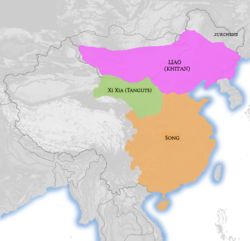
If the fall of the Tangut kingdom is your emotionally resonant moment in history, this is the movie for you. A combination of Russians, Mongolians, Kazhaks, and Germans have invested a lot of money and talent on the intuition that there are millions of moviegoers just like you.
Just in case you have never heard of the Tangut kingdom, this destruction, if you believe the movie, was the turning point in the early life of Genghis Khan. Its destruction begins and ends the movie; in between there is a rather curious account of the early years of the great conqueror, when he is repeatedly betrayed, defeated, robbed of all his meager wealth, and enslaved. The only positive elements in the story are his relationship with his wife, and his relationship with a blood brother who is not always on his side. Oh, he is also faithful to the Mongol code, which other people give lip service to but ditch whenever it is convenient. Thus Temugin's (Genghis' ) rough early years. He plays by the rules, everybody else cheats. But don't worry, he will undoubtedly return in a later movie (if financing is available) to teach the Mongols law. In the meantime, he looks soulful, and does not send away his wife, whom he chose when he was nine, even though there is a reasonable doubt about the paternity of her son. (She was kidnapped by his enemies and who knows what happened then.)
A whole bunch of cultural buttons are being pushed here, but if you're not a Central Asian it's not exactly clear what they are.
This may come across as a negative review, but actually it is a well made movie. It's just not Robin Hood. For the non-Central Asians among us, the most remarkable feature of the film may be the vast landscapes which fill the screen for the entire two hours.
Saturday, April 03, 2010
Oligarchy, democracy, and conciliar government
Jonathan Jarrett read this earlier post, suggesting that he go to Phil Paine's site and read these posts, and did so. He left a comment here and Phil responded here as well. I thought this conversation good enough to promote all the comments. And here they are:
Jonathan Jarrett said:
Phil Paine said...
Phil Paine said...
Jonathan Jarrett said:
I love both those posts, and I'd tell Phil so himself there but I see no room for comments. I do wonder whether, although I agree with his criticism of those historians who tend to see what they know should be in the evidence rather than what might be, Phil isn't guilty himself to an extent of seeing democracy wherever he looks. A social structure such as that he describes in the so-called 'super-towns' seems to me to be as readable as oligarchy as democracy, although I would admit that a community of 3-400 clan heads in an assembly would look quite a lot like an Athenian assembly... It's still really interesting though.
Another possible angle of the historians' perspective: a while back I saw something online, which indeed you may have linked here, about Inner Central Asia, Bukhara and that general (massive) neck of the woods, being a cradle of learning and urban civilisation for many centuries, something which was partly wiped out by the warfare of the Mongol Empire. That, too, reflected on the fact that few people nowadays can easily entertain the idea that there were huge cities there in what to us is the Middle Ages, largely because the area's subsequent history has been so much as the battleground for troops and troops of steppe warriors (I risk betraying much ignorance here). I wonder if the difficulty here isn't the apparent discontinuity with the present-day locations of power rather than the spectres of Athens and Ur. Though, contrariwise, Ur is hardly in a major power zone now. I just find it particularly hard to think my way into that Inner-Asia-high picture of the world, even though I grasp it intellectually, because it's so far off my mental world map of today, and I wonder if that is all educational or if some of it is modern political (or indeed growing up in the Cold War when anything in that area was beyond study).
Thinking in type here, sorry. The Cold War training might be the strongest idea there.
Phil Paine said...
My focus was not on whether the Tripolye towns were "democratic" or not, but on the assumption that they could not be called cities because they had no palaces or temples. It is the Russian archaeologists who excavated them that came to the conclusion that they were governed by some sort of assembly. This is jumping the gun. They are guessing entirely on the basis of the configuration of buildings. Similar building patterns in many cultures around the world are characterized by consiliar management of various kinds. It is not conclusive evidence that they were run by a council. Hence my remark "a consular system, if that was indeed how they were governed".
My point is that Anthony accepts this consiliar interpretation, and because he sees the sites as not showing evidence of aristocracy, he automatically degrades them from "city" status, despite their clear urban nature. The facile equation of urbanization with aristocratic or priestly rule is what I am challenging.
This is part of a long-established notion that conciliar institutions are "primitive" and automatically disappear in a fixed series of "evolutionary" stages of "progress" (presumably toward the sophisticated acme of Napoleon or Stalin). This is the notion that I've always objected to.
Consiliar institutions are widespread in every era and location of the world, usually co-existent and intertwined with aristocratic institutions --- not as exclusive alternative. The balance is constantly shifting between them (the history of Athens or the Iroquois Confederacy show this well), with occasionally one eclipsing the other. Sometimes they can cooperated (as in Novgorod), and at other times they conflict. Historians raised to equate civilization with aristocracy have been systematically blind to evidence of conciliar institutions.
Central Asian cities are a special interest of mine. The Central Asian cities are a perfect example of another sin I complained about, the "accident of sequence". As long as the Soviet Empire existed, and Central Asia remained a modern backwater, global historians showed little interest in the Central Asian cities, despite the fact that they were huge, prosperous and politically powerful for many centuries. Cities as big as anything in Europe, in their day, were routinely discussed as if they were minuscule oases on a caravan route. The paleodemographer Tertius Chandler,asserts that Merv (in Turkmenistan) was briefly the world's largest city in the 12th century. Yet this huge chunk of the Earth is known only vaguely to many people who consider themselves well-read in world history. A great philosopher such as Ibn Sina, for instance, has usually been discussed as if he lived in an abstract Islamic dimension, and not as somebody from Bokhara. But nobody would discourse on Peter Abelard without ever mentioning that he was French.
The Chinese government jams my e-mail, and attempted to take down my site, so I can't leave a comment function open (that's how they jam it), and I can no longer post an e-mail address online. Steve, however, can provide you with an alternative e-mail address if you contact him.
Phil Paine said...
A second thought (sorry, I tend to walk away from a comment and then think of something else to say while out for a bike ride). When one talks about "science" in the Middle Ages or the Ancient world, one doesn't have to constantly fend off objections that it wasn't like what they do now at CERN or CalTech. The differences and similarities between modern scientific practice and the activities of Archimedes and Roger Bacon that underly them are understood. It is still meaningful to talk about Archimedes as a scientist.
But when one brings up the practice of conciliar, or proto-democratic institutions, in ancient times, there is always a flurry of objections of the sort that this and that isn't "true" democracy. But that isn't the issue for someone making the points that I am making. I am concerned with accurately evaluating the historical role of conciliar governance (sometimes called "collective" or "egalitarian" governance, though these terms carry baggage I prefer to avoid). Conciliar governance often involves proto-democratic and sometimes unequivocably democratic procedures. These forms of decision-making by committee, consensus or voting compete with the powerful notion of aristocratic or autocratic rule. This is not a competition that has ever been fully resolved: right now, here in Canada, the Prime Minister is refusing to devulge documents on Canada's military activities in Afghanistan, even though Parliament, which is supposed to be supreme in these matters, has demanded it. A very ancient struggle is going on, one that is well known to students of constitutional history.
The evolutionary scheme absorbed by many historians, on purely theoretical grounds, dismisses conciliar institutions as primitive and irrelevant to civilization. It is this evolutionary scheme that I strenuously object to.
Athens has always been a thorn in the side of that scheme, because it doesn't fit into it at all. So the solution, for many, has been to wall off Athens, or all the Greek city states, into a separate category and to fend off any suggestion that it might not be unique. If Greek democracy is always portrayed as uniquely exceptional, some weird event outside of "normal" cultural patterns, then the a priori scheme of democracy being a negligible "primitive" stage of history can be preserved. If, however, processes similar to those that took place in Athens turn up elsewhere, in different times, places and cultures, then the whole castle of cards trembles and, I hope, can be made to fall.
The issue of Oligarchy is quite relevant to this. All settled communities are vulnerable to aristocratic rule, for the same reasons that all restaurants in big cities are vulnerable to mafia shakedowns. Anyone who has the military skills to kill peasants and burn crops, control trade routes, or extract protection payments is a formidable threat to conciliar self-rule. The majority of human communities have been saddled with some sort of aristocracy. Nevertheless, other forms of decision-making have survived, and occasionally have consolidated enough to keep aristocrats at bay. These are the building blocks of today's existing (and hopefully tomorrow's emerging) democratic polities.
Yes, most of the polities that I describe as "proto-democratic" or "conciliar" were, at best, oligarchies. Athens was best describable as an oligarchy most of the time. Even when the democratic component was on the ascendant, the aristocrats didn't go away... they spent all their time scheming to overthrow or subvert it. Even "modern" democracies face this problem. Anyone familiar with the history of the United States knows that for generations, states like Alabama and Mississippi may have been like Vermont and Wisconsin on paper, but in reality were crude oligarchies enlivened by lynch mobs. Yet that doesn't invalidate the United States as an object for the study of democracy, or eliminate the concept from its history.
-

-
Wow, thankyou for the exhaustive reply, and sorry about the inadvertent straw-man. I shall keep the phrase `accident of sequence' by for the many parallels out there.
Subscribe to:
Posts (Atom)