One of Chesterton's most famous essays is an early one (1901) called "in defence of penny dreadfuls" – "penny dreadfuls" being what we might call "pulp fiction," but for adolescents. Apparently many cultural pedagogues of the time were exercised by the popularity of such "vulgar" stories and wished them to be replaced by genuine literature. GKC is half – puzzled and half – offended by this alarm. He has no wish to defend the dreadfuls as literature but he does want to defend them as "the actual centre of 1 million flaming imaginations." To Chesterton, "the simple need for some kind of ideal world in which fictitious persons play an unhampered part is infinitely deeper and older than the rules of good art, and much more important. Every one of us in childhood has constructed such an invisible dramatis personae, but it never occurred to our nurses to correct the composition by careful comparison with Balzac." In fact, he continues, "literature is a luxury; fiction is a necessity." That is while we can live without Balzac, brilliant though he may be, the penny dreadfuls are actually vital to human well-being.
Showing posts with label literary studies. Show all posts
Showing posts with label literary studies. Show all posts
Saturday, May 21, 2016
GK Chesterton and Alan Jacobs discuss fiction and literature
I am reading Alan Jacobs' The Narnian: the life and imagination of CS Lewis. On page 123 Jacobs has a very interesting comment on GK Chesterton.


Friday, November 12, 2010
One scholar's view on love, beauty and courtliness in the Middle Ages
In what follows, I will show that nobility is an attribute of bodies, that it is visible, and that visible nobility provokes love.…Page 91:
The heroes and heroines Middle High German romance can hide their individual identity, but it is impossible for them to hide their noble identity. Their bodies give them away...
When Oringles comes across Enite,... [he] has no idea who she is. This much, however, he can tell "she is in truth a noble woman: that is proved by her most beautiful body."...
Just as the beauty of bodies incites love, so does the nobility of bodies, of which their beauty is an unmistakable index. Meinloh is devoted to a woman he has not even spoken with because "my eyes saw the absolute truth: she is noble and beautiful."
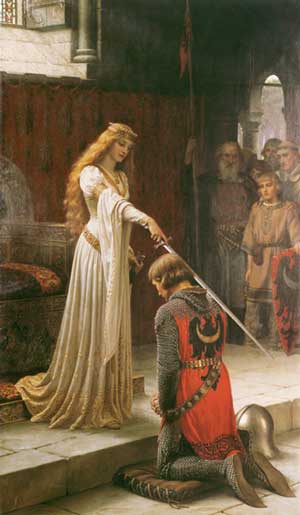
Courtly lovers do not respond to a sexy body or to an engaging personality or to a mere display of wealth. They fall in love with an ideal of courtly nobility. This ideal presents itself as a single image that combines a noble body, courtly virtue, splendid clothing, and the visible mastery of courtly skills. When someone susceptible to these qualities sees them realized in the highest form, that person is taken aback, is captivated, and falls in love.Image: The Accolade, by EdmundBlair Leighton.
Tuesday, November 17, 2009
The danger of a single story
A thought-provoking talk by Chimamanda Adichie from TED. "It's not that stereotypes are false, it's that they are incomplete."
Thursday, August 20, 2009
Blogging, especially medieval blogging, is a dangerous occupation

Witness I Have Consumed and Excreted Your Blogger.
As another medievalist blogger, at least part of the time, I have to call this an impressive performance.
Subscribe to:
Posts (Atom)