I ate dinner with Martha Carlin of the University of Wisconsin-Milwaukee last night and among other subjects we discussed was her use of my Tales from Froissart website for some of her medieval history classes. She mentioned that she had links to a lot of sources on her academic home page.
Boy, does she ever!
And of sources related to food and culinary history, she has a mountain. I had no idea, and probably you don't either, how much is available.
Showing posts with label medieval resources. Show all posts
Showing posts with label medieval resources. Show all posts
Saturday, May 15, 2010


Friday, May 14, 2010
A wonderful new resource -- The Online Froissart
I am currently at the International Congress on Medieval Studies at Western Michigan University, in Kalamazoo. "Kalamazoo," as many people call it, is my favorite academic conference, big, sprawling, varied, on the informal side. Sometimes the weather is even springlike, rather than wintry or summery! (But you can't count on anything, weatherwise!)
Today I had the pleasure of being introduced to a new scholarly resource by its designers, who put it through its paces, to our growing appreciation. It is the Online Froissart, an electronic edition and translation of the famous 14th century chronicler.
About a decade ago, I started typing Tales from Froissart out of my copy of Johnes' early 19th century translation and onto the Web. I am in a good position to appreciate how much of an advance this is. This is huge, since it allows you to browse transcripts of lots of manuscripts, collate (compare) them with each other, examine images, etc., etc. One example: if you click on a word in the French text, the program takes you immediately to a definition at the ATIFL Middle French dictionary. This kind of generosity reminds me of undeserved divine grace.
Although there are still improvements to come, especially in the use of more dynamic instruction,please have a look at it now. Poke around and get beyond that bland exterior. It's time to rock 'n' roll Froissart!
And if you've got an ms. of your own that you want to study, know that the most useful parts of this program are open source.
Today I had the pleasure of being introduced to a new scholarly resource by its designers, who put it through its paces, to our growing appreciation. It is the Online Froissart, an electronic edition and translation of the famous 14th century chronicler.
About a decade ago, I started typing Tales from Froissart out of my copy of Johnes' early 19th century translation and onto the Web. I am in a good position to appreciate how much of an advance this is. This is huge, since it allows you to browse transcripts of lots of manuscripts, collate (compare) them with each other, examine images, etc., etc. One example: if you click on a word in the French text, the program takes you immediately to a definition at the ATIFL Middle French dictionary. This kind of generosity reminds me of undeserved divine grace.
Although there are still improvements to come, especially in the use of more dynamic instruction,please have a look at it now. Poke around and get beyond that bland exterior. It's time to rock 'n' roll Froissart!
And if you've got an ms. of your own that you want to study, know that the most useful parts of this program are open source.
Tuesday, April 20, 2010
Medieval soldiers' profiles
Once upon a time the scholarly site The Soldier in Later Medieval England had a feature called Medieval Soldier of the Month. It's now called Soldier Profiles. Highly recommended, especially to students who take my 2010 fourth-year seminar on chivalry and medieval men-at-arms.
Sunday, November 15, 2009
Friday, January 02, 2009
Karen Larsdatter's site

I know I mentioned this site long ago, but I lost track of it, and I am sure that many of my readers have never heard of it.
Actually Karen Larsdatter, one of those public benefactors like Roger Pearse, has two projects worthy of note. The first, Material Culture Linkspages for the Middle Ages and Renaissance, I will let her describe herself:
Links to material culture (stuff!) from the Middle Ages and Renaissance, including representations in period artwork. Some of these focus on garments, or surveys of occupational dress, or even animals. For a complete list of the linkspages and articles on this site, see the sitemap.
A good example is her recent linkspage on depictions of knighting ceremonies from datable manuscripts.
And if you want to keep up with her new linkspages and other interesting news, she's got a blog.
Image: The knighting of Roland as depicted in the mid-13th century.
Sunday, December 07, 2008
Medievalists.net now open!
Peter Konieczny tells me his all-purpose medievalists' news and resources site, Medievalists.net is open and ready to meet your every need. Go see what it has to offer.
Monday, November 24, 2008
For your holiday gift lists
 Will McLean, re-enactor extraordinaire, wrote a guide to Daily Life in Chaucer's England a decade or so ago; I liked it and once used it as a text for a course on 14th century England. Now, not quite in time for Christmas (but perhaps before New Year's) the second edition is coming out. Bigger, better, and with a snappier cover.
Also maybe in time for Christmas, Darrell Markewitz, blacksmith and ironmonger, is putting out a DVD on his research trip to Denmark earlier this year. The DVD is being put together in connection with a talk he is giving at the Peterborough, Ontario SCA meeting of November 26 (Traill College, 8 pm). To get an idea of what will be included in the DVD and whether you would be interested, have a look at this post on Darrell's all-historical-ironwork-all-the-time site, Hammered Out Bits.
Thursday, July 24, 2008
Two useful resources for HIST 3116, Crusade and Jihad
Although I hope all my students in this fall course are enjoying the perfect weather I've been out in today, there will come a time when this post will prove useful. I'm noting two resources, one online, one in print and in the Nipissing University library.
The online resource is Crusades-Encyclopedia, a large and varied assemblage of useful texts and commentary. It has been lovingly compiled by the energetic Andrew Holt. This is the place to go for a lot of things: a historical text our library does not have, what a famous scholar said that made the scholar famous (historiography!), or a short introduction to many, many basic terms, persons, and places.
If you need quick help on some medieval subject not obviously to be found in Crusades-Encyclopedia, and the library is handy, go looking for The Dictionary of the Middle Ages at Library of Congress class D 114. Despite the name, it is a 13 volume encyclopedia which will be quite good for initial orientation or basic fact checking on a great many subjects, including many aspects of the Crusades.
Happy exploring!
Thursday, July 03, 2008
14th century economy and society
 Over at A Commonplace Book, Will McLean has a couple of short articles on the English social hierarchy at the time of the Canterbury Tales, and the value of money at the same time.
Image: A Richard II London groat (4d or pence) from a site by Ivan Buck. Alas, no depiction of the golden angel.
Update: Hoisted from comments:
Saturday, May 10, 2008
Medieval soldier of the month
I am currently at the International Congress on Medieval Studies in Kalamazoo.
Yesterday I was at a session based on the online database The Soldier in Later Medieval England, and one of the directors reminded me that there is a feature called Medieval Soldier of the Month. Go here to see May's soldier, Walter, 5th lord Fitzwalter of Little Dunmow, Essex.
Back to the conference!
Yesterday I was at a session based on the online database The Soldier in Later Medieval England, and one of the directors reminded me that there is a feature called Medieval Soldier of the Month. Go here to see May's soldier, Walter, 5th lord Fitzwalter of Little Dunmow, Essex.
Back to the conference!
Thursday, April 03, 2008
Checking out the archives of Vic
At any good university the historians insist that students use original sources. But only a few early medieval historians get to use sources like this in their original form:
 The archive in question is in Vic, in Catalonia (which may be in Spain, depending on who you ask).
Also in Vic is this modern statue 11th century bishop Oliba, which symbolizes his connection to the Peace and Truce of God, which students in HIST 3116 next fall will be learning about to their complete satisfaction.
Thanks to Jonathan Jarrett at A Corner of Tenth-Century Europe who had entirely too much fun in the archives.

 The archive in question is in Vic, in Catalonia (which may be in Spain, depending on who you ask).
Also in Vic is this modern statue 11th century bishop Oliba, which symbolizes his connection to the Peace and Truce of God, which students in HIST 3116 next fall will be learning about to their complete satisfaction.
Thanks to Jonathan Jarrett at A Corner of Tenth-Century Europe who had entirely too much fun in the archives.

Monday, March 31, 2008
Heroes of medieval historical research
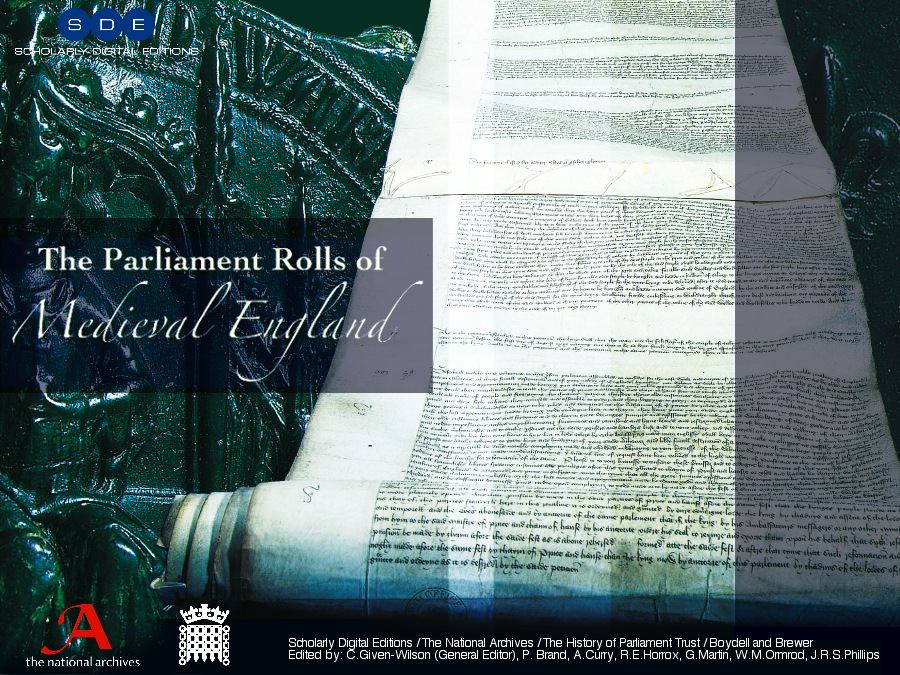 Perhaps because I am teaching communism at the same time as the history of medieval England, I am minded to award to my students in HIST 3425 the heretofore unheard of award, "Heroes of Medieval Historical Research, Undergraduate Class," for unprecedented efforts in tackling the Parliamentary Rolls of Medieval England.
PROME is a wonderful resource, a CD/online searchable edition of all the medieval records of parliament from the beginning until they stopped using rolls and started using codices. By then you are well into Tudor times. Nipissing University allowed me to acquire a site license to PROME and so I was able to assign my Medieval England students an essay based on these valuable primary resources. They just finished that assignment.
They are not heroes because they did well on the assignment (how well they did is not your business) but because their diligence in research showed up on the site statistics of the online version of PROME. The publishers (see link above) noticed and wrote to their contact at the NU Library and said, who's making such substantial use of our material? (They were very pleased.) My students had beat the entire scholarly world for the month of March!
Congratulations, heroes!
Saturday, March 15, 2008
Mesterinde Karen Larsdatter's site

The Society for Creative Anachronism gets a lot of flak from scholars, some of it quite justified (ask an SCA member!), but in its ranks are a fair number of people who have spent 10, 20 or 30 years researching their particular interest from a re-enactor's or recreator's point of view, and these people sometimes know things no one else does.
Nowadays it's easier for such people to do research and make available the results. One of those people is Mesterinde Karen, who has put together structurally simple but very valuable pages showing representations of medieval objects. Will McLean spotted the ones showing tournament galleries and the barriers or fences that marked off listfields, and alerted me through his blog. But larsdatter.com seems to have much more. And it's searchable.
Image: Lancelot and Gawain as imagined in the early 15th century.
Tuesday, March 04, 2008
The Palace of Westminster --developing before your very eyes!

A friendly contributer to the medieval history list Mediev-L has just alerted me to an online "film" of the development of the Palace of Westminster, the home of the UK Parliament and one of the most historical sites in Britain. Well worth taking some time with.
I'm not quite sure who is responsible for this site. It may be a commercial site and other such presentations may be available from the home page.
Sunday, February 24, 2008
Anglo-Norman Dictionary online

A kind contributor to the Mediev-L list just told me about this handy dictionary!
Image: Edward II in Langtoft's late 14th century chronicle, written in Angl0-Norman.
Sunday, January 27, 2008
Medieval soldiers
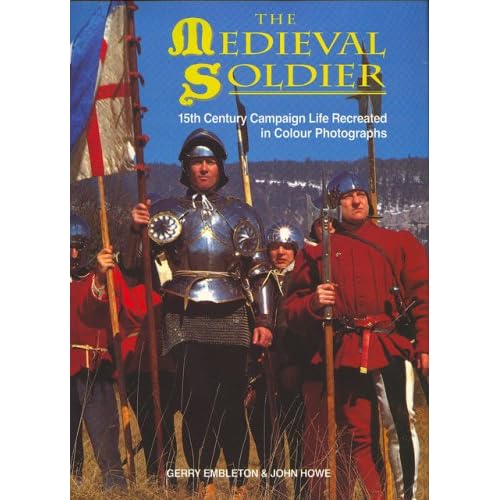
Will McLean has a blog called A Commonplace Book: Deeds of Arms and Other Matters Medieval and Otherwise. His interests and mine overlap considerably, which is only natural, since we've been friends for years, sharing information and insights about the history and conduct of medieval deeds of arms.
Will has had some good posts recently. One, called Haubergeons, is a spin-off of a post of mine on "mail-shirts," wherein he spells out some features of the medieval army discussed in the first French ordinance of arms and makes some comparisons to English armies of the same century. I'll be writing on this material, too (mostly the French), so I was interested, and maybe you will, too.
His most recent post springs from his discovery of an on-line data base called The Soldier in Later Medieval England. I know there are people out there who will be as pleased to see this as I was, and Will's own comments are worth reading.
Image: borrowed from the Amazon site for this book.
Friday, September 14, 2007
The Coutumes De Beauvaisis of Philippe De Beaumanoir, trans. by Akehurst
Last month I decided that I needed to see what this book, a summary of legal doctrine and procedure in one north French province, said about warfare. When I got hold of this translation of Beaumanoir's Customs of the Beauvaisis I found that I couldn't put it down. Legal texts of any era are not usually my favorite reading, but this had so much personality. I probably ended up reading two thirds of this heavy tome, without complaint.
One warning: given the scholarly debates around the terms vassal and fief I found it rather unfortunate that the translator was not absolutely clear what Old French terms he was translating when he used these English words.
One warning: given the scholarly debates around the terms vassal and fief I found it rather unfortunate that the translator was not absolutely clear what Old French terms he was translating when he used these English words.
Saturday, June 30, 2007
Pecia: a blog on manuscripts

Anyone who can read French and who is interested in medieval manuscripts might want to go by the blog Pecia and have a look.
Friday, June 22, 2007
Other medieval blogs
There are a number of medievalists who write weblogs. Some of those blogs are devoted to tales of survival in the academic life; others are more focused on medieval subject matter; a few are quite substantial, and include some of the fruits of the author's scholarly efforts. Let me draw your attention to a couple of the latter, and then two more resources worth knowing.
Matthew Gabriele teaches at Virginia Tech and writes a blog called Modern Medieval. I'll bet he's a good teacher by my own personal standards, because he clearly does not believe that the Middle Ages are dead and gone, or impossibly remote. Two posts illustrate this, the first being Tony, meet Chuck, wherein he draws an interesting and I think non-trivial parallel between Tony Soprano and Charlemagne: people now aren't sure that Tony Soprano is dead, and people then weren't sure Charlemagne was. You may say that Tony Soprano is a fictional character, while Charlemagne was a real person, but then I'd ask you to reread The Song of Roland and explain your position in light of that.
A second post is more somber: Gabriele teaches at that same Virginia Tech where the shootings took place, and this eventually inspired him to write a short essay called The New Relevance of the Middle Ages at Virginia Tech. He made two major points in it: first, the motivations of the killer were not all that different than the motivations from those that inspired the First Crusade; second, in looking for hope Gabriele says:
Here I have to say that it's easier to say what "the world" says or thinks than to prove it. We don't know what the majority thought or did in 1095. Certainly we know what a dynamic and influential minority did and were able to do. But the rest? Did they agree or were they just ignored, or steamrollered? And it's pretty sure that no Yakutians or Incans were involved at all.
Now, of course, we hear lots of cries of horror, but also lots of influential calls for more bombings and more secret prisons.
Nonetheless I look forward to more reading at Modern Medieval.
Modern Medieval has already made me aware through its blogroll of A Corner of Tenth-Century Europe. This blog, which seems to be anonymous, has lots of scholarly comment on things I find interesting, including an essay on whether material motivations influenced the Crusaders. The 10th century blogger rightly says that recent scholars have downplayed the idea that members of the First Crusade enlisted to get rich quick, for the reason that it was appallingly dangerous and expensive to go. A good point, but our blogger wonders if the First Crusaders knew it was such a bad bet (a point also made by others).
Having studied the motives behind warriors taking part in dangerous "deeds of arms" I ask, didn't they use a different calculus of risk back then. There were plenty of cautious and conservative people in 1095, but weren't active warriors expected to be risk takers beyond what was normal? They sure were expected to be stronger and braver.
I've mentioned this blog before, but I'll mention it here again for new readers: Medievalists.net is a compilation of a lot of valuable material, especially the section called News for Medievalists. And I should mention, too, the section of About.com devoted to the Middle Ages. It is edited by Melissa Snell, who has a fine, light touch and shows a lot of imagination in her compiling of good material from the Web.
Matthew Gabriele teaches at Virginia Tech and writes a blog called Modern Medieval. I'll bet he's a good teacher by my own personal standards, because he clearly does not believe that the Middle Ages are dead and gone, or impossibly remote. Two posts illustrate this, the first being Tony, meet Chuck, wherein he draws an interesting and I think non-trivial parallel between Tony Soprano and Charlemagne: people now aren't sure that Tony Soprano is dead, and people then weren't sure Charlemagne was. You may say that Tony Soprano is a fictional character, while Charlemagne was a real person, but then I'd ask you to reread The Song of Roland and explain your position in light of that.
A second post is more somber: Gabriele teaches at that same Virginia Tech where the shootings took place, and this eventually inspired him to write a short essay called The New Relevance of the Middle Ages at Virginia Tech. He made two major points in it: first, the motivations of the killer were not all that different than the motivations from those that inspired the First Crusade; second, in looking for hope Gabriele says:
If nothing else, the Middle Ages show us how the intellectual path we’re on isn’t the only one available. In 1095, 100,000 people thought that violence could bring peace. In 2007, Seung Cho believed the same and the world cried out in horror. Cho took one path from 1095 and the vast majority took the other. In and of itself, and in the middle of all this sadness, this is a reason for hope.
Here I have to say that it's easier to say what "the world" says or thinks than to prove it. We don't know what the majority thought or did in 1095. Certainly we know what a dynamic and influential minority did and were able to do. But the rest? Did they agree or were they just ignored, or steamrollered? And it's pretty sure that no Yakutians or Incans were involved at all.
Now, of course, we hear lots of cries of horror, but also lots of influential calls for more bombings and more secret prisons.
Nonetheless I look forward to more reading at Modern Medieval.
Modern Medieval has already made me aware through its blogroll of A Corner of Tenth-Century Europe. This blog, which seems to be anonymous, has lots of scholarly comment on things I find interesting, including an essay on whether material motivations influenced the Crusaders. The 10th century blogger rightly says that recent scholars have downplayed the idea that members of the First Crusade enlisted to get rich quick, for the reason that it was appallingly dangerous and expensive to go. A good point, but our blogger wonders if the First Crusaders knew it was such a bad bet (a point also made by others).
Having studied the motives behind warriors taking part in dangerous "deeds of arms" I ask, didn't they use a different calculus of risk back then. There were plenty of cautious and conservative people in 1095, but weren't active warriors expected to be risk takers beyond what was normal? They sure were expected to be stronger and braver.
I've mentioned this blog before, but I'll mention it here again for new readers: Medievalists.net is a compilation of a lot of valuable material, especially the section called News for Medievalists. And I should mention, too, the section of About.com devoted to the Middle Ages. It is edited by Melissa Snell, who has a fine, light touch and shows a lot of imagination in her compiling of good material from the Web.
Wednesday, June 06, 2007
Song of Roland
 Richard Nokes at Unlocked Wordhoard cites an interesting post on the Song of Roland by the single-named Jacob at the University of Arkansas who, after reviewing a new translation of Roland, reflects in an interesting manner on the poem itself, and as Nokes has already said, provided some possible topics for future and non-plagiarized papers.
Image: The so-called horn of Roland, a real medieval elephant-tusk horn, or olifant.
Subscribe to:
Posts (Atom)
Got no golden angel, but can do you a golden leopard... a relevant one too :-)