Showing posts with label ecclesiastical history. Show all posts

Sunday, May 15, 2016

Why Can the Dead Do Such Great Things? Saints and Worshippers from the Martyrs to the Reformation, by Robert Bartlett

This sounds like a fantastic book. But then he's written them before.  

Bartlett, Robert. Why Can the Dead Do Such Great Things? Saints and Worshippers from the Martyrs to the Reformation


   Reviewed by Diane Fruchtman

        DePauw University

        dianefruchtman@depauw.edu


Robert Bartlett's Why Can the Dead Do Such Great Things? is delightful. Its acuity, readability, and impressive aggregation of fascinating details make it a compelling, useful, and thoroughly enjoyable read at any level of expertise. While the book is not without fault, its strengths as an avenue into the complex and multifaceted world of saints and worshippers in the Middle Ages far outweigh its shortcomings. Bartlett has a knack for selecting beautifully illustrative and compelling quotations from a wide range of primary sources to illuminate his points, allowing him to present, in glorious array, the diversity of the cult of saints. The book is a wonderful blend of judicious synthesis and confident command of detail, and its almost conversational progression of topics helps maintain and cultivate the reader's curiosity.


Bartlett offers his readers a chronological introduction to the cult of saints before branching out to a thematic exploration. Part one, "Developments," includes chapters on "Origins (100-500)," "The Early Middle Ages (500-1000)," "The High and Later Middle Ages (1000-1500)," and "The Protestant Reformation." While Bartlett occasionally uses primary sources uncritically (for instance, treating the whole of The Martyrdom of Polycarp as a contemporary account [2]), and while some of his chronological choices are curious (for instance, waiting until the second chapter to introduce Christian ambivalence about the power of the saints' bodily relics), in general these chapters provide an excellent diachronic overview of Western Christian saint veneration, one that lays a solid and necessary framework for the thematic chapters to come. The narrative Bartlett offers is familiar and succinct, yet filled with enough astute observations to make even a seasoned scholar pause and ponder. The chapter on the Reformation is rather too brief: Bartlett touches upon Luther, Zwingli, the Tudors, and Calvin just long enough to register these Reformers' varied rejections of the cult of saints, though not long enough to explore the underpinnings and manifestations of those rejections. Furthermore, the Catholic Reformation, to which the cult of the saints was essential and whose impact on saint veneration was substantial, is wholly absent from Bartlett's narrative. Nonetheless, this historical sketch is an excellent and compelling invitation into the medieval world of saints and worshippers; not only does it provide an accessible historical trajectory for the reader's reference, it piques the reader's interest and prompts questions for further study, many of which are addressed in later chapters.


The second (and far more substantial) section of the book (Part II: "Dynamics") is where Bartlett's brilliance most shines through, as he examines the cult of saints from many different angles, turning the jewel, so to speak, so that we can fully appreciate each facet. These ten chapters, covering topics as varied as liturgical calendars, literary effusions, pilgrim garb, and satirical skepticism, are so wide ranging and engaging that they warrant individual attention here.


"A saint was not a person of a particular type but a person who was treated in a particular way. That 'way' can be summed up by the word 'cult' and its three key elements were public recognition of the name and the day of the saint; special treatment of the saint's bodily remains; and celebrations of the saint in writing" (95). With these parameters, Bartlett (chapter 5: "The Nature of Cult") offers a conceptual foundation for how we can identify saints and their cults. Though sainthood remains in the eye of the beholder, historians and scholars can identify a cult by establishing that worshippers maintained a special relationship to the saint's name, body, and textual traditions. This chapter also assesses the purpose of cult--briefly stated, it is patronage, on a level slightly more accessible than dealing directly with God. The saints intercede on behalf of their petitioners, can be invoked by them, and are bound by the patron's rules of reciprocity, such that saints could be "shamed" or "humiliated" should their intervention seem in need of prodding.


Chapter 6, "Saints' Days," addresses the timing of saints' veneration and celebration. Bartlett describes the development of various liturgies for the saints (showing, in compelling detail, how murky and unsystematic this process often was); the hierarchy of feast days; how the celebration of saints' days varied by locality and thus served to carve out and reinforce local identities; and finally, how those holy days were publicized and celebrated in the lay calendar. This short chapter shows in microcosm the strengths of the book as a whole--attention to detail, illustrative examples, and an overarching dialogic tone that first illuminates what scholars "know" and then problematizes that body of knowledge by addressing questions the reader may not have considered, ultimately providing a cautious and nuanced overview of the topic. Similarly compelling is chapter 11, "Dedications and Naming." Once again, Bartlett sheds light on lesser-noted aspects of the cult of saints: the politics, logic, importance, consequences, and power of naming children after saints; the history of popes taking on saintly names as they ascend to office; the regional patterns of naming conventions, etc.

Chapters 7 and 8 tackle "Types of Saints" and "Relics and Shrines," respectively. Chapter 7 begins with the difficulties inherent in the historiographic project of counting saints--not least of which is the question of whom one should count. After describing the benefits and limitations of several models (delimiting by time, geography, canonization attempts, successful canonizations, etc.) and offering some insight into the data we think we have, Bartlett proceeds to discuss all of the various categories of saints he can muster, including Mary, angels, apostles and evangelists, martyrs, confessors (including doctors of the church, bishops, abbots, and hermits), virgins, Old Testament saints, lay saints, and royal saints (with a subsection on female royals). Then, acknowledging that any identity-based schema will fall short, Bartlett explores saints categorized by their roles as patrons of specific churches, cities, "nations," and individuals. The short sections allow the reader to peruse closely the examples that Bartlett offers, making the chapter, despite its length and encyclopedic potential, immensely readable--it is concise without being inane, wide ranging without ever becoming list-like. The "Relics and Shrines" chapter is, likewise, well structured and clear. It spans the various forms of relics (including body parts and contact relics), the logistics of shrines (their location and management), the collection of relics (in reliquaries and as objects of trade and theft), the movement of relics (in translation, procession, exchange, and theft), how relics appear in legal and military scenarios, and disputes about relics (both about their possession and about their validity).

One of the most satisfying chapters in this book, chapter 9 ("Miracles"), combines survey and analysis, incorporating medieval theories of the miraculous as well as scholarly debates about how to approach, quantify, and analyze the miracles we see in medieval sources. The chapter moves from theorizing and problematizing the miraculous to highlighting and exploring various categories of miracles, first by type (healing, provision, visions, prophecy) and then by context (war, against demons, among animals, in response to scoffers).

Less satisfying is chapter 10, on pilgrimage. While the chapter as a whole is replete with excellently chosen and illustrative quotes, an array of scholarly perspectives, and useful information, Bartlett's frame is perplexingly unhelpful. The chapter begins with a discussion of "Origins and Definitions," which opens with the following: "Unlike Judaism or Islam, Christianity did not originally have the idea of pilgrimage, that is, journeying to a holy place, a specially sanctioned spot with intrinsic spiritual significance like Jerusalem or Mecca" (410). Not only does this ill-judged preamble assume a clear historical separation between Judaism, Christianity, and Islam (such that we can accurately assess "original" practices, as if each tradition emerged neatly as a discrete and distinct entity), it employs a definition of pilgrimage that limits the phenomenon to the purely physical. At the end of the chapter, Bartlett mentions--almost as an aside--the idea that a human's whole life is a pilgrimage to God, but this idea is both early and ubiquitous in Christian thought, from New Testament injunctions that a Christian should live "as a stranger and a pilgrim" in the world (Heb 11:13; 1 Pet 2:11) to Augustine's repeated characterizations of life as pilgrimage. On the one hand, by circumscribing pilgrimage as physical, Bartlett has facilitated his description of what medieval pilgrimage to the shrines of the saints looked like, what it entailed, and how it was thought of; on the other hand, he has foreclosed exploration of the spirituality that lies at the heart of the Christian experience of pilgrimage and alienation more broadly. Nonetheless, the chapter does compass some excellent topics of focus, including the debates over the localization of sanctity in a tradition whose divinity is transcendent, the various accouterments of shrines and their visitors, and the nuts-and-bolts logistics of medieval pilgrimage.

Chapters 12 and 13, on "Images of the Saints" and "The Literature of Sanctity," once again represent Bartlett at his best. These vast topics are treated with attention to detail, superbly selected examples, and fair representations of current scholarship and historical debates alike, all suspended in a clear and helpful organizational framework. In chapter 12, Bartlett explores the rise of images in the cult of saints as "focused on devotion rather than just being mimetic or memorial" (472), and he gives a clear and sensitive overview of iconoclasm (both East and West) before discussing the manifestations of the iconophile victory in various media and contexts. Likewise, in chapter 13, Bartlett's treatment of the literature of sanctity explores the whys and wherefores of writing about saints (including a brief discussion of hagiography as both a genre and a source for historians of religious life) before addressing various manifestations in legendaries, miracle books, sermons, canonizations, and vernacular hagiography.

Confidence in the cult of saints, generally speaking, was a consistent feature of Christian life in the medieval Latin West. But in every generation there were objectors, Christians who felt that the cult of the saints was ridiculous, idolatrous, polytheistic, pointless, or simply distracting. This "Doubt and Dissent" forms the subject of chapter 14. Beginning with Vigilantius, Bartlett moves from early medieval dissenters to the "Western Heretics" (the Cathars, Waldensians, and Lollards), finally proceeding to address the more diffuse skepticism that pervaded medieval cultures: the "bubbling broth of mockery, disrespect, doubt, disbelief, disdain, and derision" that stood in contrast to the "serious and principled" objections of the "heretics" (596). Recorded in hagiographies (where these doubters were invariably overcome) and in satire (where true sanctity is inviolate and sham sanctity a comedy of errors), this "skepticism and scoffing" usually served to reinforce the cult of the saints, rather than to undermine it. Bartlett ends the chapter with a section on "policing the saints"--how the Church controlled the proliferation of veneration and in effect instituted its own internal and ultimately cult-preserving systematic doubt and dissent. This chapter is essential to the book, providing a much-needed counterbalance to the attitudes seen in other chapters. And its placement at the end, concentrating all naysayers in one final content chapter, serves well to highlight positions that, if dispersed among other topics, might have been overwhelmed. It leaves the reader with a strong sense that there is much more to be known and to be questioned than she has already encountered. On the other hand, the separation of "doubt and dissent" into its own chapter replicates the impression that these positions were marginal and worthy of exclusion from the general discussion of saint veneration, an impression only underscored by Bartlett's unqualified use of terms like "heretic" and "orthodox."


The only thoroughly disappointing chapter is the final one, "Reflections," which is preoccupied with the conceptual origins and transcultural touchstones of the cult of saints. Bartlett explores whether saint veneration was an extension of pagan devotion to the gods, an offshoot of nature-worship, a negotiation of ancient mortuary practice, a consequence of Abrahamic views about inhumation, and/or a cousin to ancestor veneration. In each case, Bartlett presents the possibilities alongside scholarship that has assessed them, and in each case unsurprisingly finds the cult of saints unique in some way, not entirely attributable to one or another theory of origination. The question is: why do these possibilities, so long and so clearly discredited and so reductive of the topic itself, need to be aired? They are certainly less illuminating than a phenomenological or theological analysis of saint veneration would be. Singularly problematic is the final section, "Comparisons and Conclusions." The evenhanded diplomacy, helpful documentation, and reader-focused progression of topics evidenced elsewhere in the book are all lacking here, and Bartlett's comparisons are facile and unhelpful. He makes unsubstantiated comparisons between martyrdom in Christianity, Islam, and Judaism, resorting, for example, to the historically incorrect commonplace that Christian martyrdom is "marked off" from "Muslim martyrdom by its almost exclusively passive character" (634); furthermore (and once again with no supporting citations), he asserts that "in their radical asceticism Christian saints are closer to the holy men of Hinduism and Buddhism than to those of Judaism or Islam" (634). Comparisons between and across traditions must not be grounded in superficial external similarities but in contextual study that respects the intricacies of each tradition in the appropriate historical moment. Without sufficient care, comparisons are at best academically useless and at worst politically irresponsible. It was disappointing to see such carelessness here, at the end of such a strong book.


Also disappointing is the absence of an answer to the title's query: Why can the dead do such great things? Intermittently throughout the text we catch possible glimpses of medieval reasoning regarding the theology, anthropology, and soteriology behind belief in the efficacy of saintly intercession, but the question is never an object of focus or direct discussion, despite the fact that, for medieval thinkers, it often was. Of course, it would be impossible to address all of the cultural and theological logics that made the cult of the saints intelligible to practitioners, but given Bartlett's elsewhere evident talent for presenting disputed ideas in a productive and illuminating way, the omission of this central topic, a key feature of medieval spirituality and the medieval logic of sainthood, is jarring. Bartlett's is not a history of theology, but a history of practice, overwhelmingly¬--the two must be considered in tandem to be fully understood.


Aside from these (perhaps parochial) disappointments, the book is both a fantastic resource and an enjoyable read. Despite its concatenation of sources and exempla, the book never feels list-like or tedious, and the author's skill in selecting topics, quotations, and references makes the reader more than usually inclined to use this as a jumping-off point for further exploration--a
quality that makes this work particularly well suited to casual readers seeking an exciting overview of the medieval cult of saints, upper-level undergraduates in classroom settings and exploring independent research projects, and academics interested in pursuing conversations across areas of specialty. Frankly, it is difficult to imagine a scholar who would not glean something new from reading this work

Thursday, September 26, 2013

In Georgia in the Caucasus, a modern stylite monk revives living on a stone pillar

Here's the story (Radio Free Europe/Radio Liberty):
In an isolated part of the Caucasus, a monk is spending his days in prayer and silence atop a 40-meter pillar of limestone in western Georgia (near the town of Chiatura). The Katskhi Pillar was used by stylites -- Christian ascetics who lived atop pillars and eschewed worldly temptations -- until the 15th century when the practice was stopped following the Ottoman Empire's invasion of Georgia. For centuries the pillar was abandoned and locals could only look up at the mysterious ruins on its summit. Finally, in 1944, a mountain climber ascended the pillar, discovering the skeleton of a stylite and the remains of a chapel. Shortly after the collapse of communism and the resurgence of religion in Georgia, former "bad boy" Maxime Qavtaradze (now 59) decided to live atop the pillar in the way of the old stylites. “When I was young I drank, sold drugs, everything. When I ended up in prison.... It was time for a change. I used to drink with friends in the hills around here and look up at this place, where land met sky. We knew the monks had lived up there before and I felt great respect for them." In 1993 Maxime took monastic vows and climbed the pillar to begin his new life. "For the first two years there was nothing up here so I slept in an old refrigerator to protect me from the weather." Since then Maxime and the nearby Christian community have constructed a ladder to the top, rebuilt the chapel, and built a cottage where Maxime spends his days praying, reading, and "preparing to meet God." As a result of the interest in the site there is now a religious community at the base of the pillar. Men with troubled lives come to stay and ask for guidance from Maxime and the young priests who live at the site. The men are fed and housed on the condition they join the priests in praying for around seven hours per day (including from 2 a.m. until sunrise) and help with chores. (19 PHOTOS) Photos by Amos Chapple.

Saturday, July 13, 2013

Michael the Syrian says

Concerning the War of the Birds.
In 1434 of the Syrian Era [A.D. 1123], a great war of the birds took place. Cranes and storks assembled for many days in the country from Amida to Tellakum (T'lxum/T'e"lxam). Then they began sending emissaries back and forth for three days. After a good deal of this traffic, they commenced fighting from the third hour [g411] until the ninth hour, shrieking loudly the while. There was a great slaughter on both sides. The storks were defeated and fled, and the war ended. Only God knows the reason for this. 
More on this important chronicle and its new English translation soon. 

Sunday, May 27, 2012

The Crusades and the Christian World of the East: Rough Tolerance, by Christopher MacEvitt. Another good one

Christopher MacEvitt's book has a certain resemblance to Giancarlo Casale's book on Ottoman exploration. It's about an important, difficult subject; it goes against the prevailing wisdom; and it is based on difficult research in fragmentary sources.

MacEvitt presents  the prevailing wisdom  about relations between Western Christians settling in the holy land and the Eastern Christians who already lived there, thus:  as a case of colonial segregation. There are not a lot of sources that discuss the legal situation, how legal doctrines actually worked, or how Eastern and Western Christians interacted in daily life. The sources we do have come from the 13th century, after the restoration of the kingdom of Jerusalem following its destruction in the 1180s. MacEvitt has returned to the 12th century, and done his best to find the real story of daily life in charters and, in the north where Armenian documents exist in some numbers, chronicles, to see whether different Christian groups actually lived strictly segregated.

Well of course, he concludes that 13th century evidence gives a false picture of the earlier era. In contrast to the effort by churchmen and legislators to classify people by ecclesiastical and even Christological criteria, the early crusader states were characterized by an effort to obscure the dividing lines. Although there was a strong argument for giving priority to the person's ecclesiastical allegiance in legal and status matters, MacEvitt portrays a society where most people did not want to live in religiously-defined silos. They wanted to have a certain degree of freedom of association, and there was a consistent effort by documented individuals to make sure that they were not pinned down against their will. That does not mean that everybody loved everyone else or that some groups were not more important than others. That's the rough in "rough tolerance."

 Over the last year the situation in Syria has made me realize how very diverse the country is even now. Sometimes the divisions– religious divisions – between Syrians don't matter very much, and other times you are forced to pick a side, generally one chosen for you by unsympathetic neighbors.  And then you fight till everybody's tired of fighting, or one group establishes a short or long-term supremacy. It looks to me like during the crusading times, things were not that different.  Except in the 12th and 13th century, there was always some Frank or Turk or Egyptian or Byzantine showing up to claim the land and the holy places. But if you look back a century or so and realize that Syria not so long ago included Lebanon, Jordan, and Israel, then maybe that difference disappears, too.

Update:  can sectarianism be discussed in today's Syria?  Should it?  From Ehsani at Syria Comment:

This is what a Syrian commentator wrote on one of the social media outlets this morning:
“Anyone that mentions the name of sect or religion in Syria, in any context, and all those who incite sect or religion in Syria, in any context and all those who try to show a range as a victim and a look executioner in any context is a traitor to Syria and Syria is innocent of it. All intolerance for other than Syria is betrayal. Martyrs have one religion and one sect and that is Syria. Blood flowing on the soil of Syria have a single identity and that is the identity of Syria.”
كل من يذكر اسم طائفة أو دين في سوريا بأي سياق و كل من يحرض على طائفة أو دين في سوريا بأي سياق وكل من يحاول أن يظهر طائفة بمظهر الضحية و طائفة بمظهر الجلاد بأي سياق هو خائن لسوريا و سوريا بريئة منه فكل تعصب لغير سوريا قدس الأقداس خيانة.
للشهداء دين واحد و طائفة واحدة هي سوريا فالدماء التي تسيل على تراب سوريا لها هوية واحدة هي الهوية السورية
While it is hard to argue with pleas to ignore religious and sectarian tendencies that may incite more killings and hatred, ignoring the obvious demons we face does not strike me as a credible solution.
It should be obvious to all of us by now that fake stability is an unsustainable model that is unlikely to last for long. Societies cannot advance and prosper unless they openly face their demons and discuss their long held taboos.
I, for one, want every Syrian to openly discuss everything that ails our society. This covers the role of religion and sectarianism.

Image:  Not St. George; St. Sergios.

Saturday, January 21, 2012

How one gained entree into the highest circles in 6th-century Europe


This year I returned to the early Middle Ages or late Antiquity to teach a fourth-year seminar on Gregory of Tours. Gregory was a sixth century bishop of what is now western France and who wrote a massive history of his times, the Histories, or more commonly the History of the Franks.  Gregory is a lot of fun to study because he is interested in lots of things and wrote with a great deal of personality (though how much of that personality is literary artefact is hard to say).


Gregory begins his history with this statement: "I wish first of all to explain my faith, so that whoever reads me may not doubt that I am a Catholic." This is followed by about two pages of a detailed creed or declaration of faith. Fair warning about his priorities, admittedly not very surprising from a bishop who is justifying his role as a teacher to his audience, which undoubtedly included his fellow bishops and would include in the future his successors in the church at Tours.  For some people, this declaration was an essential preamble to anything else Gregory might say.. Gregory was completely in sympathy with that point of view.


Yesterday, I was reading the letters of St. Radegund in preparation for a class discussion of this famous nun who lived at the same time Gregory did.    Radegund is a very interesting figure.  Born as a Thuringian princess, she was carted off to Gaul while still a child, after the Franks had destroyed most of her family. On reaching adulthood, she was married to King Lothar of the Franks, presumably to strengthen the Frankish claim to overlordship of Thuringia. Radegund and Lothar never got along very well, and eventually she insisted on becoming a nun and establishing a convent where she could live the ascetic life surrounded by other like minded women – and some women who were also high-ranking refugees from court life. Radegund became the foremost female religious figure in Frankish Gaul, but never completely lost her royal status.  One example of her working the system through her dual status was her acquisition of a piece or pieces of the True Cross from the Byzantine emperor. We can guess that if a random, distant nun had asked for such a fantastic gift, she would not have gotten it.  Her request would never have gotten to the Emperor.


We dod not have Radegund's request for a relic, we do have something that looks like a thank you letter that she set off to Emperor Justin (II) and Empress Sophia once she had it.  And a curious letter it is.  
Here's the beginning of her letter:


To the August Justin and Sophia 
The highest glory of the father, son, and nourishing spirit, 
one god to be adored in this trinity, 
majesty, triple person, simple substance, 
equal consort and coeval with itself, 
one force remaining the same, one power in three 
(which the father begetting , the spirit enables), 
indeed distinct in persons, joined in vigor, 
of one nature, equal in strength, light, throne, 
the trinity was always with him, ruling without time, 
lacking no use nor capable by seizing. 10 
Highest glory to you, creator of things and redeemer, 
who, just, gives Justin headship in the world. 
He claims, properly, the dominant fortress over kings, 
who pleases the heavenly king by serving. 
How deservedly he rules Rome and the Roman world 
who follows what the dogma says from the cathedra of Peter, 
what Paul sang far and wide, with one trumpet to thousands, 
to heathens and the senseless he poured out salt from his mouth, 
whose four-sided axle the wheel of his tongue circled, 
cold hearts are warm from the faith of his eloquence. 20 
Highest glory to you, creator of things and redeemer, 
who, just, gives Justin headship in the world. 
Strengthened, the disturbed faith of the church shines again 
and venerable law returns to its former place. 
Give back your vows to God, since the new purple holds whatever 
the council of Chalcedon established. 
Gaul sings this to your merits, Augustus, 
the Rhone, the Rhine, the Danube, the Elbe do. 
Beneath the western axle Galicia heard the deed, 
Biscayne brought it to the nearby Basques. 30 
The pious fable runs to the farthest people of the faith 
and the British land across the ocean is favorable. 
How well, lover, do you share the care with the lord! 
You make his causes yours, he makes yours his. 
Christ gives you the power, you give Christ the honor: 
he gives the summit, you give back the faith. 
There was nothing more on earth that he might give to be ruled, 
nor more that you could give back than nourishing faith is strong. 
Fathers sent into exile for the name of Christ 
then came back, with the diadem to you. 40 
Released from prison, residing in the former seat, 
hold you to be one general good. 
Curing so many sorrows of the confessors, 
you come as a healing to innumerable people. 


Presumably Radegund had in a previous communication established that she was the kind of person who was worthy of Imperial attention -- holy woman and influential Frankish queen.  But just in case Justin and  Sophia might have second thoughts, and be tempted to think that Radegund was only a barbarian they mistakenly had been overgenerous to, Radegund spends line after line of poetry buttering them up, showing that she is quite aware of current religious conflicts, is on the right side of them, and appreciates (weak word) Justin's role in establishing theological truth and restoring unjustly persecuted bishops to their sees.  The man is a universal hero and his wife is not far behind him.  

That's the way, or one way, that one established one's right to a place in the Big Time in sixth-century Christian Europe.  Radegund may have been a Thuringian or a Frank, she was determined to show that she was no hick. One wonders if the letter had the desired effect.


Image:  Radegund imagined by the illustrator of the Nuremberg Chronicle, 15th century.

Saturday, December 03, 2011

Monday, November 07, 2011

The situation of Arab Christians


Daniel Philpott:
A tense subplot of the Arab Spring is the increasing endangerment of the region’s Christians. In Egypt, Coptic Christians, 10% of the population, have been attacked repeatedly by Salafist Muslims unleashed – many literally released from prison -- by the fall of President Hosni Mubarak. No wonder that Christians in Syria now fear their fate at the hands of the country’s Sunni Muslim majority should President Bashar al-Assad’s government fall.
The experience of Christians in Iraq is hardly encouraging, either. The kidnapping and murder of Chaldean Catholic Archbishop Paulos Faraj Rahho by Muslim militants in early 2008 is emblematic of what Iraq’s Christian community has suffered since the fall of Saddam Hussein. The population of Iraqi Christians has declined from around two million to around 400,000 since the Gulf War of 1991, which weakened Hussein’s rule. Under the dictatorships of Mubarak, Assad, and even Hussein and Qaddafi, all of them unsavory to be sure, Christians enjoyed relative security, though it was sometimes bloodily interrupted and usually attended by pervasive social discrimination. Arab authoritarianism was a leaky shelter but it was nevertheless a roof over their heads.

But however dangerous Arab Christians’ fate now may be, going back to the good old days of dictatorships is not an option. The surge of democracy-demanding youth, popular impatience with corruption and economic stagnation, and a religious reawakening over the past generation all serve to block such a backslide. Of course, for other minorities and for Muslims at odds with their regimes, the good old days were not good at all. They were not good for the residents of Hama, Syria, 10,000 of whose inhabitants were murdered by the current president’s father, Hafez al-Assad; and they are not good for protesters of the son’s dictatorship, over 2900 of whom the regime has killed by now. They were not good for democracy activists or traditional Muslims in Egypt, over 20,000 of whom Mubarak held in his jails. Arab authoritarianism was a model that could not last. Apart from suppressing the dynamism of democracy and the free market, such regimes were repressively secular, creating legions of religious discontents and radicalizing traditional Muslims, often in the direction of violence. Ultimately this shelter for Christians proved to be not only leaky but rotten at its foundations.

The position of today’s Arab Christians is indeed precarious. Among the possible outcomes, Islamist regimes that afford Christians little freedom to practice their faith or participate in politics are entirely plausible. But this outcome is far from inevitable, no more inevitable than was the persistence of dictatorship. Only this past week, elections in Tunisia, the country that ignited the Arab Spring, gave a plurality of votes to an Islamic party, but one that is relatively liberal and that will rule in coalition with non-religious liberal parties. In Egypt, too, the possibilities are more complex than secularist safety and Salafist violence. When Christians are attacked it is not always at the hands of Muslims. The shooting of Christian demonstrators in Cairo this past October 9th was carried out by the army. When Muslims have attacked Christians, far more have defended them. Just after Muslim terrorists slaughtered 25 Coptic worshippers and injured some 100 others in Alexandria on New Year’s Day of this year, thousands of Muslims across the country gathered in candlelight vigils and formed human chains around Coptic churches during worship. Today, Egyptian Muslim office-seekers are divided among proponents of a strongly Islamic state and supporters of liberal rights, including religious freedom for Christians. The scenario of religious freedom, then, is plausible, too.
He goes on to discuss what outsiders might do to help.

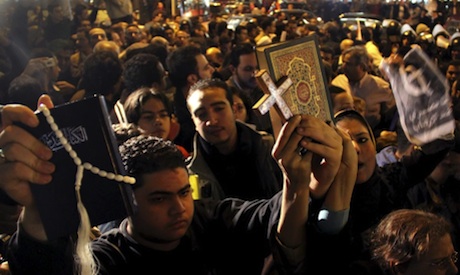
Image: Egyptian Christians celebrating Easter.

Thursday, January 27, 2011

Fourth Annual Coptic Studies Symposium: Ottawa, February 26, 2011

I don't know if anyone who reads this blog will be interested, but just in case here's a message from Prof Greatrex.  Note that this mostly about old-time Copts (late antiquity).

I would like to draw your attention to the Fourth Annual Coptic Studies Symposium: Coptic Heritage – Dynamics and Diversity, organized by the Canadian Society for Coptic Studies (CSCS), which will take place at the University of Ottawa on 26 February 2011. The programme is as follows:

9.00-9.45   registration

9.45-10.00  welcome

Ramez Boutros, President, Canadian Society for Coptic Studies

His Excellency Wael Aboulmagd, Ambassador, Arab Republic of Egypt

Antoni Lewkowicz, Dean, Faculty of Arts, University of Ottawa


10.00-10.45 Keynote lecture by Jacques van der Vliet (University of

Leiden/Radboud University Nijmegen), ‘Pesynthios of Koptos/Qift (569–632) and the Rise of the Egyptian Miaphysite Church’

10.45-11.00 discussion


11.00-11.30 Robert Edwards (University of Ottawa), ‘A Case for Martyrdom? Editorial Intention and the First Apocalypse of James (NHC V,3//AM 2)’

11.30-12.00 Timothy Pettipiece (Carleton University), ‘Towards a Manichaean Reading of the Nag Hammadi Codices’


12.00-1.30  lunch break


1.30-2.00   Anne Moore (University of Calgary), ‘Syncretism and Confrontation in Besa’s Life of Shenoute’

2.00-2.30   Theodore de Bruyn (University of Ottawa), ‘The Intercessory Function of Mary in Egyptian Amulets

and Anaphoras in Late Antiquity’


2.30-3.00   coffee break


3.00-3.30   Sabrina Higgins (University of Ottawa), ‘Divine Mothers: The Influence of Isis on the Virgin Mary in Egyptian Monastic Iconographic Programs’

3.30-4.00   Ramez Boutros (University of Toronto), ‘The Architectural Stone Carvings in the Christian Basilica of Dendara: Style and Workmanship’


4.00-4.30   stretch break


4.30-5.00   Helene Moussa (St. Mark’s Coptic Museum, Scarborough), ‘Museums as Cultural Institutions: The Experience of St. Mark’s Coptic Museum’

5.00-5.30   May Telmissany (University of Ottawa), ‘Coptic Films and Copts in Egyptian Films: Intersections and Discrepancies’

In case you would like to attend the event and for more information, please get in touch with the organizer, my colleague Jitse Dijkstra (jdijkstr@uottawa.ca).

Geoffrey Greatrex


Geoffrey Greatrex
Département d'études anciennes et de sciences des religions
Department of Classics and Religious Studies
Université d'Ottawa/University of Ottawa
70 av. Laurier est/Laurier Ave. East
Ottawa, ON, CANADA K1N 6N5
tél. (613)-562-5808
fax. (613)-562-5991

Dr. Mark Crane on scholasticism vs. humanism; another colleague shows his stuff

I don't think I can send out copies, as with the link to the Murton podcast just below, but let it be known that Mark Crane has also been busy, producing this article:

Mark Crane, "A Scholastic Response to Biblical Humanism:  Noel Beda against Lefevre d'Etaples and Erasmus (1526),"  Humanistica Lovaniensia 59 (2010): 55-81.

Tuesday, August 03, 2010

Agora preview

John Emerson alerted me to this. Could it be any good? Could it stir up a huge controversy?

Sunday, April 25, 2010

Dead Kennedys’ Plastic Surgery Disasters and Christian-Muslim relations in Early Medieval Spain


If you are one of those people who comes here looking for insights into obscure medieval topics, I am afraid I've got nothing for you today -- except, of course, something from Jonathan Jarrett, who is trying to interpret a ninth-century theological treatise written in Muslim -ruled Cordoba, Spain.

And if you want to know what the Dead Kennedys have to do with this, you'll have to read not just the post but the footnotes.

Image: the martyrs of Córdoba at the Last Judgment.

Saturday, December 19, 2009

An old monastery serves as a window into Iraq's past


Some American soldiers learn a bit about the complexities of Iraq's religious history.
As historic sites in Iraq go, St. Elijah’s has little of the significance of the ruins of the great Sumerian, Babylonian and Assyrian civilizations, all endangered by decay and looting. The ruins of Nimrud, Hatra and Nineveh are only a few miles away. So is the tomb of the Old Testament prophet Jonah, and that of another, Nahum, whose short chapter in the Bible warns Nineveh of its destruction.

“Nineveh is like a walk through the Bible,” said W. Patrick Murphy, the leader of the American provincial reconstruction team here, which is coordinating the restoration, referring to the modern name for the province that includes Mosul.

In the years of American occupation, St. Elijah’s became a curiosity, a diversion for soldiers and contractors who might otherwise never leave the base and encounter Iraq’s deeply layered history. Amid the hardship of modern military operations, it once again became a place of prayer.

“We stand in a long line of people who bequeathed the faith to us,” said Maj. Jeffrey Whorton, a Roman Catholic chaplain, presiding over Mass in the monastery the other day, attended by three camouflaged soldiers, their rifles leaning in a corner.

Little definitive is known about the history of St. Elijah’s, or Dair Mar Elia. The site has never been studied or excavated, according to the State Board of Antiquities and Heritage, which oversees all of Iraq’s historic sites. Before the war, Iraq’s Republican Guard occupied the base and, according to the Americans, used the cistern as a latrine.

The board, which has previously been critical of American activities at ruins, including Babylon, is now reviewing the proposal to restore St. Elijah’s.


Accompanied by an excellent slide show of St. Elijah's Monastery.

Thursday, December 17, 2009

Richard W. Kaeuper, Holy Warriors: the Religious Ideology of Chivalry

Here is what I wrote about Richard Kaeuper's Holy Warriors for the online Medieval Review, a valuable electronic source for up-to-date reviews. It's free and sends the reviews right to your mailbox, and because it is electronic it allows and encourages reviewers to say more than they could in a print review. Here's where you can find subscription information, and here's where you go to search for past reviews.

Richard Kaeuper's most recent book is the product of remarkable learning. It takes a classic, well-studied topic of undoubted importance and, based on the author's wide and deep reading of both primary and secondary sources, not only sheds new and valuable light on its ostensible subject--the relationship between chivalry and religion in the Middle Ages--but also illuminates many other aspects of medieval history. Readers may well come away from this book with a whole new understanding of subjects that they thought they knew well. This reviewer, fresh from teaching a course on the Crusades, might well do things differently next time, thanks to Kaeuper's discussion of chivalry as struggle or labor.


Two decades ago, in his War, Justice, and Public Order: England and France in the Later Middle Ages (1988), Kaeuper found himself doubting that the values of chivalry as understood in the High Middle Ages were an unambiguous force for promoting civility and order: "The code of chivalry encouraged as much violence as it curbed" (7). Further research, notably extensive reading in chivalric epics and romance, led him to find unconvincing an older understanding of the relationship between Christianity and chivalry, that chivalry was a process of a more pacific clerical establishment slowly imposing its values on the warrior aristocracy. In Chivalry and Violence in Medieval Europe (1999) he traced a convincing picture of the autonomous value system of knights who though they might aspire to courtliness and piety saw the core of their social identity in their prowess, and their right and duty to use force when they judged it appropriate.

The current book is a logical extension of Chivalry and Violence in that it focuses again on the self-image of knights, specifically how knights justified their way of life religiously. It is Kaeuper's primary contention that knights (or more generally well-armed, professional soldiers) had independent religious ideas that they adopted and adapted to suit their own needs, ideas that were related to those put forward by the clergy, but not a pale reflection of clerical theories and demands. This thesis deserves some detailed exploration before we look at an important secondary theme of the book, which is Kaeuper's demonstration that some of the most important theories of salvation were shaped by the existence and self-assertion of a Christian knighthood, the members of which could be either valuable allies or dangerous enemies of clerical interests and high-minded ecclesiastical efforts to reform the world.

First, let us look at what Kaeuper says about knightly self-image and how it related to the way penance and salvation were understood in medieval culture in general. Texts written by and for knights that tackled serious issues--practically by definition religious issues--upheld warrior values such as prowess (courage, skill, the prime warrior virtue) despite the frequent disapproval of clerics, but also identified other aspects of the knightly profession with universally admitted aspects of the economy of salvation. We might, following Kaeuper and the Book of Job, consider the equation of the struggle for salvation with militia (1-2); militia in medieval usage could mean not just military service or knighthood, but hard struggle, even suffering. The struggle or labor of human life was part of the punishment derived from the sins of Adam and Eve; but submitting oneself to hard work and other kinds of suffering were also constantly praised and encouraged by sermonizers and ascetic writers, because done right, as Christ did, it was the road to salvation. Knights believed that their own way of life was labor and led to pains experienced by no other mortals (though one wonders what their mothers thought of that argument), comparable, some said, to the work and suffering of Christ. Thus knights, when thinking about their participation in the process of salvation, could point to a perfectly orthodox claim to Christian respectability (if not one that was uncontested): imitatio Christi. Indeed, there was a lively debate; when rating their own spiritually valuable ascetic achievements, knights argued that monks could not bear the burdens of military life, and vice versa. Kaeuper provides a number of stories from his wide reading which illustrate the terms of that debate, with all its gruesome and humorous aspects, as in fact he does when discussing other arguments that arose from clerical-chivalric tensions. It is one of the great virtues of this book is that Kaeuper constantly keeps the reader aware that clerics often found themselves facing arguments justifying knighthood that were difficult to answer.

Kaeuper devotes a long chapter to discussing how the effort of the twelfth-century clerical reformers to create a working theology to guide the laity intersected with the developing ideology of chivalry--this being the century when chevalerie ceased to mean "horsemen" or "skill with horses" only, and became a moral status or aspiration. Reform in the twelfth century involved among other things an organized effort to define various legitimate professions of the human community, how each contributed at its best to the Christian life, and the dangers inherent in each profession. Among the lay ordines knighthood took a leading place, because the warrior aristocracy was the chief rival of the clergy in power, wealth and respectability. It may be that as much effort was put into defining and critiquing the military ordo as was devoted to all other laypeople together. For reformers there was much about warfare to criticize, but it was impossible to simply denounce or ignore the problem of the Christian warrior. Ecclesiastical authority had already conceded, in the form of crusade theology (still evolving, still rife with contradiction), that appropriate military service could gain salvation. Clerics used violence, and had to justify and theorize it. In this case, too, their expertise in learning failed to impose their formulation--that only violence authorized by the clergy and directed towards enemies of the faith was legitimate--on an unquestioning audience. Chivalric writers and clerical writers sympathetic to them appropriated what they liked about the theory of ordines and the theory of crusade, adapting what was useful to their own purposes and discarding the rest. Witness the way that treatises on chivalry, right from the very beginning, appropriated the language of ordo and ordines to give the "order of chivalry" an undoubted predominance in the Christian community, save only for the formal respect due to priests for their unique sacramental role. Witness the way proper warfare of any kind was seen by knights as equal in worth to expeditions to the Holy Land or against other unbelievers, equally pleasing to God.

Kaeuper continues to be interested in the end of the self-justifying, consciously Christian knightly identity and devotes his final chapter to "writing the death certificate for chivalric ideology." Here he provides the reader with a fuller and more convincing analysis of the death of medieval knighthood than he did in Chivalry and Violence, although it is not entirely satisfying. Kaeuper offers up several factors that contributed to the "death of chivalry." He suggests that since after the Reformation the penitential economy of the Middle Ages no longer made sense in much of the Christian West, its logic no longer could be appropriated to depict the well-armed professional warrior as a member of an autonomous Christian ordo. At the same time various developments made it easier to see knights as servants of the State (the Prince?) than as members of an international brotherhood, while the state became the source of all honor (a view seen, for instance, in the sixteenth-century biography of the Chevalier Bayard). It would have been interesting and useful if Kaeuper had said more about the tension between the ideas of knights as members of a "national" state (or subjects of a Sovereign) and knights as members of a class that transcended boundaries and allegiances. Admittedly he said quite a bit on this subject, but one feels that there is more to be said. It would have been interesting to see Kaeuper engage with the recent work of Crouch and Keen on the evolution of European ideas of nobility.

This book is well and entertainingly written, and is well-presented and designed. The University of Pennsylvania Press is to be congratulated for being willing to include the large bibliography and the extensive (and rich) scholarly apparatus that add much of value to Kaeuper's presentation. One can no longer take these things for granted, even from academic publishers. Also remarkable is the inclusion of a striking thirteenth-century illustration of an armored knight about to fight a phalanx of vices. It is reproduced on both the cover and the frontispiece, providing the reader with one incomplete but color reproduction plus one complete in black and white. This allowed the author to present a striking image to his reader, in a way that makes vivid some of the symbolism relevant to his argument. These things cost money and are sometimes skimped on; in this case the money was well spent.

Monday, November 02, 2009

Christ as tourneyer

I have just finished reading this new book, Holy Warriors: The religious ideology of chivalry, by Richard Kaeuper, and I'll have much more to say about it later. Right now I just want to point out an interesting quotation that shows how one medieval warrior, writing a spiritual autobiography, visualized what he saw as the ideal knight's resemblance to Jesus.

The warrior was Duke Henry of Lancaster, also known as Henry of Grosmont, one of Edward III's best generals in the Hundred Years War. Here is what Kaeuper says on page 41:

Duke Henry sometimes wonderfully reveals his chain of thought, if indirectly. In discussing how the tears shed by the Blessed Virgin will wash the wounds of his own wretched body he comes to nasal wounds, a topic which puts the realist in him in mind of the blows that struck Christ's nose during his scourging. He comments, in all piety, that Christ's nose must have looked like that of a habitual tourneyer, and that his mouth must have been discolored and beaten out of shape. Here he writes with the voice of experience. Warming to his topic, he says that indeed Christ did fight in a tournament -- and won it, securing life for humanity. As a strenuous knight, his conception of imitating Christ readily turns to this martial version of the savior and his role.
Image: the cover of the book, which can be seen better at Google Books.

Tuesday, October 20, 2009

A Most Holy War: the Albigensian Crusade and the Battle for Christendom, by Mark Gregory Pegg

My review of this book is at The Michigan War Studies Review, specifically here.

Here's an excerpt:
A sense of the attractions of this book, as opposed to the several others available on the subject, may be gained from its last paragraph:

God's homicidal pleasure lasted another eighteen years. Mountaintop castles were assaulted. Castrum after castrum was razed to the ground. Young viscounts died of heartache. Counts were humiliated. Toulouse was besieged. Corpses fouled rivers. Great long meandering armies traipsed every summer from the Rhône to the Garonne. Vultures and ravens grew plump. Legates cried out for vengeance. Men died hearing Veni Creator Spiritus. Wives and little girls worked catapults. Great cats assaulted battlements. Skulls were crushed. Murder was a path to redemption. Vines and fields were devastated. A pregnant girl was mocked. Good men became heretics. A young count surrendered to a boy king. Inquisitors scoured the countryside. Heretics dangled from walnut trees. Very few who began the war lasted to the end. The world was changed forever (191)
This is not only a good sample of Pegg's hard-hitting, vivid, and economical style, but a reasonable summary of the book...

This might give the impression that A Most Holy War is an opinionated, emotional tirade, but such is not the case. Certainly there are opinions here, strongly presented, on all manner of events, movements, and developments. But Pegg, concerned to reveal the minds, emotions, and motives of his subjects, skillfully and gracefully uses quotations to give the voices of historical figures--clerics, counts, chroniclers, and troubadours--precedence over his own.

Readers unacquainted with Pegg's scholarship may be surprised by his presentation of the heresy Innocent III was trying to extirpate. In a previous book[1] and several articles and reviews, he has attacked a consensus going right back to the Middle Ages--that the heretics of the South of France, usually called "Cathars" or, earlier, "Albigensians," constituted a dualist counter-church. Its doctrines were descended from those of the Manichaeans, Bogomils, and Paulicians of Christian antiquity, and its growth owed much to missionaries from the Eastern Mediterranean beginning in the eleventh century. Pegg, on the other hand, believes this interpretation depends more on presuppositions of medieval heresy hunters (long since adopted by modern scholars) than on contemporary evidence. Theologians of the Middle Ages tended to see all disbelief as a single subversive plot against the truth. In the twelfth and thirteenth centuries, ecclesiastical authorities became increasingly obsessed with any deviation from "orthodox" teachings and rituals, both of which were being more strictly defined and enforced. In actual fact, Pegg argues, there were no Cathars or Albigensians till activist monks, bishops, and popes detected and named them....

Whether or not that position ultimately survives criticism, Pegg at least clearly explains his view of the nature of southern French deviance, emphasizing that the heretical leaders were commonly designated "good man" or "good woman," a form of address appropriate to just about any respectable person at the time. Similarly, he contends that the ritual greetings of heretical "believers" to their supposed leaders were mannerly gestures with no particular religious content. In the South, the exchange of courtesies, essential to the peace of a fragmented society, had its own flavor and terminology, and unsympathetic outsiders put a harsh interpretation on them. The efforts of these outsiders to control and reform southern French behavior according to their own standards, according to Pegg, had a strong effect on the culture of the church hierarchy and the theory and practice of crusade. Indeed, "the Albigensian Crusade is one of the great pivotal moments in world history .... The crusade ushered genocide into the West, changing forever what it meant to be Christian, what it meant to be like Christ" (xiv). This is Pegg's sincere justification for considering his book's subject to be a world-historical "pivotal moment."

Remarkably, this book's less than 200 pages of main text includes far more than a critique of heresiology and descriptions of the religious views of various major actors. It also outlines the politics and military activities of a more than twenty-year period through brief but vivid vignettes that well convey the flavor of original source material[.]

If the book has a flaw, it is its failure to draw sufficient connections between the Albigensian Crusade and the general phenomenon of crusading. Readers conversant with the career of Innocent III and his desire to mobilize all of Christendom against its various enemies might well wonder why a crusade in the South of France was so crucial a prelude to later genocide. It would not have taken more than a few paragraphs to make a stronger and clearer connection between the preaching of Gregory VII and Urban II against emperors and Turks, and Innocent's determination to rally Christendom to fight the whole disobedient world, whether Markward of Anweiler or Raimon of Toulouse or the Livs in the Gulf of Riga. The case for the uniqueness of the Albigensian Crusade is not made as strongly as it might have been.

Nonetheless, Pegg has succeeded in writing a stirring and memorable treatment of an event easily overlooked because it does not fit neatly into conventional narrative histories based on national boundaries and categories.

[1] The Corruption of Angels: The Great Inquisition of 1245-1246 (Princeton: Princeton U Pr, 2001)

Thursday, August 20, 2009

Defenders of the Faith: Charles V, Suleyman the Magnificent, and the Battle for Europe, 1520-1536, by James Reston, Jr.


James Reston, Jr. has written a number of histories of the Middle Ages and Renaissance, but till now I have never read any of his books. So when The Penguin Press asked me if I'd like to review Defenders of the Faith for this blog, I said "yes."

Reston states in his Foreword that this book is "a work of historical literature, accurate in every respect but winnowing [names, dates and places] to the essentials..." Translation: this book (which contains lots of detail in any case, is an old-fashioned narrative history. It's a story, not a discussion of how scholars have interpreted the material and why. There is definitely a market for this sort of thing, always has been and always will be. And Reston has picked an interesting period, when the Ottoman Turkish Sultan and the German-Spanish Hapsburg Emperor fought for the domination of Europe, just as the Reformation split the Christian churches of Europe. Reston can honestly present this as a time when the future was up for grabs. No need to hoke up the historical drama, it's really there.

If you read this book, you should be prepared to believe that such periods are best understood by following the exploits of rulers and generals and the occasional religious leader. Defenders of the Faith strikes me as a little too focused on them, to the neglect of their historical background. For instance, Reston thinks Martin Luther is an interesting and important figure, but he spends very little time discussing why he developed the ideas he did, why he took a stand, and why his fellow Germans followed him in such numbers. Why the Reformation, why Germany, why the particular shape it took? Are the answers to these questions so obvious? A few well-chosen paragraphs could have told the readership, not all of them well-informed on the structure or theology of the Catholic and Lutheran churches, some key facts that would help put this "sometimes violently angry" monk/professor into a more vivid context. It seems to me that Reston's talents lie in the direction of describing dramatic set-piece battles, confrontations at court, or the Diet of Worms where Luther defied Emperor Charles V.

I could complain some more about things that I found frustrating or things Reston handled well (relating the chronology of all the complex military and diplomatic maneuvering), but this should give you an idea of whether you'd like the book.

Tuesday, December 16, 2008

Crusader motivation

In a famous eyewitness account of the taking of Jerusalem in 1099, the crusading chaplain Raymond of Aguilers described a bloodbath at the Temple Mount (drawing, as has often been pointed out, on the Book of Revelations):

It was necessary to pick one's way over the bodies of men and horses. These are small matters compared to what happened at the Temple of Solomon, a place where religious services are ordinarily chanted. What happened there? If I tell the truth, it will exceed your powers of belief. So let it suffice to say this much, at least, that in the Temple and porch of Solomon, men rode in blood up to the knees and bridle reins.. Indeed it was a just and splendid judgment of God that in this place should be filled with the blood of the unbelievers, since it suffered so long from their blasphemies. The city was filled with corpses and blood.... Now that the city was taken, it was well worth all of our previous labors and hardships to see the devotion of the pilgrims at the holy sepulcher. How they rejoiced and exulted and sang a new song to the Lord! For their hearts offered prayers of praise to God, victorious and triumphant, which cannot be told in words. A new day, new joy, me and perpetual gladness, the consummation of our labor and devotion, drew forth from all new words and new songs. This day, I say, will be famous in all future ages, for it turned our labors and sorrows into joy and exultation; this day, I say, marks the justification of all Christianity, the humiliation of paganism, and the renewal of our faith. "This is the day which the Lord hath made, let us rejoice and be glad in it," for on this day the Lord revealed himself to his people and blessed them.

This passage relates to two questions that often come up in studying history, but particularly the history of the Crusades (or for that matter, jihad).

The first might be the question of sincerity. Did so-and-so undertake this project, or conquer this country, or start this war because he sincerely believed in his stated ideals? I find this as a historical question somewhat uninteresting. Every observer has his or her views as to how human nature works in general and in particular cases, say for instance, how kings and emperors act. It is hard to convince people to change their mind on this issue. So arguments about sincerity don't go very far unless you clearly define what you are talking about -- and people generally don't.

Part of the problem is terminology, especially the use of the word "religion." Often when people talk about "religion" they are talking about a creed or set of beliefs that someone else really (or doesn't really) believes in. Or they may mean a set of rules that members of a given religion are supposed to follow. But both beliefs and rules are usually discussed in terms of formal definitions laid down by higher authorities in well-defined religious organizations. If you look in detail about what individuals say they believe or how they actually act, you may well find that these individual "believers" or "followers" not to have the same "religion" as the great authorities. If a theologian says that Christianity believes thus, or a scholar says that Islam demands thus, it is trivially easy to find Christians or Muslims who do not believe or do those things. In any big-name religion, the greatest and most respected authorities only speak for one stream of a very diverse tradition. And if ordinary people attached to that tradition claim to be obedient followers, the outside observer may often find that they don't realize how far they are from literal adherence to proclamations of their leaders; or do realize, and have good reasons of their own for their particular interpretation of what the religion means.

Which brings us to the second question, which might be put this way: "Were the Crusades really about religion? What does holy war have to do with the teachings of Jesus?" My answer to these questions is, yes they were about religion (if you just want a war that were plenty closer to hand in 11th- century Europe) -- but what was that religion like? What was its actual content? Christianity in most varieties is a lot more than the teachings of Jesus. Put aside for the moment the vast diversity of the Bible, which makes it possible to find justification for almost anything in it, especially if you use sophisticated symbolic interpretation. More important, I think, is that even Christians with little or no firsthand knowledge of the Bible have strong opinions about what Christianity is. When we are talking about the motivations of Crusaders it is probably more useful to think about the individuals who trekked across the Balkans and Anatolia and how they acted, rather than what Pope Urban II said at Clermont (important as that might be in other contexts). When we are talking about the religion that led men to Jerusalem and helped produce the slaughter there, Raymond of Aguilers’s version of Christianity is as important as that of any Pope, or of Augustine of Hippo, if not more so.