It struck me reading the section on 20th century material, seeing the 20th century as referring to a time when my grandmothers were young, that the 20th century was a long time ago!
Showing posts with label Arthurian legendry. Show all posts
Showing posts with label Arthurian legendry. Show all posts
Sunday, October 26, 2025
The 20th Century is a long time ago
This morning I was reading a lecture by Alan Lupack The 2016 Loomis Lecture: Moral Chivalry and the Arthurian Revival. It started out rather slow, describing material I was quite familiar with, but became increasingly fascunating to me as it got into later times, especially late 19th century and early 20th century Arthurian revivals. (The title of the lecture is deceptive; Lupack himself shows that there is always an Arthurian revival, often more than one at the same time.


Sunday, October 27, 2013
Worlds of Arthur, by Guy Halsall
I know Guy Halsall and correspond with him fairly frequently. I think he's a very good historian. So when he wrote a book with a riproaring commercial title like "Worlds of Arthur" it was only a matter of time before I got around to having a look.
Frankly, I don't know how commercial this book is, or how much impact it will have on even the more serious readers among the general public, namely the people who actually shell out their own money to read books on serious subjects like post-Roman Britain and King Arthur. Certainly Halsall tries very hard to reach those people, and does a much better job than most academics do on similar projects. But the book is a thorough debunking of certain ideas about Arthur and his place in history, and is already provoking a mixed reaction.
Halsall believes that trying to find the real Arthur behind the legends is entirely futile, and he classifies most efforts to do so as pseudo-history. It is possible that somebody named Arthur led British forces against Saxon invaders, but the simple truth is that we know nothing about any such person and can't reconstruct his life and career. The few written sources we have for this two-century period (410-597) does not allow us to do it and unless some miraculous discovery turns up new information (and none has appeared for many centuries) we will never find Arthur. A lot of professional historians agree with this, but I doubt that anyone has made such an uncompromising presentation of this fact – the unknowability of Arthur – as Halsall does here.
Halsall is equally interested in revising a framework that scholars of the past have imposed on our understanding of post-Roman Britain. To simplify, Halsall does not think that British history of the fifth and sixth centuries is best understood as a fight between "the Britons" and "the Saxons," a long contest which resulted in the expulsion of Britons from most of what is now England. In line with developments in other parts of Western Europe, English ethnic identity came to dominate because older identities, specifically the Roman identity, were no longer relevant to a Britain where the Roman economy and society had collapsed.
Halsall both discusses changes in our interpretation of British archaeology over the last 40 years, and offers his own reinterpretation, which he frankly labels as speculative. It's an interesting interpretation and one I find fairly persuasive, though in this period we will never have certainty.
One of the best things about this book is that Halsall discusses how people use and misuse evidence for difficult historical problems in great detail. This may put people off, but it is one of the most transparent discussions of what historians do in interpreting the often difficult to understand early Middle Ages that I've ever seen. It is not likely to be everybody's cup of tea. But have a look at this discussion of DNA evidence and how it can deceive, especially people who want to be deceived.
Even with these data, an even more serious problem concerns the move from DNA to conclusions about ethnic or political identity. Ethnic identity is multi-layered. It is deployed (or not) in particular situation as the occasion demands, and can be changed. DNA cannot give you a sense of all the layers of that person's ethnicity, or of which she thought the most important, or even if she generally used a completely different one, or when and where such identities are stressed or concealed. A male Saxon immigrant into the Empire in, say, the fourth century, would – one assumes – have DNA revealing the area where he grew up, but he would probably increasingly see himself, and act, as a Roman. Saxon origins would have little part in his social, cultural, or political life, and even less for his children, if they stay in the Empire. If he returned home with the cachet of his Imperial service, it might have been his Roman identity that gave him local status. He might even have called himself a Roman. However, if a distant male relative moved to Britain 150 years later, his DNA might be very similar but, in complete distinction, he might make a very big deal of the Saxon origins. They would, or could, propel him to the upper echelons of society. DNA tells us nothing about any of this. What is pernicious about this use of genetic data is its essentialism. It views a person's identity as one-dimensional, unchanging, and as entirely derived from that person's biological and geographical origins. In short, it reduces identity to something similar to 19th century nationalist ideas of race. Everyone sane knows that people moved from northern Germany to Britain in the fifth and sixth centuries. In that sense, these expensive analyses tell us nothing we do not already know. In their implicit reduction of identity to a form of race, masking all the other contingent and interesting aspects of cultural interaction and identity-change they risk setting back the understanding of this period by more than a century. Moreover, they provide pseudo-historical and pseudo-scientific ammunition for present-day nationalists xenophobes and racists.If you teach history, wouldn't you want your students to be exposed to such a clear discussion of a historiographical problem? One with real relevance to the present?
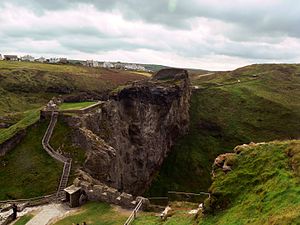
Image: Tintagel. People in the 12th century thought this was an Arthurian site.
Wednesday, March 02, 2011
Sunday, May 20, 2007
Mordred Prince of Britain
 When I was growing up reading science fiction, one of the oddest notions was the idea of alternate history. It's a common idea now, but back then you seldom ran across it outside of the small circle of science fiction readers, unless the subject was, what if the South had won the Civil War?
In such stories authors often gave their heroes technology that altered the time stream, weapons maybe, or even the printing press. But what about an alternate history where it's just an artistic image that's different? How big a difference could that make?
Some years back I was thinking about how Shakespeare wrote many of his "biographical historical" plays -- the non-English ones-- about characters that were really obscure. Who would ever have heard of Lear or Macbeth if Shakespeare hadn't used them to build a striking dramatic situation? Next to nothing is known about Macbeth and I have my doubts that Lear ever existed. Even the characters of Julius Caesar, Antony, and Cleopatra as we know them were somewhat new to his audience, since Plutarch's Lives had only recently been translated from ancient Greek into western European languages.
I thought, what if Shakespeare had not gone for the obscure figures he could shape to his liking, but preferred to reshape famous ancient legends? What if he'd done an Arthurian play? Instead of writing about a melancholic, haunted Hamlet, Prince of Denmark, he'd put his genius into portraying Modred (Mordred), Prince of Britain?
What would it mean to Anglophone culture -- world culture -- if these famous words were associated with the treacherous bastard son of Arthur?
What a piece of work is man! How noble in reason! how infinite in faculties! in form and moving, how express and admirable! in action how like an angel! in apprehension, how like a god! the beauty of the world! the paragon of animals! And yet, to me, what is this quintessence of dust? Man delights not me; no, nor woman neither, though by your smiling you seem to say so.
Maybe none. But maybe...
Subscribe to:
Posts (Atom)